

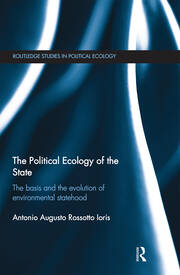
The political ecology of the state : the basis and the evolution of environmental statehood / Antonio Augusto Rossotto Ioris.
Erişim Adresi
ISBN
9781315858401 (e-book : PDF)
9781317936602 (e-book: Mobi)
9781317936619 (e-book: ePub)
9780415722193 (hardback)
9781317936602 (e-book: Mobi)
9781317936619 (e-book: ePub)
9780415722193 (hardback)
Dil Kodu
İngilizce
Yayın Bilgisi
London ; New York : Routledge, 2014.
Fiziksel Niteleme
1 online resource (ix, 185 pages)
Dizi
Routledge studies in political ecology
İçindekiler Notu
1. Introduction -- 2. The reason and the purpose of environmental statehood : environmental statehood as irrational rationalism -- 3. Early and conventional environmental statehood : unpacking the Hobbesian influence -- 4. Responding to regulation rigidity and persisting socioecological problems : the Kantian basis of the transition -- 5. The contingent relation between flexible environmental statehood and the neoliberalisation of socionature : the increasing neoliberalisation of socionature -- 6. Flexible environmental statehood as the realisation (actualisation) of the Hegelian state -- 7. What is beyond flexible environmental statehood and the naive faith in the eco-state?.
Özet, vb.
"The contemporary state is not only the main force behind environmental change, but the reactions to environmental problems have played a crucial role in the modernisation of the state apparatus, especially because of its mediatory role. The Political Ecology of the State is the first book to critically assess the philosophical basis of environmental statehood and regulation, addressing the emergence and evolution of environmental regulation from the early 20th Century to the more recent phase of ecological modernisation and the neoliberalisation of nature. The state is understood as the result of permanent socionatural interactions and multiple forms of contestation, from a critical politico-ecological approach. This book examines the tension between pro- and anti-commons tendencies that have permeated the organisation and failures of the environmental responses put forward by the state. It provides a reinterpretation of the achievements and failures of mainstream environmental policies and regulation and offers a review of the mains philosophical influences behind different periods of environmental statehood and regulation. It sets out an agenda for going beyond conventional state regulation and grassroots dealings with the state, and as such redefines the environmental apparatus of the state"-- Provided by publisher.
Konu
Political ecology.
State, The.
Environmental policy.
State, The.
Environmental policy.
Veritabanı
