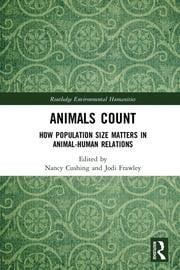
Animals count : how population size matters in animal-human relations / edited by Nancy Cushing and Jodi Frawley.
Erişim Adresi
ISBN
9781351210645 (e-book : PDF)
Dil Kodu
İngilizce
Basım Bildirimi
First edition.
Yayın Bilgisi
Boca Raton, FL : Routledge, an imprint of Taylor and Francis, 2018.
Fiziksel Niteleme
1 online resource (222 pages) : 34 illustrations.
Dizi
Routledge environmental humanities series
İçindekiler Notu
chapter 1 Why count animals? / NANCY CUSHING -- part Part I Excess -- chapter 2 Cane toads as sport: conservation practice and animal ethics at odds / LIBBY ROBIN -- chapter 3 Taking locust country / ANDREA GAYNOR -- chapter 4 On the ant frontier: ontological conflict with Iridomyrmex humilis in post-war Sydney / ADAM GALL -- chapter 5 A swarm of sheep: colonising the Esperance bioregion / NICOLE CHALMER -- part Part II Abundance -- chapter 6 Optimism unlimited: prospects for the pearl-shell, bêche-de-mer and trochus industries on Australia’s Great Barrier Reef, 1860–1940 / ROHAN LLOYD -- chapter 7 Swamplands: human-animal relationships in place / EMILY O’GORMAN -- chapter 8 ‘Pain for Animals, Profit for People’: the campaign against live sheep exports, 1974–1986 / GONZALO VILLANUEVA -- part Part III Equilibrium -- chapter 9 “Cunning, intractable, destructive animals”: pigs as co-colonisers in the Hunter Valley of New South Wales, 1840–1860 / NANCY CUSHING -- chapter 10 Wine worlds are animal worlds too: native Australian animal vine feeders and interspecies relations in the ecologies that host vineyards / JULIE MCINTYRE -- chapter 11 Defending nature: animals and militarised landscapes in Australia / BEN WILKIE -- part Part IV Scarcity -- chapter 12 A slow catastrophe? Fishing for sport and commerce in colonial Victoria / DAVID HARRIS -- chapter 13 The palatability of pests: redfin in the Murray-Darling Basin / JODI FRAWLEY -- part Part V Extinction -- chapter 14 After none: memorialising animal species extinction through monuments / DOLLY JØRGENSEN.
Özet, vb.
Whether their populations are perceived as too large, just right, too small or non-existent, animal numbers matter to the humans with whom they share environments. Animals in the right numbers are accepted and even welcomed, but when they are seen to deviate from the human-declared set point, they become either enemies upon whom to declare war or victims to be protected. In this edited volume, leading and emerging scholars investigate for the first time the ways in which the size of an animal population impacts how they are viewed by humans and, conversely, how human perceptions of populations impact animals.This collection explores the fortunes of amphibians, mammals, insects and fish whose numbers have created concern in settler Australia and examines shifts in these populations between excess, abundance, equilibrium, scarcity and extinction. The book points to the importance of caution in future campaigns to manipulate animal populations, and demonstrates how approaches from the humanities can be deployed to bring fresh perspectives to understandings of how to live alongside other animals.
Konu
Animal populations __ Australia.
Human-animal relationships __ Australia.
Wildlife conservation __ Social aspects __ Australia.
Biodiversity & Conservation.
Biodiversity conservation.
Environmental History.
Human ecology __ History.
Human ecology.
HISTORY / Historical Geography. __ bisacsh
NATURE / Animals / General. __ bisacsh
Abundance.
Animal.
Australia.
Biodiversity.
Conservation.
Endangered.
Environment.
Equilibrium.
Excess.
Extinction.
History.
Human.
Intervention.
Plague.
Population.
Scarcity.
Swarm.
Wildlife.
Human-animal relationships __ Australia.
Wildlife conservation __ Social aspects __ Australia.
Biodiversity & Conservation.
Biodiversity conservation.
Environmental History.
Human ecology __ History.
Human ecology.
HISTORY / Historical Geography. __ bisacsh
NATURE / Animals / General. __ bisacsh
Abundance.
Animal.
Australia.
Biodiversity.
Conservation.
Endangered.
Environment.
Equilibrium.
Excess.
Extinction.
History.
Human.
Intervention.
Plague.
Population.
Scarcity.
Swarm.
Wildlife.
Diğer Yazarlar
Kurum Adı
Veritabanı

Eseri Alıntıla
Referansları kullanmadan önce gözden geçirmeniz ve varsa gerekli düzeltmeleri yapmanız önerilir.
Dijital Kaynak
MARC Görünümü
LEADER 05018nam a2200697Ii 4500
001 802560
003 TR_AnAIT
005 20260123024126
008 180727s2018 fluab ob 001 0 eng d
020 |a9781351210645|q(e-book : PDF)
035 |a(OCoLC)1033688123
040 |aFlBoTFG|cFlBoTFG|erda
041 |aeng
043 |au-at---
049 |aTürk Tarih Kurumu Kütüphanesi
050 4|aQL752|b.A66 2018
072 7|aHIS|x004000 |2bisacsh
072 7|aHIS|x052000 |2bisacsh
072 7|aNAT|x001000 |2bisacsh
072 7|aHB |2bicscc
082 04|a591.7/880994|223
245 00|aAnimals count :|bhow population size matters in animal-human relations /|cedited by Nancy Cushing and Jodi Frawley.
250 |aFirst edition.
264 1|aBoca Raton, FL :|bRoutledge, an imprint of Taylor and Francis,|c2018.
300 |a1 online resource (222 pages) :|b34 illustrations.
336 |atext|2rdacontent
337 |acomputer|2rdamedia
338 |aonline resource|2rdacarrier
490 1 |aRoutledge environmental humanities series
505 00|tchapter 1 Why count animals? /|rNANCY CUSHING -- |tpart Part I Excess -- |tchapter 2 Cane toads as sport: conservation practice and animal ethics at odds /|rLIBBY ROBIN -- |tchapter 3 Taking locust country /|rANDREA GAYNOR -- |tchapter 4 On the ant frontier: ontological conflict with Iridomyrmex humilis in post-war Sydney /|rADAM GALL -- |tchapter 5 A swarm of sheep: colonising the Esperance bioregion /|rNICOLE CHALMER -- |tpart Part II Abundance -- |tchapter 6 Optimism unlimited: prospects for the pearl-shell, bêche-de-mer and trochus industries on Australia’s Great Barrier Reef, 1860–1940 /|rROHAN LLOYD -- |tchapter 7 Swamplands: human-animal relationships in place /|rEMILY O’GORMAN -- |tchapter 8 ‘Pain for Animals, Profit for People’: the campaign against live sheep exports, 1974–1986 /|rGONZALO VILLANUEVA -- |tpart Part III Equilibrium -- |tchapter 9 “Cunning, intractable, destructive animals”: pigs as co-colonisers in the Hunter Valley of New South Wales, 1840–1860 /|rNANCY CUSHING -- |tchapter 10 Wine worlds are animal worlds too: native Australian animal vine feeders and interspecies relations in the ecologies that host vineyards /|rJULIE MCINTYRE -- |tchapter 11 Defending nature: animals and militarised landscapes in Australia /|rBEN WILKIE -- |tpart Part IV Scarcity -- |tchapter 12 A slow catastrophe? Fishing for sport and commerce in colonial Victoria /|rDAVID HARRIS -- |tchapter 13 The palatability of pests: redfin in the Murray-Darling Basin /|rJODI FRAWLEY -- |tpart Part V Extinction -- |tchapter 14 After none: memorialising animal species extinction through monuments /|rDOLLY JØRGENSEN.
520 3 |aWhether their populations are perceived as too large, just right, too small or non-existent, animal numbers matter to the humans with whom they share environments. Animals in the right numbers are accepted and even welcomed, but when they are seen to deviate from the human-declared set point, they become either enemies upon whom to declare war or victims to be protected. In this edited volume, leading and emerging scholars investigate for the first time the ways in which the size of an animal population impacts how they are viewed by humans and, conversely, how human perceptions of populations impact animals.This collection explores the fortunes of amphibians, mammals, insects and fish whose numbers have created concern in settler Australia and examines shifts in these populations between excess, abundance, equilibrium, scarcity and extinction. The book points to the importance of caution in future campaigns to manipulate animal populations, and demonstrates how approaches from the humanities can be deployed to bring fresh perspectives to understandings of how to live alongside other animals.
650 0|aAnimal populations|zAustralia.
650 0|aHuman-animal relationships|zAustralia.
650 0|aWildlife conservation|xSocial aspects|zAustralia.
650 0|aBiodiversity & Conservation.
650 0|aBiodiversity conservation.
650 0|aEnvironmental History.
650 0|aHuman ecology|xHistory.
650 0|aHuman ecology.
650 7|aHISTORY / Historical Geography.|2bisacsh
650 7|aNATURE / Animals / General.|2bisacsh
650 0|aAbundance.
650 0|aAnimal.
650 0|aAustralia.
650 0|aBiodiversity.
650 0|aConservation.
650 0|aEndangered.
650 0|aEnvironment.
650 0|aEquilibrium.
650 0|aExcess.
650 0|aExtinction.
650 0|aHistory.
650 0|aHuman.
650 0|aIntervention.
650 0|aPlague.
650 0|aPopulation.
650 0|aScarcity.
650 0|aSwarm.
650 0|aWildlife.
700 1 |aCushing, Nancy,|eeditor.
700 1 |aFrawley, Jodi,|eeditor.
710 2 |aTaylor and Francis.
776 08|iPrint version: |z9780815381365|w(DLC) 2018007508
830 0|aRoutledge environmental humanities series.
856 40|uhttps://www.taylorfrancis.com/books/9781351210645|zClick here to view.
901 |aTaylor & Francis
001 802560
003 TR_AnAIT
005 20260123024126
008 180727s2018 fluab ob 001 0 eng d
020 |a9781351210645|q(e-book : PDF)
035 |a(OCoLC)1033688123
040 |aFlBoTFG|cFlBoTFG|erda
041 |aeng
043 |au-at---
049 |aTürk Tarih Kurumu Kütüphanesi
050 4|aQL752|b.A66 2018
072 7|aHIS|x004000 |2bisacsh
072 7|aHIS|x052000 |2bisacsh
072 7|aNAT|x001000 |2bisacsh
072 7|aHB |2bicscc
082 04|a591.7/880994|223
245 00|aAnimals count :|bhow population size matters in animal-human relations /|cedited by Nancy Cushing and Jodi Frawley.
250 |aFirst edition.
264 1|aBoca Raton, FL :|bRoutledge, an imprint of Taylor and Francis,|c2018.
300 |a1 online resource (222 pages) :|b34 illustrations.
336 |atext|2rdacontent
337 |acomputer|2rdamedia
338 |aonline resource|2rdacarrier
490 1 |aRoutledge environmental humanities series
505 00|tchapter 1 Why count animals? /|rNANCY CUSHING -- |tpart Part I Excess -- |tchapter 2 Cane toads as sport: conservation practice and animal ethics at odds /|rLIBBY ROBIN -- |tchapter 3 Taking locust country /|rANDREA GAYNOR -- |tchapter 4 On the ant frontier: ontological conflict with Iridomyrmex humilis in post-war Sydney /|rADAM GALL -- |tchapter 5 A swarm of sheep: colonising the Esperance bioregion /|rNICOLE CHALMER -- |tpart Part II Abundance -- |tchapter 6 Optimism unlimited: prospects for the pearl-shell, bêche-de-mer and trochus industries on Australia’s Great Barrier Reef, 1860–1940 /|rROHAN LLOYD -- |tchapter 7 Swamplands: human-animal relationships in place /|rEMILY O’GORMAN -- |tchapter 8 ‘Pain for Animals, Profit for People’: the campaign against live sheep exports, 1974–1986 /|rGONZALO VILLANUEVA -- |tpart Part III Equilibrium -- |tchapter 9 “Cunning, intractable, destructive animals”: pigs as co-colonisers in the Hunter Valley of New South Wales, 1840–1860 /|rNANCY CUSHING -- |tchapter 10 Wine worlds are animal worlds too: native Australian animal vine feeders and interspecies relations in the ecologies that host vineyards /|rJULIE MCINTYRE -- |tchapter 11 Defending nature: animals and militarised landscapes in Australia /|rBEN WILKIE -- |tpart Part IV Scarcity -- |tchapter 12 A slow catastrophe? Fishing for sport and commerce in colonial Victoria /|rDAVID HARRIS -- |tchapter 13 The palatability of pests: redfin in the Murray-Darling Basin /|rJODI FRAWLEY -- |tpart Part V Extinction -- |tchapter 14 After none: memorialising animal species extinction through monuments /|rDOLLY JØRGENSEN.
520 3 |aWhether their populations are perceived as too large, just right, too small or non-existent, animal numbers matter to the humans with whom they share environments. Animals in the right numbers are accepted and even welcomed, but when they are seen to deviate from the human-declared set point, they become either enemies upon whom to declare war or victims to be protected. In this edited volume, leading and emerging scholars investigate for the first time the ways in which the size of an animal population impacts how they are viewed by humans and, conversely, how human perceptions of populations impact animals.This collection explores the fortunes of amphibians, mammals, insects and fish whose numbers have created concern in settler Australia and examines shifts in these populations between excess, abundance, equilibrium, scarcity and extinction. The book points to the importance of caution in future campaigns to manipulate animal populations, and demonstrates how approaches from the humanities can be deployed to bring fresh perspectives to understandings of how to live alongside other animals.
650 0|aAnimal populations|zAustralia.
650 0|aHuman-animal relationships|zAustralia.
650 0|aWildlife conservation|xSocial aspects|zAustralia.
650 0|aBiodiversity & Conservation.
650 0|aBiodiversity conservation.
650 0|aEnvironmental History.
650 0|aHuman ecology|xHistory.
650 0|aHuman ecology.
650 7|aHISTORY / Historical Geography.|2bisacsh
650 7|aNATURE / Animals / General.|2bisacsh
650 0|aAbundance.
650 0|aAnimal.
650 0|aAustralia.
650 0|aBiodiversity.
650 0|aConservation.
650 0|aEndangered.
650 0|aEnvironment.
650 0|aEquilibrium.
650 0|aExcess.
650 0|aExtinction.
650 0|aHistory.
650 0|aHuman.
650 0|aIntervention.
650 0|aPlague.
650 0|aPopulation.
650 0|aScarcity.
650 0|aSwarm.
650 0|aWildlife.
700 1 |aCushing, Nancy,|eeditor.
700 1 |aFrawley, Jodi,|eeditor.
710 2 |aTaylor and Francis.
776 08|iPrint version: |z9780815381365|w(DLC) 2018007508
830 0|aRoutledge environmental humanities series.
856 40|uhttps://www.taylorfrancis.com/books/9781351210645|zClick here to view.
901 |aTaylor & Francis
Materyaller
Depodan talep edilen materyal sadece kütüphane içerisinde kullanılmaktadır.
Materyal dışarıya ödünç verilmemektedir.
