

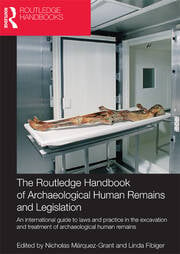
The Routledge Handbook of Archaeological Human Remains and Legislation : An international guide to laws and practice in the excavation and treatment of archaeological human remains / edited by Nicholas Marquez-Grant and Linda Fibiger.
Erişim Adresi
ISBN
9781136879555 (e-book: ePub) (e-book : PDF)
Dil Kodu
İngilizce
İngilizce
İngilizce
Basım Bildirimi
First edition.
Yayın Bilgisi
Boca Raton, FL : Routledge, 2011.
Fiziksel Niteleme
1 online resource (800 pages) : 25 illustrations, text file, PDF
Bibliyografi, vb. Notu
Includes bibliographical references and index.
İçindekiler Notu
FOREWARD Professor Don Brothwell -- PART 1 INTRODUCTION - Nicholas Mrquez-Grant and Linda Fibiger -- PART 2 EUROPE -- 1. Albania Maria Grazia Amore -- 2. Andorra Abel Fort Garca -- 3. Armenia - Maureen E. Marshall and Ruzan A. Mkrtchyan -- 4. Azerbaijan - David Maynard and Najaf Museyibli -- 5. Belarus - Lydia Tegako and Olga Sorokina -- 6. Belgium - Kim Quintelier, Agns Malevez, Rosine Orban, Michel Toussaint, Marit Vandenbruaene and Genevive Yernaux -- 7. Bosnia and Herzegovina - Amila Zukanovi, Nermin Sarajli and Senem kulj -- 8. Bulgaria - Bisserka Gaydarska -- 9. Croatia - Mario laus, Mario Novak and Marin Vodanovi -- 10. Cyprus - Kirsi O. Lorentz -- 11. Czech Republic - Petr Velemnsk and Lumr Polek -- 12. Denmark - Tina Christensen and Pia Bennike -- 13. Finland - Milton Nez, Markku Niskanen, Marja-Leena Kortelainen, Juho-Antti Junno, Kirsti Paavola, Sirpa Niinimki and Mirette Modarress -- 14. France - Juliette Michel and Phillipe Charlier -- 15. Germany - Jrg Orschiedt, Ursula Wittwer-Backofen and Stefan Flohr -- 16. Greece - Constantine Eliopoulos, Konstantinos Moraitis, Velissaria Vanna and Sotiris Manolis -- 17. Hungary - Ildik Pap and Gyrgy Plfi -- 18. Iceland - Gun Zoga and Hildur Gestsdttir -- 19. Ireland - Laureen Buckley -- 20. Italy - Dario Piombino-Mascali and Albert R. Zink -- 21. Kosova - Shirley J. Schermer, Edi Shukriu and Sylvia Deskaj -- 22. Lithuania - Rimantas Jankauskas -- 23. Luxembourg - Ilka Weidig, Christiane Bis-Worch, Nils-Jrn Rehbach, Ulrich Nothwang, Anja Sindermann, Jean Krier, Foni Le Brun-Ricalens and Jeannot Metzler -- 24. Macedonia, FYRO - Fanica Veljanovska -- 25. Malta - Anthony Pace -- 26. Moldova - Sergiu Mustea and Alexander Varzari -- 27. Monaco - Luca Bianconi -- 28. Montenegro - Mile Bakovi and Ivana Medenica -- 29. The Netherlands - Elisabeth Smits -- 30. Norway - Berit J. Sellevold -- 31. Poland - Wiesaw Lorkiewicz, Iwona Teul and Paulina Kubacka -- 32 Portugal - Cludia Umbelino and Ana Lusa Santos -- 33. Romania - Szilrd Sndor Gl -- 34. Russia - Alexandra Buzhilova -- 35. Serbia - Marija Djuri and Andrej Starovi -- 36. Slovakia - Radoslav Beu, Soa Masnicov, Zuzana Obertov and Drahoslav Hulnek -- 37. Slovenia - Petra Leben-Seljak and Pavel Jamnik -- 38. Spain - Nicholas Mrquez-Grant, Carme Rissech, Olalla Lpez Costas, Inmaculada Alemn and Luis Caro Dobn -- 39. Sweden - Torbjrn Ahlstrm, Elisabeth Iregren, Lena Strid and Kristina Jennbert -- 40. Turkey - Handan stnda -- 41. Ukraine - Inna Potekhina -- 42. United Kingdom - Bill White -- --PART 3 REST OF THE WORLD -- AFRICA -- 43. Egypt - Salima Ikram -- 44. Sudan - Tina Jakob and Mongeda Khalid Magzoub Ali -- 45. South Africa - Willem Coenraad Nienaber and Maryna Steyn -- NORTH AMERICA -- 46. Canada - Jerome S. Cybulski -- 47. USA - Douglas H. Ubelaker -- 48. Mexico - Lourdes Mrquez Morfn and Ernesto Gonzlez Licn -- 49. Guatemala - Lourdes Penados -- 50. Puerto Rico - Myriam Llorens-Liboy and Milton Nez -- SOUTH AMERICA Coordinated by Paola Ponce -- South America [Introduction by Paola Ponce] -- 51. Argentina - Marina L. Sardi -- 52. Brazil - Sheila Maria Ferraz Mendona de Souza -- 53. Chile - Eugenio Aspillaga Fontaine and Bernardo Arriaza -- 54. Uruguay - Mnica Sans -- ANTARTICA -- 55. Human remains in Antartica a unique historical and legal context - Michael Pearson -- ASIA -- 56. Israel - Yossi Nagar -- 57. Thailand - Sin Halcrow, Nancy Tayles, Natthamon Pureepatpong and Korakot Boonlop -- OCEANIA -- 58. Australia - Denise Donlon and Judith Littleton -- 59. New Zealand - Nancy Tayles and Sin Halcrow -- 60. Vanuatu - Stuart Bedford, Ralph Regenvanu, Matthew Spriggs, Hallie Buckley and Frdrique Valentin -- --PART 4. CONCLUDING REMARKS Nicholas Mrquez-Grant and Linda Fibiger -- --APPENDIX -- A1. BRITISH OVERSEAS TERRITORIES - Karl Harrison -- A2. GIBRALTAR - Kimberly Brown and Clive Finlayson -- A3. BURIALS RELATED TO RECENT MILITARY CONFLICTS: CASE STUDIES FROM FRANCE - Michel Signoli and Guillaume de Vedrines.
Özet, vb.
Methodologies and legislative frameworks regarding the archaeological excavation, retrieval, analysis, curation and potential reburial of human skeletal remains differ throughout the world. As work forces have become increasingly mobile and international research collaborations are steadily increasing, the need for a more comprehensive understanding of different national research traditions, methodologies and legislative structures within the academic and commercial sector of physical anthropology has arisen. The Routledge Handbook of Archaeological Human Remains and Legislation provides comprehensive information on the excavation of archaeological human remains and the law through 62 individual country contributions from Europe, Asia, Africa, North America, South America and Australasia. More specifically, the volume discusses the following: What is the current situation (including a brief history) of physical anthropology in the country? What happens on discovering human remains (who is notified, etc.)? What is the current legislation regarding the excavation of archaeological human skeletal remains? Is a license needed to excavate human remains? Is there any specific legislation regarding excavation in churchyards? Any specific legislation regarding war graves? Are physical anthropologists involved in the excavation process? Where is the cut-off point between forensic and archaeological human remains (e.g. 100 years, 50 years, 25 years…)? Can human remains be transported abroad for research purposes? What methods of anthropological analysis are mostly used in the country? Are there any methods created in that country which are population-specific? Are there particular ethical issues that need to be considered when excavating human remains, such as religious groups or tribal groups? In addition, an overview of landmark anthropological studies and important collections are provided where appropriate. The entries are contained by an introductory chapter by the editors which establish the objectives and structure of the book, setting it within a wider archaeological framework, and a conclusion which explores the current European and world-wide trends and perspectives in the study of archaeological human remains. The Routledge Handbook of Archaeological Human Remains and Legislation makes a timely, much-needed contribution to the field of physical anthropology and is unique as it combines information on the excavation of human remains and the legislation that guides it, alongside information on the current state of physical anthropology across several continents. It is an indispensible tool for archaeologists involved in the excavation of human remains around the world.
Konu
Human remains (Archaeology) __ Law and legislation.
LAW __ Administrative Law & Regulatory Practice.
Electronic books.
LAW __ Administrative Law & Regulatory Practice.
Electronic books.
Diğer Yazarlar
Kurum Adı
Veritabanı
Eseri Alıntıla
Referansları kullanmadan önce gözden geçirmeniz ve varsa gerekli düzeltmeleri yapmanız önerilir.
Dijital Kaynak
MARC Görünümü
LEADER 08437cam a2200421Ii 4500
001 802633
003 TR_AnAIT
005 20260123024230
006 m o d
007 cr
008 181122s2011 fluab ob 001 0 eng d
020 |a9781136879555 (e-book: ePub)|q(e-book : PDF)
035 |a(OCoLC)719074648
040 |aFlBoTFG|cFlBoTFG|erda
041 1 |aeng
041 |aeng
049 |aTürk Tarih Kurumu Kütüphanesi
050 4|aK3791
072 7|aSOC|x003000 |2bisacsh
072 7|aHD |2bicscc
082 04|a344/.094|223
245 04|aThe Routledge Handbook of Archaeological Human Remains and Legislation :|bAn international guide to laws and practice in the excavation and treatment of archaeological human remains /|cedited by Nicholas Marquez-Grant and Linda Fibiger.
250 |aFirst edition.
264 1|aBoca Raton, FL :|bRoutledge,|c2011.
300 |a1 online resource (800 pages) :|b25 illustrations, text file, PDF
336 |atext|2rdacontent
337 |acomputer|2rdamedia
338 |aonline resource|2rdacarrier
504 |aIncludes bibliographical references and index.
505 00|tFOREWARD Professor Don Brothwell -- |tPART 1 INTRODUCTION - Nicholas Mrquez-Grant and Linda Fibiger -- |tPART 2 EUROPE -- |t1. Albania Maria Grazia Amore -- |t2. Andorra Abel Fort Garca -- |t3. Armenia - Maureen E. Marshall and Ruzan A. Mkrtchyan -- |t4. Azerbaijan - David Maynard and Najaf Museyibli -- |t5. Belarus - Lydia Tegako and Olga Sorokina -- |t6. Belgium - Kim Quintelier, Agns Malevez, Rosine Orban, Michel Toussaint, Marit Vandenbruaene and Genevive Yernaux -- |t7. Bosnia and Herzegovina - Amila Zukanovi, Nermin Sarajli and Senem kulj -- |t8. Bulgaria - Bisserka Gaydarska -- |t9. Croatia - Mario laus, Mario Novak and Marin Vodanovi -- |t10. Cyprus - Kirsi O. Lorentz -- |t11. Czech Republic - Petr Velemnsk and Lumr Polek -- |t12. Denmark - Tina Christensen and Pia Bennike -- |t13. Finland - Milton Nez, Markku Niskanen, Marja-Leena Kortelainen, Juho-Antti Junno, Kirsti Paavola, Sirpa Niinimki and Mirette Modarress -- |t14. France - Juliette Michel and Phillipe Charlier -- |t15. Germany - Jrg Orschiedt, Ursula Wittwer-Backofen and Stefan Flohr -- |t16. Greece - Constantine Eliopoulos, Konstantinos Moraitis, Velissaria Vanna and Sotiris Manolis -- |t17. Hungary - Ildik Pap and Gyrgy Plfi -- |t18. Iceland - Gun Zoga and Hildur Gestsdttir -- |t19. Ireland - Laureen Buckley -- |t20. Italy - Dario Piombino-Mascali and Albert R. Zink -- |t21. Kosova - Shirley J. Schermer, Edi Shukriu and Sylvia Deskaj -- |t22. Lithuania - Rimantas Jankauskas -- |t23. Luxembourg - Ilka Weidig, Christiane Bis-Worch, Nils-Jrn Rehbach, Ulrich Nothwang, Anja Sindermann, Jean Krier, Foni Le Brun-Ricalens and Jeannot Metzler -- |t24. Macedonia, FYRO - Fanica Veljanovska -- |t25. Malta - Anthony Pace -- |t26. Moldova - Sergiu Mustea and Alexander Varzari -- |t27. Monaco - Luca Bianconi -- |t28. Montenegro - Mile Bakovi and Ivana Medenica -- |t29. The Netherlands - Elisabeth Smits -- |t30. Norway - Berit J. Sellevold -- |t31. Poland - Wiesaw Lorkiewicz, Iwona Teul and Paulina Kubacka -- |t32 Portugal - Cludia Umbelino and Ana Lusa Santos -- |t33. Romania - Szilrd Sndor Gl -- |t34. Russia - Alexandra Buzhilova -- |t35. Serbia - Marija Djuri and Andrej Starovi -- |t36. Slovakia - Radoslav Beu, Soa Masnicov, Zuzana Obertov and Drahoslav Hulnek -- |t37. Slovenia - Petra Leben-Seljak and Pavel Jamnik -- |t38. Spain - Nicholas Mrquez-Grant, Carme Rissech, Olalla Lpez Costas, Inmaculada Alemn and Luis Caro Dobn -- |t39. Sweden - Torbjrn Ahlstrm, Elisabeth Iregren, Lena Strid and Kristina Jennbert -- |t40. Turkey - Handan stnda -- |t41. Ukraine - Inna Potekhina -- |t42. United Kingdom - Bill White -- |t--PART 3 REST OF THE WORLD -- |tAFRICA -- |t43. Egypt - Salima Ikram -- |t44. Sudan - Tina Jakob and Mongeda Khalid Magzoub Ali -- |t45. South Africa - Willem Coenraad Nienaber and Maryna Steyn -- |tNORTH AMERICA -- |t46. Canada - Jerome S. Cybulski -- |t47. USA - Douglas H. Ubelaker -- |t48. Mexico - Lourdes Mrquez Morfn and Ernesto Gonzlez Licn -- |t49. Guatemala - Lourdes Penados -- |t50. Puerto Rico - Myriam Llorens-Liboy and Milton Nez -- |tSOUTH AMERICA Coordinated by Paola Ponce -- |tSouth America [Introduction by Paola Ponce] -- |t51. Argentina - Marina L. Sardi -- |t52. Brazil - Sheila Maria Ferraz Mendona de Souza -- |t53. Chile - Eugenio Aspillaga Fontaine and Bernardo Arriaza -- |t54. Uruguay - Mnica Sans -- |tANTARTICA -- |t55. Human remains in Antartica a unique historical and legal context - Michael Pearson -- |tASIA -- |t56. Israel - Yossi Nagar -- |t57. Thailand - Sin Halcrow, Nancy Tayles, Natthamon Pureepatpong and Korakot Boonlop -- |tOCEANIA -- |t58. Australia - Denise Donlon and Judith Littleton -- |t59. New Zealand - Nancy Tayles and Sin Halcrow -- |t60. Vanuatu - Stuart Bedford, Ralph Regenvanu, Matthew Spriggs, Hallie Buckley and Frdrique Valentin -- |t--PART 4. CONCLUDING REMARKS Nicholas Mrquez-Grant and Linda Fibiger -- |t--APPENDIX -- |tA1. BRITISH OVERSEAS TERRITORIES - Karl Harrison -- |tA2. GIBRALTAR - Kimberly Brown and Clive Finlayson -- |tA3. BURIALS RELATED TO RECENT MILITARY CONFLICTS: CASE STUDIES FROM FRANCE - Michel Signoli and Guillaume de Vedrines.
520 3 |aMethodologies and legislative frameworks regarding the archaeological excavation, retrieval, analysis, curation and potential reburial of human skeletal remains differ throughout the world. As work forces have become increasingly mobile and international research collaborations are steadily increasing, the need for a more comprehensive understanding of different national research traditions, methodologies and legislative structures within the academic and commercial sector of physical anthropology has arisen. The Routledge Handbook of Archaeological Human Remains and Legislation provides comprehensive information on the excavation of archaeological human remains and the law through 62 individual country contributions from Europe, Asia, Africa, North America, South America and Australasia. More specifically, the volume discusses the following: What is the current situation (including a brief history) of physical anthropology in the country? What happens on discovering human remains (who is notified, etc.)? What is the current legislation regarding the excavation of archaeological human skeletal remains? Is a license needed to excavate human remains? Is there any specific legislation regarding excavation in churchyards? Any specific legislation regarding war graves? Are physical anthropologists involved in the excavation process? Where is the cut-off point between forensic and archaeological human remains (e.g. 100 years, 50 years, 25 years…)? Can human remains be transported abroad for research purposes? What methods of anthropological analysis are mostly used in the country? Are there any methods created in that country which are population-specific? Are there particular ethical issues that need to be considered when excavating human remains, such as religious groups or tribal groups? In addition, an overview of landmark anthropological studies and important collections are provided where appropriate. The entries are contained by an introductory chapter by the editors which establish the objectives and structure of the book, setting it within a wider archaeological framework, and a conclusion which explores the current European and world-wide trends and perspectives in the study of archaeological human remains. The Routledge Handbook of Archaeological Human Remains and Legislation makes a timely, much-needed contribution to the field of physical anthropology and is unique as it combines information on the excavation of human remains and the legislation that guides it, alongside information on the current state of physical anthropology across several continents. It is an indispensible tool for archaeologists involved in the excavation of human remains around the world.
530 |aAlso available in print format.
650 0|aHuman remains (Archaeology)|xLaw and legislation.
650 0|aLAW|xAdministrative Law & Regulatory Practice.
655 7|aElectronic books.
700 1 |aMarquez-Grant, Nicholas,|eeditor.
700 1 |aFibiger, Linda ,|eeditor.
710 2 |aTaylor and Francis.
776 08|iPrint version: |z9780415588577
856 40|uhttps://www.taylorfrancis.com/books/9781136879562|zClick here to view.
901 |aTaylor & Francis
001 802633
003 TR_AnAIT
005 20260123024230
006 m o d
007 cr
008 181122s2011 fluab ob 001 0 eng d
020 |a9781136879555 (e-book: ePub)|q(e-book : PDF)
035 |a(OCoLC)719074648
040 |aFlBoTFG|cFlBoTFG|erda
041 1 |aeng
041 |aeng
049 |aTürk Tarih Kurumu Kütüphanesi
050 4|aK3791
072 7|aSOC|x003000 |2bisacsh
072 7|aHD |2bicscc
082 04|a344/.094|223
245 04|aThe Routledge Handbook of Archaeological Human Remains and Legislation :|bAn international guide to laws and practice in the excavation and treatment of archaeological human remains /|cedited by Nicholas Marquez-Grant and Linda Fibiger.
250 |aFirst edition.
264 1|aBoca Raton, FL :|bRoutledge,|c2011.
300 |a1 online resource (800 pages) :|b25 illustrations, text file, PDF
336 |atext|2rdacontent
337 |acomputer|2rdamedia
338 |aonline resource|2rdacarrier
504 |aIncludes bibliographical references and index.
505 00|tFOREWARD Professor Don Brothwell -- |tPART 1 INTRODUCTION - Nicholas Mrquez-Grant and Linda Fibiger -- |tPART 2 EUROPE -- |t1. Albania Maria Grazia Amore -- |t2. Andorra Abel Fort Garca -- |t3. Armenia - Maureen E. Marshall and Ruzan A. Mkrtchyan -- |t4. Azerbaijan - David Maynard and Najaf Museyibli -- |t5. Belarus - Lydia Tegako and Olga Sorokina -- |t6. Belgium - Kim Quintelier, Agns Malevez, Rosine Orban, Michel Toussaint, Marit Vandenbruaene and Genevive Yernaux -- |t7. Bosnia and Herzegovina - Amila Zukanovi, Nermin Sarajli and Senem kulj -- |t8. Bulgaria - Bisserka Gaydarska -- |t9. Croatia - Mario laus, Mario Novak and Marin Vodanovi -- |t10. Cyprus - Kirsi O. Lorentz -- |t11. Czech Republic - Petr Velemnsk and Lumr Polek -- |t12. Denmark - Tina Christensen and Pia Bennike -- |t13. Finland - Milton Nez, Markku Niskanen, Marja-Leena Kortelainen, Juho-Antti Junno, Kirsti Paavola, Sirpa Niinimki and Mirette Modarress -- |t14. France - Juliette Michel and Phillipe Charlier -- |t15. Germany - Jrg Orschiedt, Ursula Wittwer-Backofen and Stefan Flohr -- |t16. Greece - Constantine Eliopoulos, Konstantinos Moraitis, Velissaria Vanna and Sotiris Manolis -- |t17. Hungary - Ildik Pap and Gyrgy Plfi -- |t18. Iceland - Gun Zoga and Hildur Gestsdttir -- |t19. Ireland - Laureen Buckley -- |t20. Italy - Dario Piombino-Mascali and Albert R. Zink -- |t21. Kosova - Shirley J. Schermer, Edi Shukriu and Sylvia Deskaj -- |t22. Lithuania - Rimantas Jankauskas -- |t23. Luxembourg - Ilka Weidig, Christiane Bis-Worch, Nils-Jrn Rehbach, Ulrich Nothwang, Anja Sindermann, Jean Krier, Foni Le Brun-Ricalens and Jeannot Metzler -- |t24. Macedonia, FYRO - Fanica Veljanovska -- |t25. Malta - Anthony Pace -- |t26. Moldova - Sergiu Mustea and Alexander Varzari -- |t27. Monaco - Luca Bianconi -- |t28. Montenegro - Mile Bakovi and Ivana Medenica -- |t29. The Netherlands - Elisabeth Smits -- |t30. Norway - Berit J. Sellevold -- |t31. Poland - Wiesaw Lorkiewicz, Iwona Teul and Paulina Kubacka -- |t32 Portugal - Cludia Umbelino and Ana Lusa Santos -- |t33. Romania - Szilrd Sndor Gl -- |t34. Russia - Alexandra Buzhilova -- |t35. Serbia - Marija Djuri and Andrej Starovi -- |t36. Slovakia - Radoslav Beu, Soa Masnicov, Zuzana Obertov and Drahoslav Hulnek -- |t37. Slovenia - Petra Leben-Seljak and Pavel Jamnik -- |t38. Spain - Nicholas Mrquez-Grant, Carme Rissech, Olalla Lpez Costas, Inmaculada Alemn and Luis Caro Dobn -- |t39. Sweden - Torbjrn Ahlstrm, Elisabeth Iregren, Lena Strid and Kristina Jennbert -- |t40. Turkey - Handan stnda -- |t41. Ukraine - Inna Potekhina -- |t42. United Kingdom - Bill White -- |t--PART 3 REST OF THE WORLD -- |tAFRICA -- |t43. Egypt - Salima Ikram -- |t44. Sudan - Tina Jakob and Mongeda Khalid Magzoub Ali -- |t45. South Africa - Willem Coenraad Nienaber and Maryna Steyn -- |tNORTH AMERICA -- |t46. Canada - Jerome S. Cybulski -- |t47. USA - Douglas H. Ubelaker -- |t48. Mexico - Lourdes Mrquez Morfn and Ernesto Gonzlez Licn -- |t49. Guatemala - Lourdes Penados -- |t50. Puerto Rico - Myriam Llorens-Liboy and Milton Nez -- |tSOUTH AMERICA Coordinated by Paola Ponce -- |tSouth America [Introduction by Paola Ponce] -- |t51. Argentina - Marina L. Sardi -- |t52. Brazil - Sheila Maria Ferraz Mendona de Souza -- |t53. Chile - Eugenio Aspillaga Fontaine and Bernardo Arriaza -- |t54. Uruguay - Mnica Sans -- |tANTARTICA -- |t55. Human remains in Antartica a unique historical and legal context - Michael Pearson -- |tASIA -- |t56. Israel - Yossi Nagar -- |t57. Thailand - Sin Halcrow, Nancy Tayles, Natthamon Pureepatpong and Korakot Boonlop -- |tOCEANIA -- |t58. Australia - Denise Donlon and Judith Littleton -- |t59. New Zealand - Nancy Tayles and Sin Halcrow -- |t60. Vanuatu - Stuart Bedford, Ralph Regenvanu, Matthew Spriggs, Hallie Buckley and Frdrique Valentin -- |t--PART 4. CONCLUDING REMARKS Nicholas Mrquez-Grant and Linda Fibiger -- |t--APPENDIX -- |tA1. BRITISH OVERSEAS TERRITORIES - Karl Harrison -- |tA2. GIBRALTAR - Kimberly Brown and Clive Finlayson -- |tA3. BURIALS RELATED TO RECENT MILITARY CONFLICTS: CASE STUDIES FROM FRANCE - Michel Signoli and Guillaume de Vedrines.
520 3 |aMethodologies and legislative frameworks regarding the archaeological excavation, retrieval, analysis, curation and potential reburial of human skeletal remains differ throughout the world. As work forces have become increasingly mobile and international research collaborations are steadily increasing, the need for a more comprehensive understanding of different national research traditions, methodologies and legislative structures within the academic and commercial sector of physical anthropology has arisen. The Routledge Handbook of Archaeological Human Remains and Legislation provides comprehensive information on the excavation of archaeological human remains and the law through 62 individual country contributions from Europe, Asia, Africa, North America, South America and Australasia. More specifically, the volume discusses the following: What is the current situation (including a brief history) of physical anthropology in the country? What happens on discovering human remains (who is notified, etc.)? What is the current legislation regarding the excavation of archaeological human skeletal remains? Is a license needed to excavate human remains? Is there any specific legislation regarding excavation in churchyards? Any specific legislation regarding war graves? Are physical anthropologists involved in the excavation process? Where is the cut-off point between forensic and archaeological human remains (e.g. 100 years, 50 years, 25 years…)? Can human remains be transported abroad for research purposes? What methods of anthropological analysis are mostly used in the country? Are there any methods created in that country which are population-specific? Are there particular ethical issues that need to be considered when excavating human remains, such as religious groups or tribal groups? In addition, an overview of landmark anthropological studies and important collections are provided where appropriate. The entries are contained by an introductory chapter by the editors which establish the objectives and structure of the book, setting it within a wider archaeological framework, and a conclusion which explores the current European and world-wide trends and perspectives in the study of archaeological human remains. The Routledge Handbook of Archaeological Human Remains and Legislation makes a timely, much-needed contribution to the field of physical anthropology and is unique as it combines information on the excavation of human remains and the legislation that guides it, alongside information on the current state of physical anthropology across several continents. It is an indispensible tool for archaeologists involved in the excavation of human remains around the world.
530 |aAlso available in print format.
650 0|aHuman remains (Archaeology)|xLaw and legislation.
650 0|aLAW|xAdministrative Law & Regulatory Practice.
655 7|aElectronic books.
700 1 |aMarquez-Grant, Nicholas,|eeditor.
700 1 |aFibiger, Linda ,|eeditor.
710 2 |aTaylor and Francis.
776 08|iPrint version: |z9780415588577
856 40|uhttps://www.taylorfrancis.com/books/9781136879562|zClick here to view.
901 |aTaylor & Francis
Materyaller
Depodan talep edilen materyal sadece kütüphane içerisinde kullanılmaktadır.
Materyal dışarıya ödünç verilmemektedir.
Materyal dışarıya ödünç verilmemektedir.
