

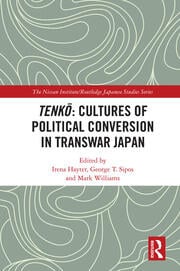
Tenkō [electronic resource] : cultures of political conversion in transwar Japan / edited by Irena Hayter, George T. Sipos and Mark Williams.
1000397300 (electronic bk.)
9781000397291 (PDF ebook)
1000397297
9780429280559 (ebook)
0429280556
9780367235796
036723579X
9780367770365
0367770369
Part 1: Conceptual Excursions
1. 'Ideological Conversion as Historical Catachresis: Coming to Terms with tenkō'
Max Ward
2. 'The Historical Origins of tenkō as an Intellectual and Social Issue: Marxism -- Thought Control -- Media'
Brice Fauconnier
3. 'Tenkō in Korea: Revealing the Critical Threshold of Colonial Empire'
Hong Jong-wook
4. 'Takeuchi Yoshimi and the Problem of tenkō'
Viren Murthy
Part 2: Literary Possibilities
5. 'Literature and Affect: Proletarian Literature as Discovery'
Nakagawa Shigemi
6. 'Common Tropes and Themes in Japan's tenkō Literature'
George T. Sipos
7. "Doublethink" in Seisan bungaku Theory'
Wada Takashi
8. 'The Problem of Literary "Truth": The tenkō of Nakano Shigeharu and Hayashi Fusao'
Naitō Yoshitada
9. 'The Disjointed Narratives and Fractured Subjects of Takami Jun'
Irena Hayter
10. 'Crossing the Void: Shimaki Kensaku's Search for Meaning in "Leprosy" and "Blindness"'
Jeff E. Long
11. 'The Tenkō of Anarchist Poets: Agrarian and Cinematic Latencies'
Murata Hirokazu
12. 'A Proletarian Writer in the Showcase Window: The Shifting Representation of "the Masses" in Sata Ineko's Kurenai'
Lee Juhee
13. 'Mythic Reality, Battlefield Survival and Psycho-social Conversion in Yoshida Mitsuru's The End of Battleship Yamato'
David Stahl
Nationalism __ Social aspects __ Japan __ History __ 20th century.
Social integration __ Japan __ History __ 20th century.
Political culture __ Japan __ History __ 20th century.
Political crimes and offenses __ Japan __ History __ 20th century.
HISTORY / Asia / Japan __ bisacsh
LITERARY CRITICISM / Asian / Japanese __ bisacsh
Japan __ Politics and government __ 1926-1945.
Eseri Alıntıla
Dijital Kaynak
MARC Görünümü
001 802697
003 TR_AnAIT
005 20260123024335
006 m o d
007 cr |n|||||||||
008 210504s2021 nyu ob 001 0 eng d
020 |a9781000397307|q(electronic bk.)
020 |a1000397300|q(electronic bk.)
020 |a9781000397291|q(PDF ebook)
020 |a1000397297
020 |a9780429280559|q(ebook)
020 |a0429280556
020 |z9780367235796
020 |z036723579X
020 |z9780367770365
020 |z0367770369
024 7 |a10.4324/9780429280559|2doi
035 |a(OCoLC)1249505690
035 |a(OCoLC-P)1249505690
040 |aOCoLC-P|beng|cOCoLC-P
041 |aeng
049 |aTürk Tarih Kurumu Kütüphanesi
050 4|aJQ1681
072 7|aHIS|x021000|2bisacsh
072 7|aLIT|x008030|2bisacsh
072 7|aPHI|x034000|2bisacsh
072 7|aHB|2bicssc
082 04|a320.532095209043|223
245 00|aTenkō|h[electronic resource] :|bcultures of political conversion in transwar Japan /|cedited by Irena Hayter, George T. Sipos and Mark Williams.
264 1|aNew York :|bRoutledge,|c2021.
300 |a1 online resource.
336 |atext|2rdacontent
336 |astill image|2rdacontent
337 |acomputer|2rdamedia
338 |aonline resource|2rdacarrier
490 0 |aNissan institute/Routledge Japanese studies series
505 0 |a
Part 1: Conceptual Excursions
1. 'Ideological Conversion as Historical Catachresis: Coming to Terms with tenkō'
Max Ward
2. 'The Historical Origins of tenkō as an Intellectual and Social Issue: Marxism -- Thought Control -- Media'
Brice Fauconnier
3. 'Tenkō in Korea: Revealing the Critical Threshold of Colonial Empire'
Hong Jong-wook
4. 'Takeuchi Yoshimi and the Problem of tenkō'
Viren Murthy
Part 2: Literary Possibilities
5. 'Literature and Affect: Proletarian Literature as Discovery'
Nakagawa Shigemi
6. 'Common Tropes and Themes in Japan's tenkō Literature'
George T. Sipos
7. "Doublethink" in Seisan bungaku Theory'
Wada Takashi
8. 'The Problem of Literary "Truth": The tenkō of Nakano Shigeharu and Hayashi Fusao'
Naitō Yoshitada
9. 'The Disjointed Narratives and Fractured Subjects of Takami Jun'
Irena Hayter
10. 'Crossing the Void: Shimaki Kensaku's Search for Meaning in "Leprosy" and "Blindness"'
Jeff E. Long
11. 'The Tenkō of Anarchist Poets: Agrarian and Cinematic Latencies'
Murata Hirokazu
12. 'A Proletarian Writer in the Showcase Window: The Shifting Representation of "the Masses" in Sata Ineko's Kurenai'
Lee Juhee
13. 'Mythic Reality, Battlefield Survival and Psycho-social Conversion in Yoshida Mitsuru's The End of Battleship Yamato'
David Stahl
520 |aThis book approaches the concept of tenk (political conversion) as a response to the global crisis of interwar modernity, as opposed to a distinctly Japanese experience in postwar debates. Tenk connotes the expressions of ideological conversion performed by members of the Japanese Communist Party, starting in 1933, whereby they renounced Marxism and expressed support for Japan's imperial expansion on the continent. Although tenk has a significant presence in Japan's postwar intellectual and literary histories, thiscontributed volume is one of the first in Englishm language scholarship to approach the phenomenon. International perspectives from both established and early career scholars show tenk as inseparable from the global politics of empire, deeply marked by an age of mechanical reproduction, mediatization and the manipulation of language. Chapters draw on a wide range of interdisciplinary methodologies, from political theory and intellectual history to literary studies. In this way, tenk is explored through new conceptual and analytical frameworks, including questions of gender and the role of affect in politics, implications that render the phenomenon distinctly relevant to the contemporary moment. Tenk: Cultures of Political Conversion in Transwar Japan will prove a valuable resource to students and scholars of Japanese and East Asian history, literature and politics.
588 |aOCLC-licensed vendor bibliographic record.
650 0|aIdeology|zJapan|xHistory|y20th century.
650 0|aNationalism|xSocial aspects|zJapan|xHistory|y20th century.
650 0|aSocial integration|zJapan|xHistory|y20th century.
650 0|aPolitical culture|zJapan|xHistory|y20th century.
650 0|aPolitical crimes and offenses|zJapan|xHistory|y20th century.
650 7|aHISTORY / Asia / Japan|2bisacsh
650 7|aLITERARY CRITICISM / Asian / Japanese|2bisacsh
651 0|aJapan|xPolitics and government|y1926-1945.
700 1 |aHayter, Irena,|eeditor.
700 1 |aSipos, George T.,|eeditor.
700 1 |aWilliams, Mark,|d1957-|eeditor.
856 40|3Taylor & Francis|uhttps://www.taylorfrancis.com/books/9780429280559
856 42|3OCLC metadata license agreement|uhttp://www.oclc.org/content/dam/oclc/forms/terms/vbrl-201703.pdf
901 |aTaylor & Francis
Materyaller
Materyal dışarıya ödünç verilmemektedir.
