

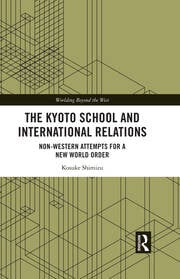
The Kyoto school and international relations : non-Western attempts for a new world order / Kosuke Shimizu.
ISBN
0429460309
9780429460302 electronic book
9780429863301 electronic book
0429863306 electronic book
9780429863318 electronic book
0429863314 electronic book
9780429863295 (electronic bk. : Mobipocket)
0429863292 (electronic bk. : Mobipocket)
9781138624955 hardcover
9781032004013 paperback
9780429460302 electronic book
9780429863301 electronic book
0429863306 electronic book
9780429863318 electronic book
0429863314 electronic book
9780429863295 (electronic bk. : Mobipocket)
0429863292 (electronic bk. : Mobipocket)
9781138624955 hardcover
9781032004013 paperback
Dil Kodu
İngilizce
Yayın Bilgisi
Abingdon, Oxon ; New York, NY : Routledge, 2022.
©2022
©2022
Fiziksel Niteleme
1 online resource.
Dizi
Worlding beyond the West
İçindekiler Notu
Introduction -- East Asian IR revisited -- Encounter, transformation of time, and self-colonisation : the Japanese modernisation -- Nishida Kitaro and Tanbae Hajime : the first generation of the school -- The transcendental whole and 'inclusiveness' : the discourse of the Big 4 -- Miki Kisyoshi's philosophy of imagination : towards everyday life -- Tosaka Jun's theory of critical relationality : morality of everydayness -- The reception of the Kyoto School philosophy in the post-war era -- Bringing bodily experience back in : postwar Japanese IR -- Conclusion : towards a Mahāyāna Buddhist IR?
Özet, vb.
"The Kyoto School and International Relations explores the Kyoto School's challenge to transcend the 'Western' domination over the 'rest' of the world, and the issues this raises for contemporary 'non-Western' and 'Global IR' literature. Was the support of Kyoto School thinkers inevitable due to the despotism of military government, thus nothing to do with their philosophy, or a logical extension of their philosophical engagement? The book answers this question by investigating individual Kyoto School philosophers in detail. The author argues that any attempts to transcend the 'West' are destined to be drawn into power politics as far as they uncritically adopt and use the prevailing ontological concept of linear progressive time and dominant meta-narrative of Westphalia. Thus, to fully understand this problem, there is the need to be cautious of the power of language of Westphalia and the concept of time in IR. Aimed at students and scholars of IR Theory, Japanese Politics and East Asian IR in general, this book provides some introductory explanations of these academic subjects, developing a theory based on the concepts of time and language of Kyoto School philosophy"-- Provided by publisher.
Konu
International relations __ Philosophy.
Kyoto school.
East and West.
POLITICAL SCIENCE / General __ bisacsh
POLITICAL SCIENCE / History & Theory __ bisacsh
POLITICAL SCIENCE / International Relations / General __ bisacsh
Japan __ Foreign relations __ Philosophy.
Asia __ Foreign relations __ Philosophy.
Kyoto school.
East and West.
POLITICAL SCIENCE / General __ bisacsh
POLITICAL SCIENCE / History & Theory __ bisacsh
POLITICAL SCIENCE / International Relations / General __ bisacsh
Japan __ Foreign relations __ Philosophy.
Asia __ Foreign relations __ Philosophy.
Veritabanı
