

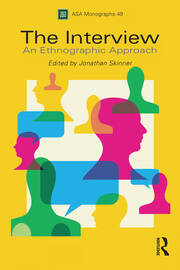
The interview : an ethnographic approach / edited by Jonathan Skinner.
ISBN
9781003087014 (electronic bk.)
1003087019 (electronic bk.)
9781847889409
9781847889393
9781847889416
9781000181616 (electronic bk. : EPUB)
1000181618 (electronic bk. : EPUB)
9781000188240 (electronic bk. : Mobipocket)
1000188248 (electronic bk. : Mobipocket)
9781000184792 (electronic bk. : PDF)
100018479X (electronic bk. : PDF)
1003087019 (electronic bk.)
9781847889409
9781847889393
9781847889416
9781000181616 (electronic bk. : EPUB)
1000181618 (electronic bk. : EPUB)
9781000188240 (electronic bk. : Mobipocket)
1000188248 (electronic bk. : Mobipocket)
9781000184792 (electronic bk. : PDF)
100018479X (electronic bk. : PDF)
Dil Kodu
İngilizce
Yayın Bilgisi
Abingdon, Oxon ; New York, NY : Routledge, Taylor & Francis Group, 2020.
Fiziksel Niteleme
1 online resource (288 pages).
Dizi
ASA. monographs ; 49
Genel Not
"First published 2012 by Berg Publishers, published 2013 by Bloomsbury Academic."
İçindekiler Notu
AcknowledgementsAbout the Editor and ContributorsIntroduction A Fourt-part Introduction to the Interview: Introducing the Interview; Society, Sociology and the Interview; Anthropology and the Interview; Anthropology and the Interview - Edited. Jonathan Skinner (Queen's University Belfast, UK) Part One: Positioning The InterviewThe Interview as a Form of Talking-partnership: Dialectical, Focused, Ambiguous, Special. Nigel Rapport (St Andrews University, UK) Ethnography is Not Participant Observation: Reflections on the Interview as Participatory Qualitative Research. Jenny Hockey (University of Sheffield, UK) and Martin Forsey (University of Western Australia, Australia) Finding and Mining the Talk: Negotiating Knowledge and Knowledge Transfer in the Field. Lisette Josephides (Queen's University Belfast, UK)Part Two: Interview TechniquesThe Autobiographical Narrative Interview: A Potential Arena of Emotional Remembering, Performance and Reflection. Maruska Svasek and Markieta Domecka (Queen's University Belfast, UK) Eliciting the Tacit: Interviewing to Understand Bodily Experience. Georgiana Gore (Université Blaise Pascal, France), Géraldine Rix-Lieévre (Université Blaise Pascal, France), Olivier Wathelet (Institut Paul Bocuse, France) and Anne Cazemajou (Université Blaise Pascal, France)Difficult Moments in the Ethnographic Interview: Vulnerability, Silence and Rapport. Ann Montgomery (Barts and The London School of Medicine and Dentistry, UK)Part Three: Interview Cases Instances of Inspiration: Interviewing Dancers and Writers. Helena Wulff (Stockholm University, Sweden)'Angola Calling': A Study of Registers of Imagination in the Interview. Madalina Florescu (School of Oriental and African Studies, UK)The Contortions of Forgiveness: Betrayal, Abandonment, and Narrative Entrapment among the Harkis. Vincent Crapanzano (CUNY, USA)Integrating Interviews into Quantitive Domains: Reaching the Parts Controlled Trials Can't Reach. Alex Greene (University of Dundee, UK)Recalling What Was Unspeakable: Hunger in North Korea. Sandra Fahy (L'École des Hautes Études en Sciences Sociales, France)Re-presenting Hopis: Indigenous Responses to the Ethnographic Interview. Nick McCaffery (Independent Scholar, UK)Epilogue: Expectations, Auto-Narrative and Beyond. Marilyn Strathern (University of Cambridge, UK)ReferencesIndex
Özet, vb.
What are new interview methods and practices in our new 'interview society' and how do they relate to traditional social science research? This volume interrogates the interview as understood, used - and under-used - by anthropologists. It puts the interview itself in the hotseat by exploring the nature of the interview, interview techniques, and illustrative cases of interview use.What is a successful and representative interview? How are interviews best transcribed and integrated into our writing? Is interview knowledge production safe, ethical and representative? And how are interviews used by anthropologists in their ethnographic practice?This important volume leads the reader from an initial scrutiny of the interview to interview techniques and illustrative case studies. It is experimental, innovative, and covers in detail matters such as awkwardness, silence and censorship in interviews that do not feature in general interview textbooks. It will appeal to social scientists engaged in qualitative research methods in general, and anthropology and sociology students using interviews in their research and writing in particular.
Konu
Interviewing in ethnology __ Congresses.
Ethnology __ Fieldwork __ Congresses.
Interviewing __ Congresses.
SOCIAL SCIENCE / Anthropology / General __ bisacsh
SOCIAL SCIENCE / Anthropology / Cultural __ bisacsh
SOCIAL SCIENCE / Anthropology / Physical __ bisacsh
Ethnology __ Fieldwork __ Congresses.
Interviewing __ Congresses.
SOCIAL SCIENCE / Anthropology / General __ bisacsh
SOCIAL SCIENCE / Anthropology / Cultural __ bisacsh
SOCIAL SCIENCE / Anthropology / Physical __ bisacsh
Diğer Yazarlar
Veritabanı
Eseri Alıntıla
Referansları kullanmadan önce gözden geçirmeniz ve varsa gerekli düzeltmeleri yapmanız önerilir.
Dijital Kaynak
MARC Görünümü
LEADER 05857cam a2200589Ii 4500
001 802829
003 TR_AnAIT
005 20260123024603
006 m o d
007 cr cnu|||unuuu
008 200615r20202012enk ob 100 0 eng d
020 |a9781003087014|q(electronic bk.)
020 |a1003087019|q(electronic bk.)
020 |z9781847889409
020 |z9781847889393
020 |z9781847889416
020 |a9781000181616|q(electronic bk. : EPUB)
020 |a1000181618|q(electronic bk. : EPUB)
020 |a9781000188240|q(electronic bk. : Mobipocket)
020 |a1000188248|q(electronic bk. : Mobipocket)
020 |a9781000184792|q(electronic bk. : PDF)
020 |a100018479X|q(electronic bk. : PDF)
035 |a(OCoLC)1158313724
035 |a(OCoLC-P)1158313724
040 |aOCoLC-P|beng|erda|epn|cOCoLC-P
041 |aeng
049 |aTürk Tarih Kurumu Kütüphanesi
050 4|aGN346.3
072 7|aSOC|x002000|2bisacsh
072 7|aSOC|x002010|2bisacsh
072 7|aSOC|x002020|2bisacsh
072 7|aJHM|2bicssc
082 04|a305.8/00723|223
110 2 |aAssociation of Social Anthropologists of the UK and the Commonwealth.|bConference|d(2010 :|cQueen's University of Belfast)
245 14|aThe interview :|ban ethnographic approach /|cedited by Jonathan Skinner.
264 1|aAbingdon, Oxon ;|aNew York, NY :|bRoutledge, Taylor & Francis Group,|c2020.
300 |a1 online resource (288 pages).
336 |atext|btxt|2rdacontent
337 |acomputer|bc|2rdamedia
338 |aonline resource|bcr|2rdacarrier
490 1 |aASA. monographs ;|v49
500 |a"First published 2012 by Berg Publishers, published 2013 by Bloomsbury Academic."
505 0 |aAcknowledgementsAbout the Editor and ContributorsIntroduction A Fourt-part Introduction to the Interview: Introducing the Interview; Society, Sociology and the Interview; Anthropology and the Interview; Anthropology and the Interview - Edited. Jonathan Skinner (Queen's University Belfast, UK) Part One: Positioning The InterviewThe Interview as a Form of Talking-partnership: Dialectical, Focused, Ambiguous, Special. Nigel Rapport (St Andrews University, UK) Ethnography is Not Participant Observation: Reflections on the Interview as Participatory Qualitative Research. Jenny Hockey (University of Sheffield, UK) and Martin Forsey (University of Western Australia, Australia) Finding and Mining the Talk: Negotiating Knowledge and Knowledge Transfer in the Field. Lisette Josephides (Queen's University Belfast, UK)Part Two: Interview TechniquesThe Autobiographical Narrative Interview: A Potential Arena of Emotional Remembering, Performance and Reflection. Maruska Svasek and Markieta Domecka (Queen's University Belfast, UK) Eliciting the Tacit: Interviewing to Understand Bodily Experience. Georgiana Gore (Université Blaise Pascal, France), Géraldine Rix-Lieévre (Université Blaise Pascal, France), Olivier Wathelet (Institut Paul Bocuse, France) and Anne Cazemajou (Université Blaise Pascal, France)Difficult Moments in the Ethnographic Interview: Vulnerability, Silence and Rapport. Ann Montgomery (Barts and The London School of Medicine and Dentistry, UK)Part Three: Interview Cases Instances of Inspiration: Interviewing Dancers and Writers. Helena Wulff (Stockholm University, Sweden)'Angola Calling': A Study of Registers of Imagination in the Interview. Madalina Florescu (School of Oriental and African Studies, UK)The Contortions of Forgiveness: Betrayal, Abandonment, and Narrative Entrapment among the Harkis. Vincent Crapanzano (CUNY, USA)Integrating Interviews into Quantitive Domains: Reaching the Parts Controlled Trials Can't Reach. Alex Greene (University of Dundee, UK)Recalling What Was Unspeakable: Hunger in North Korea. Sandra Fahy (L'École des Hautes Études en Sciences Sociales, France)Re-presenting Hopis: Indigenous Responses to the Ethnographic Interview. Nick McCaffery (Independent Scholar, UK)Epilogue: Expectations, Auto-Narrative and Beyond. Marilyn Strathern (University of Cambridge, UK)ReferencesIndex
520 |aWhat are new interview methods and practices in our new 'interview society' and how do they relate to traditional social science research? This volume interrogates the interview as understood, used - and under-used - by anthropologists. It puts the interview itself in the hotseat by exploring the nature of the interview, interview techniques, and illustrative cases of interview use.What is a successful and representative interview? How are interviews best transcribed and integrated into our writing? Is interview knowledge production safe, ethical and representative? And how are interviews used by anthropologists in their ethnographic practice?This important volume leads the reader from an initial scrutiny of the interview to interview techniques and illustrative case studies. It is experimental, innovative, and covers in detail matters such as awkwardness, silence and censorship in interviews that do not feature in general interview textbooks. It will appeal to social scientists engaged in qualitative research methods in general, and anthropology and sociology students using interviews in their research and writing in particular.
588 |aOCLC-licensed vendor bibliographic record.
650 0|aInterviewing in ethnology|vCongresses.
650 0|aEthnology|xFieldwork|vCongresses.
650 0|aInterviewing|vCongresses.
650 7|aSOCIAL SCIENCE / Anthropology / General|2bisacsh
650 7|aSOCIAL SCIENCE / Anthropology / Cultural|2bisacsh
650 7|aSOCIAL SCIENCE / Anthropology / Physical|2bisacsh
700 1 |aSkinner, Jonathan,|d1970-|eeditor.
856 40|3Taylor & Francis|uhttps://www.taylorfrancis.com/books/9781003087014
856 42|3OCLC metadata license agreement|uhttp://www.oclc.org/content/dam/oclc/forms/terms/vbrl-201703.pdf
901 |aTaylor & Francis
001 802829
003 TR_AnAIT
005 20260123024603
006 m o d
007 cr cnu|||unuuu
008 200615r20202012enk ob 100 0 eng d
020 |a9781003087014|q(electronic bk.)
020 |a1003087019|q(electronic bk.)
020 |z9781847889409
020 |z9781847889393
020 |z9781847889416
020 |a9781000181616|q(electronic bk. : EPUB)
020 |a1000181618|q(electronic bk. : EPUB)
020 |a9781000188240|q(electronic bk. : Mobipocket)
020 |a1000188248|q(electronic bk. : Mobipocket)
020 |a9781000184792|q(electronic bk. : PDF)
020 |a100018479X|q(electronic bk. : PDF)
035 |a(OCoLC)1158313724
035 |a(OCoLC-P)1158313724
040 |aOCoLC-P|beng|erda|epn|cOCoLC-P
041 |aeng
049 |aTürk Tarih Kurumu Kütüphanesi
050 4|aGN346.3
072 7|aSOC|x002000|2bisacsh
072 7|aSOC|x002010|2bisacsh
072 7|aSOC|x002020|2bisacsh
072 7|aJHM|2bicssc
082 04|a305.8/00723|223
110 2 |aAssociation of Social Anthropologists of the UK and the Commonwealth.|bConference|d(2010 :|cQueen's University of Belfast)
245 14|aThe interview :|ban ethnographic approach /|cedited by Jonathan Skinner.
264 1|aAbingdon, Oxon ;|aNew York, NY :|bRoutledge, Taylor & Francis Group,|c2020.
300 |a1 online resource (288 pages).
336 |atext|btxt|2rdacontent
337 |acomputer|bc|2rdamedia
338 |aonline resource|bcr|2rdacarrier
490 1 |aASA. monographs ;|v49
500 |a"First published 2012 by Berg Publishers, published 2013 by Bloomsbury Academic."
505 0 |aAcknowledgementsAbout the Editor and ContributorsIntroduction A Fourt-part Introduction to the Interview: Introducing the Interview; Society, Sociology and the Interview; Anthropology and the Interview; Anthropology and the Interview - Edited. Jonathan Skinner (Queen's University Belfast, UK) Part One: Positioning The InterviewThe Interview as a Form of Talking-partnership: Dialectical, Focused, Ambiguous, Special. Nigel Rapport (St Andrews University, UK) Ethnography is Not Participant Observation: Reflections on the Interview as Participatory Qualitative Research. Jenny Hockey (University of Sheffield, UK) and Martin Forsey (University of Western Australia, Australia) Finding and Mining the Talk: Negotiating Knowledge and Knowledge Transfer in the Field. Lisette Josephides (Queen's University Belfast, UK)Part Two: Interview TechniquesThe Autobiographical Narrative Interview: A Potential Arena of Emotional Remembering, Performance and Reflection. Maruska Svasek and Markieta Domecka (Queen's University Belfast, UK) Eliciting the Tacit: Interviewing to Understand Bodily Experience. Georgiana Gore (Université Blaise Pascal, France), Géraldine Rix-Lieévre (Université Blaise Pascal, France), Olivier Wathelet (Institut Paul Bocuse, France) and Anne Cazemajou (Université Blaise Pascal, France)Difficult Moments in the Ethnographic Interview: Vulnerability, Silence and Rapport. Ann Montgomery (Barts and The London School of Medicine and Dentistry, UK)Part Three: Interview Cases Instances of Inspiration: Interviewing Dancers and Writers. Helena Wulff (Stockholm University, Sweden)'Angola Calling': A Study of Registers of Imagination in the Interview. Madalina Florescu (School of Oriental and African Studies, UK)The Contortions of Forgiveness: Betrayal, Abandonment, and Narrative Entrapment among the Harkis. Vincent Crapanzano (CUNY, USA)Integrating Interviews into Quantitive Domains: Reaching the Parts Controlled Trials Can't Reach. Alex Greene (University of Dundee, UK)Recalling What Was Unspeakable: Hunger in North Korea. Sandra Fahy (L'École des Hautes Études en Sciences Sociales, France)Re-presenting Hopis: Indigenous Responses to the Ethnographic Interview. Nick McCaffery (Independent Scholar, UK)Epilogue: Expectations, Auto-Narrative and Beyond. Marilyn Strathern (University of Cambridge, UK)ReferencesIndex
520 |aWhat are new interview methods and practices in our new 'interview society' and how do they relate to traditional social science research? This volume interrogates the interview as understood, used - and under-used - by anthropologists. It puts the interview itself in the hotseat by exploring the nature of the interview, interview techniques, and illustrative cases of interview use.What is a successful and representative interview? How are interviews best transcribed and integrated into our writing? Is interview knowledge production safe, ethical and representative? And how are interviews used by anthropologists in their ethnographic practice?This important volume leads the reader from an initial scrutiny of the interview to interview techniques and illustrative case studies. It is experimental, innovative, and covers in detail matters such as awkwardness, silence and censorship in interviews that do not feature in general interview textbooks. It will appeal to social scientists engaged in qualitative research methods in general, and anthropology and sociology students using interviews in their research and writing in particular.
588 |aOCLC-licensed vendor bibliographic record.
650 0|aInterviewing in ethnology|vCongresses.
650 0|aEthnology|xFieldwork|vCongresses.
650 0|aInterviewing|vCongresses.
650 7|aSOCIAL SCIENCE / Anthropology / General|2bisacsh
650 7|aSOCIAL SCIENCE / Anthropology / Cultural|2bisacsh
650 7|aSOCIAL SCIENCE / Anthropology / Physical|2bisacsh
700 1 |aSkinner, Jonathan,|d1970-|eeditor.
856 40|3Taylor & Francis|uhttps://www.taylorfrancis.com/books/9781003087014
856 42|3OCLC metadata license agreement|uhttp://www.oclc.org/content/dam/oclc/forms/terms/vbrl-201703.pdf
901 |aTaylor & Francis
Materyaller
Depodan talep edilen materyal sadece kütüphane içerisinde kullanılmaktadır.
Materyal dışarıya ödünç verilmemektedir.
Materyal dışarıya ödünç verilmemektedir.
