LEADER 04055cam a2200565Ii 4500
001 802855
003 TR_AnAIT
005 20260123024629
006 m o d
007 cr |n|||||||||
008 210613s2021 enk ob 001 0 eng d
020 |a9781000405378|qelectronic book
020 |a1000405370|qelectronic book
020 |a9781003099451|qelectronic book
020 |a1003099459|qelectronic book
020 |a9781000405385|qelectronic book|qEPUB
020 |a1000405389|qelectronic book|qEPUB
020 |z9780367568153
020 |z0367568152
024 7 |a10.4324/9781003099451|2doi
035 |a(OCoLC)1256265908
035 |a(OCoLC-P)1256265908
040 |aOCoLC-P|beng|erda|cOCoLC-P
041 |aeng
049 |aTürk Tarih Kurumu Kütüphanesi
050 4|aLC5056.G72|bE577 2021
072 7|aEDU|x040000|2bisacsh
072 7|aEDU|x037000|2bisacsh
072 7|aSOC|x050000|2bisacsh
072 7|aJNAM|2bicssc
082 04|a370.9427|223
100 1 |aSimpson, Kat,|eauthor.
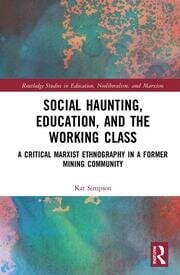
245 10|aSocial haunting, education, and the working class :|ba critical Marxist ethnography in a former mining community /|cKat Simpson.
264 1|aAbingdon ;|aNew York, NY :|bRoutledge,|c2021.
300 |a1 online resource.
336 |atext|2rdacontent
337 |acomputer|2rdamedia
338 |aonline resource|2rdacarrier
490 0 |aRoutledge studies in education, neoliberalism, and marxism
505 0 |a
Foreword by James Avis
Introduction
Chapter 1 Social Haunting of Deindustrialisation
Chapter 2 Lillydown -- A Working-Class Biography
Chapter 3 Education and Marxism
Chapter 4 The State Apparatus and the Role of Education
Chapter 5 Pedagogy, Curriculum, and Ghosts
Chapter 6 Growing-Up Working-Class: A Sense of Being
Chapter 7 How Class Haunts: Social Stratification in the Classroom
Chapter 8 The Social Haunting of Deindustrialisation: Considerations on a Marxist Pedagogy of Social Haunting
Index
520 |aBased on a critical Marxist ethnography, conducted at a state primary school in a former coalmining community in the north of England, this book provides insight into teachers' perceptions of the effects of deindustrialisation on education for the working class. The book draws on the notion of social haunting to help understand the complex ways in which historical relations and performances, reflective of the community's industrial past, continue to shape experiences and processes of schooling. The arguments presented enable us to engage with the goodness' of the past as well as the pain and suffering associated with deindustrialisation. This, it is argued, enables teachers and pupils to engage with rhythms, relations, and performances that recognise the heritage and complexities of working-class culture. Reckoning and harnessing with the fullness of ghosts is essential if schooling is to be refashioned in more encouraging and relational ways, with and for the working class. This text will benefit researchers, academics, and educators with an interest in the sociology of education, and social class and education in particular. Those interested in schooling, ethnography, and qualitative social research will also benefit from the book
588 |aOCLC-licensed vendor bibliographic record.
650 0|aWorking class|xEducation|zEngland, Northern.
650 0|aDeindustrialization|xSocial aspects|zEngland, Northern.
650 0|aSocial status|zEngland, Northern.
650 0|aEducation and state|zEngland, Northern.
650 0|aCommunism and education|zEngland, Northern.
650 7|aEDUCATION / Philosophy & Social Aspects|2bisacsh
650 7|aEDUCATION / Research|2bisacsh
650 7|aSOCIAL SCIENCE / Social Classes|2bisacsh
856 40|3Taylor & Francis|uhttps://www.taylorfrancis.com/books/9781003099451
856 42|3OCLC metadata license agreement|uhttp://www.oclc.org/content/dam/oclc/forms/terms/vbrl-201703.pdf
901 |aTaylor & Francis