LEADER 04200cam a2200553 i 4500
001 802888
003 TR_AnAIT
005 20260123024659
006 m o d
007 cr cnu---unuuu
008 220531t20242024enkab ob 001 0 eng
020 |a9781003148692|qelectronic book
020 |a1003148697|qelectronic book
020 |a9781000721584|qelectronic book
020 |a1000721582|qelectronic book
020 |a9781000721164|qelectronic book
020 |a1000721167|qelectronic book
020 |z9780367700850|qhardcover
020 |z9780367709563|qpaperback
024 7 |a10.4324/9781003148692|2doi
035 |a(OCoLC)1328141755
035 |a(OCoLC-P)1328141755
040 |aOCoLC-P|beng|erda|cOCoLC-P
041 |aeng
049 |aTürk Tarih Kurumu Kütüphanesi
050 04|aDS24|b.F56 2024
072 7|aSOC|x008000|2bisacsh
072 7|aSOC|x053000|2bisacsh
072 7|aRGL|2bicssc
082 00|a305.894/3450517|223/eng/20220610
100 1 |aFinke, Peter,|d1963-|eauthor.
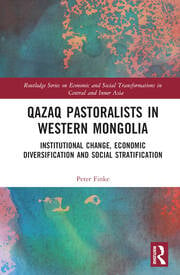
245 10|aQazaq pastoralists in western Mongolia :|binstitutional change, economic diversification and social stratification /|cPeter Finke.
264 1|aAbingdon, Oxon ;|aNew York, NY :|bRoutledge,|c2024.
264 4|c©2024
300 |a1 online resource (xii, 241 pages) :|billustrations, maps.
336 |atext|btxt|2rdacontent
337 |acomputer|bc|2rdamedia
338 |aonline resource|bcr|2rdacarrier
490 0 |aRoutledge series on economic and social transformations in central and inner Asia ;|v1
505 0 |aSystems come and go -- A portrait of Khovd-sum -- Changing regimes of production and exchange -- Making ends meet -- Using space and mobility -- Social webs and hierarchies -- Flexibility and adaptation in pastoral decision-making.
520 |a"Taking the case of Qazaq Pastoralists in Western Mongolia, this book looks at the universal human requirement to balance individual flexibility and strategies designed to make a living with the social expectations that impose particular rules of conduct but also enable mutual trust and cooperation to emerge. Pastoralists in Western Mongolia have experienced dramatic changes in recent decades, including the dismantling of the socialist economy, a series of natural disasters, and an emigration of roughly half of the local Qazaq minority to the newly independent state of Qazaqstan. Four aspects illustrate the chances and challenges that people face. First is the emergence of the market as the dominant mode of production and exchange, a thorny way full of uncertainties. Second is the individual household and its adaptation to the new economic system, creating new opportunities as well as precarities, and resulting in rapid social stratification. Thirdly, patterns of pastoral land allocation highlight problems of collective action and institutional fragmentation in the wake of a retreating state apparatus. Finally, social networks of mutual support and cooperation constitute a key component of pastoral livelihood but are under great pressure due to short time horizons and a lack of trust. The first longitudinal analysis of the Qazaqs in Mongolia in English and a contribution to anthropological theories on human adaptability and decision-making, economic and social inequalities, institutional change and the difficulty of deriving at cooperative solutions, this book will be a standard work and of interest to academics in the field of Central Asian Studies, Anthropology, Human Geography and Development Studies"--|cProvided by publisher.
588 |aOCLC-licensed vendor bibliographic record.
650 0|aKazakhs|vLongitudinal studies.
650 0|aKazakhs|zMongolia|zKhovd Aĭmag|xSocial conditions.
650 0|aKazakhs|zMongolia|zKhovd Aĭmag|xEconomic conditions.
650 0|aNomads|zMongolia|zKhovd Aĭmag.
650 7|aSOCIAL SCIENCE / Ethnic Studies / General|2bisacsh
651 0|aKhovd Aĭmag (Mongolia)|xSocial conditions.
651 0|aKhovd Aĭmag (Mongolia)|xEconomic conditions.
856 40|3Taylor & Francis|uhttps://www.taylorfrancis.com/books/9781003148692
856 42|3OCLC metadata license agreement|uhttp://www.oclc.org/content/dam/oclc/forms/terms/vbrl-201703.pdf
901 |aTaylor & Francis