

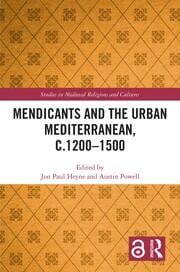
The mendicants and the urban Mediterranean, c.1200-1500 / edited by Jon Paul Heyne and Austin Powell.
ISBN
9781003377245 ebook
1003377246
9781040346952 (electronic bk. : PDF)
1040346952 (electronic bk. : PDF)
9781040346983 (electronic bk. : EPUB)
1040346987 (electronic bk. : EPUB)
9781032454962 hardback
9781032454979 paperback
1003377246
9781040346952 (electronic bk. : PDF)
1040346952 (electronic bk. : PDF)
9781040346983 (electronic bk. : EPUB)
1040346987 (electronic bk. : EPUB)
9781032454962 hardback
9781032454979 paperback
Dil Kodu
İngilizce
Yayın Bilgisi
Abingdon, Oxon ; New York, NY : Routledge, 2025.
©2025
©2025
Fiziksel Niteleme
1 online resource.
Dizi
Studies in medieval religions and cultures
Özet, vb.
"This volume explores the relationship of mendicant men and women to cities and their inhabitants in the Mediterranean world, c.1200 to 1500. It asks questions including what was specifically "urban" about the mendicant movement; what does it mean to think of the mendicants as an "urban phenomenon"; and was there anything common to mendicant experiences in the cities of the Mediterranean. In addressing these questions, the volume expands our understanding of the mendicants by offering chapters that examine this religious movement within urban environments from the Iberian Peninsula, North Africa, Southern France, and Italy, to the Dalmatian Coast, Aegean Islands, Egypt, and the Levant. The chapters treat a wide array of textual, artistic, and architectural sources to consider how mendicants navigated and negotiated the unique social dynamics of Mediterranean cities in their interactions with political potentates, merchants, prisoners, pilgrims, religious and intellectual elites, non-Christians, and inhabitants of the surrounding countryside. It thus offers an interdisciplinary and broad survey of mendicancy as a social-religious phenomenon of the urban Mediterranean, demonstrating that these communities can be defined by much more than their traditionally accepted roles as beggars, preachers, and teachers. Mendicants and the Urban Mediterranean will be of interest to scholars and students across multiple disciplines engaged in questions about medieval mendicancy, gender, urban society, inter-religious encounters, and the Mediterranean"-- Provided by publisher.
Konu
Friars __ Mediterranean Region.
Cities and towns __ Mediterranean Region __ History __ To 1500.
Mediterranean Region __ Social conditions.
Cities and towns __ Mediterranean Region __ History __ To 1500.
Mediterranean Region __ Social conditions.
Diğer Yazarlar
Veritabanı
