LEADER 03031cam a2200361Mi 4500
001 803198
003 TR_AnAIT
005 20260123235204
006 m o d
007 cr cn|||||||||
008 170919s2017 enk o 000 0 eng d
020 |a9781315124605|q(e-book)
020 |a1315124602
035 |a(OCoLC)1004369221
035 |a(OCoLC-P)1004369221
040 |aOCoLC-P|beng|erda|epn|cOCoLC-P
041 |aeng
049 |aTürk Tarih Kurumu Kütüphanesi
050 4|aE179|b.H365 2017
082 04|a973
100 1 |aHamilton, Richard F.,|eauthor.
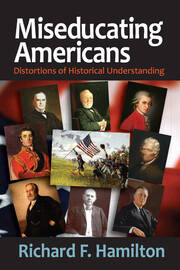
245 10|aMiseducating Americans :|bDistortions of Historical Understanding /|cRichard F. Hamilton.
250 |aFirst edition.
264 1|aLondon :|bTaylor and Francis,|c2017.
300 |a1 online resource :|btext file, PDF
336 |atext|btxt|2rdacontent
337 |acomputer|bc|2rdamedia
338 |aonline resource|bcr|2rdacarrier
505 0 |aChapter 1 Land of the Free, 1776{u2013}1865 -- chapter 2 Land of the Free, 1866 and After -- chapter 3 Benjamin Harrison{u2019}s Presidency -- chapter 4 Hanna, McKinley, Roosevelt, and Carnegie -- chapter 5 America{u2019}s Empire, 1898 and After -- chapter 6 On War and the Military -- chapter 7 On ose Past Events, the Twentieth Century, and Likely Futures.
520 2 |a"In Miseducating Americans, Richard F. Hamilton examines accounts of American history appearing in textbooks and popular accounts and compares these with the reports contained in scholarly monographs. The task: to determine how certain myths and misconstructions became accepted as recorded history. Hamilton provides much needed correction of those misleading accounts. Was America historically the "land of the free?" Not if you take into account slavery, discrimination, and post-Civil War segregation policies. Was America in the late nineteenth century truly expansionist, as American textbooks imply, or did it actually capitalize on unexpected political and economic opportunities, like Russia's desire to rid itself of Alaska? Was the acquisition of the Philippines a zealous profit-seeking effort aiming for "the China market," or the fortuitous consequences of a move against Spain during the Spanish-American War? Miseducating Americans debunks many commonly accepted explanations of historical facts. It contends that many accounts are oversimplifications, and some are one-sided depictions of virtue. Hamilton traces the sources of these misconstructions, which mostly come from history textbooks written by authors aiming for "popular audiences." He then offers explanations as to how and why the inaccuracies have been repeated and passed on."--Provided by publisher.
588 |aOCLC-licensed vendor bibliographic record.
651 0|aUnited States|xHistory|xTextbooks|xEvaluation.
856 40|3Taylor & Francis|uhttps://www.taylorfrancis.com/books/9781315124605|zClick here to view.
856 42|3OCLC metadata license agreement|uhttp://www.oclc.org/content/dam/oclc/forms/terms/vbrl-201703.pdf
901 |aTaylor & Francis
938 |aTaylor & Francis|bTAFR|n9781315124605