LEADER 03395cam a2200409Ii 4500
001 803430
003 TR_AnAIT
005 20260123235542
008 180706s2016 enkb ob 001 0 eng d
020 |a9781315667713|q(e-book : PDF)
020 |a9781317358923|q(e-book: Mobi)
020 |a9781317358930|q(e-book: ePub)
020 |z9781138952201|q(hardback)
020 |z9781138099838|q(paperback)
024 7 |a10.4324/9781315667713 |2doi
035 |a(OCoLC)958108097
041 |aeng
043 |ae-urs--|aa-mp---
049 |aTürk Tarih Kurumu Kütüphanesi
050 4|aDK766|b.S23 2016
082 04|a951.7|bS117
100 1 |aSablin, Ivan.,|eauthor.
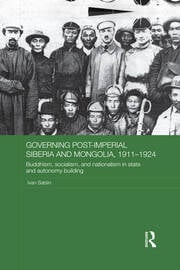
245 10|aGoverning post-imperial Siberia and Mongolia, 1911-1924 :|bBuddhism, socialism, and nationalism in state and autonomy building /|cIvan Sablin.
264 1|aLondon ;|aNew York :|bRoutledge,|c2016.
300 |a1 online resource (xii, 221 pages)
490 1 |aRoutledge studies in the history of Russia and Eastern Europe ;|v24
505 0 |a1. Demographics, economy, and communication in the borderland, 1911-1917 -- 2. Transcultural spaces and entanglements, 1911-1917 -- 13. The Buryat national autonomy, 1917-1918 -- 4. Power struggle in a stateless context, 1918-1919 -- 5. The Mongol federation and the Buddhist theocracy, 1919-1920 -- 6. The new independent states, 1920-1921 -- 7. The Buryat autonomy in transcultural governance, 1921-1924.
520 2 |a"The governance arrangements put in place for Siberia and Mongolia after the collapse of the Qing and Russian Empires were highly unusual, experimental and extremely interesting. The Buryat-Mongol Autonomous Socialist Soviet Republic established within the Soviet Union in 1923 and the independent Mongolian People's Republic established a year later were supposed to represent a new model of transnational, post-national governance, incorporating religious and ethno-national independence, under the leadership of the coming global political party, the Communist International. The model, designed to be suitable for a socialist, decolonised Asia, and for a highly diverse population in a strategic border region, was intended to be globally applicable. This book, based on extensive original research, charts the development of these unusual governance arrangements, discusses how the ideologies of nationalism, socialism and Buddhism were borrowed from, and highlights the relevance of the subject for the present day world, where multiculturality, interconnectedness and interdependency become ever more complicated"--Provided by publisher.
650 0|aBuddhism and state|zRussia (Federation)|zSiberia|xHistory|y20th century.
650 0|aBuddhism and state|zMongolia|xHistory|y20th century.
650 0|aSocialism|zRussia (Federation)|zSiberia|xHistory|y20th century.
650 0|aSocialism|zMongolia|xHistory|y20th century.
650 0|aNationalism|zRussia (Federation)|zSiberia|xHistory|y20th century.
650 0|aNationalism|zMongolia|xHistory|y20th century.
650 0|aNation-building|xHistory|y20th century.
650 0|aAutonomy|xHistory|y20th century.
651 0|aMongolia|xPolitics and government|y20th century.
651 0|aSiberia (Russia)|xPolitics and government|y20th century.
776 08|iPrint version: |z9781138952201|w(DLC) 2015030975
830 0|aRoutledge studies in the history of Russia and Eastern Europe ;|v24.
856 40|uhttps://www.taylorfrancis.com/books/9781315667713|zClick here to view.
901 |aTaylor & Francis