LEADER 03528cam a2200565 i 4500
001 803652
003 TR_AnAIT
005 20260123235929
006 m d u
007 cr |||||||||||
008 200824t20212021enk ob 001 0 eng
020 |a9781003026167|qelectronic book
020 |a1003026168|qelectronic book
020 |a9781000335613|qelectronic book
020 |a1000335615|qelectronic book
020 |a9781000335699|qelectronic book
020 |a1000335690|qelectronic book
020 |a9781000335774|qelectronic book
020 |a1000335771|qelectronic book
020 |z9780367459437|qhardcover
035 |a(OCoLC)1191456325
035 |a(OCoLC-P)1191456325
040 |aOCoLC-P|beng|erda|cOCoLC-P
041 |aeng
049 |aTürk Tarih Kurumu Kütüphanesi
050 00|aRA448.5.A73|bH84 2021
072 7|aSOC|x002000|2bisacsh
072 7|aSOC|x002010|2bisacsh
072 7|aSOC|x036000|2bisacsh
072 7|aJHMC|2bicssc
082 00|a362.17/5088297|223
100 1 |aHughes Rinker, Cortney,|eauthor.
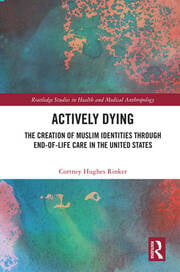
245 10|aActively dying :|bthe creation of Muslim identities through end-of-life care in the United States /|cCortney Hughes Rinker.
264 1|aAbingdon, Oxon ;|aNew York :|bRoutledge,|c2021.
264 4|c©2021
300 |a1 online resource (xx, 173 pages).
336 |atext|btxt|2rdacontent
337 |acomputer|bn|2rdamedia
338 |aonline resource|bnc|2rdacarrier
490 1 |aRoutledge studies in health and medical anthropology
505 0 |aDeath and dying within the US health care system -- Islam and end-of-life care : prevalent approaches and beliefs -- Muslim health care providers : the intersection of medical practice and religion -- The Muslim child : adult children caring for dying parents -- Death : the dead Muslim body and connections to identity -- The important case of "a bus" : a critique and intervention.
520 |a"This book explores the experiences of Muslims in the United States as they interact with the health care system during serious illness and end-of-life care. It shifts "actively dying" from a medical phrase used to describe patients who are expected to pass away soon or who exhibit signs of impending death, to a theoretical framework to analyze how end-of-life care, particularly within a hospital, shapes the ways that patients, families, and providers understand Islam and think of themselves as Muslims. Using the dying body as the main object of analysis, the volume shows that religious identities of Muslim patients, loved ones, and caregivers are not only created when living, but also through the physical process of dying and through death. Based on ethnographic and qualitative research carried out mainly in the Washington, D.C. region, this volume will be of interest to scholars in anthropology, sociology, public health, gerontology, and religious studies"--|cProvided by publisher.
588 |aOCLC-licensed vendor bibliographic record.
650 0|aMuslims|xMedical care|zUnited States.
650 0|aMedical care|xReligious aspects|xIslam.
650 0|aTerminal care|zUnited States.
650 0|aMuslims|xSocial life and customs.
650 7|aSOCIAL SCIENCE / Anthropology / General|2bisacsh
650 7|aSOCIAL SCIENCE / Anthropology / Cultural|2bisacsh
650 7|aSOCIAL SCIENCE / Death & Dying|2bisacsh
856 40|3Taylor & Francis|uhttps://www.taylorfrancis.com/books/9781003026167
856 42|3OCLC metadata license agreement|uhttp://www.oclc.org/content/dam/oclc/forms/terms/vbrl-201703.pdf
901 |aTaylor & Francis