LEADER 03125cam a2200433 i 4500
001 803732
003 TR_AnAIT
005 20260124000046
006 m o d
007 cr cnu---unuuu
008 240904s2025 nyu ob 001 0 eng
020 |a9781003364009|qelectronic book
020 |a1003364004|qelectronic book
020 |a9781040269213|qelectronic book
020 |a1040269214|qelectronic book
020 |a9781040269282|q(electronic bk. : EPUB)
020 |a1040269281|q(electronic bk. : EPUB)
020 |z9781032304595|qhardcover
020 |z9781032427294|qpaperback
024 7 |a10.4324/9781003364009|2doi
035 |a(OCoLC)1457081455
035 |a(OCoLC-P)1457081455
040 |aOCoLC-P|beng|erda|cOCoLC-P
041 |aeng
049 |aTürk Tarih Kurumu Kütüphanesi
050 04|aB3181|b.S96 2025
082 00|a193|223/eng/20240924
100 1 |aSymons, Stéphane|c(Philosopher),|eauthor.|1https://id.oclc.org/worldcat/entity/E39PCjwfbqXtJGhptBrKHFYcCP
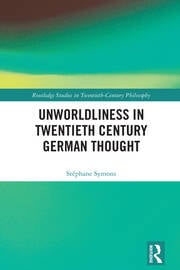
245 10|aUnworldliness in twentieth century German thought /|cStéphane Symons.
264 1|aNew York :|bRoutledge, Taylor & Francis Group,|c2025.
300 |a1 online resource (141 pages).
336 |atext|btxt|2rdacontent
337 |acomputer|bc|2rdamedia
338 |aonline resource|bcr|2rdacarrier
490 1 |aRoutledge studies in twentieth-century philosophy
520 |a"What happens when the world around us feels fragmented? How can a person continue to respond positively to their environment when it seems to have lost its internal coherence? These questions lie at the heart of this innovative interpretation of some of the most influential German philosophers of the twentieth century. The key figures in this study are the young Georg Lukács (1885-1971), Ernst Jünger (1895-1998), Ernst Bloch (1885-1977), Theodor Adorno (1903-1969), Max Kommerell (1902-1944), and Siegfried Kracauer (1889-1966). By establishing an intellectual dialogue among these otherwise diverse thinkers, this study identifies a common interest: the question whether an unworldly, fragmented universe can nonetheless elicit a creative response from individuals. Together, these authors offer an alternative to what is considered the dominant trend in twentieth-century German philosophy: the phenomenological emphasis on humans' lived interactions with a shared and unified lifeworld. Special attention is given to six distinct interpretations of Miguel de Cervantes's novel Don Quixote and the unworldly actions of its main character. Unworldliness in Twentieth Century German Thought will appeal to researchers and advanced students interested in twentieth century continental philosophy, German intellectual history, critical theory and literature and philosophy"--|cProvided by publisher.
588 |aOCLC-licensed vendor bibliographic record.
650 0|aPhilosophy, German|y20th century.
830 0|aRoutledge studies in twentieth century philosophy.
856 40|3Taylor & Francis|uhttps://www.taylorfrancis.com/books/9781003364009
856 42|3OCLC metadata license agreement|uhttp://www.oclc.org/content/dam/oclc/forms/terms/vbrl-201703.pdf
901 |aTaylor & Francis