LEADER 03802cam a22005658i 4500
001 803742
003 TR_AnAIT
005 20260124000055
006 m o d
007 cr |||||||||||
008 240612s2025 nyu ob 001 0 eng
020 |a9781003425472|q(ebook)
020 |a100342547X
020 |a9781040144954|q(electronic bk. : EPUB)
020 |a1040144950|q(electronic bk. : EPUB)
020 |a9781040144923|q(electronic bk. : PDF)
020 |a1040144926|q(electronic bk. : PDF)
020 |z9781032545653|q(hardback)
020 |z9781032545677|q(paperback)
024 7 |a10.4324/9781003425472|2doi
035 |a(OCoLC)1445425678
035 |a(OCoLC-P)1445425678
040 |aOCoLC-P|beng|erda|cOCoLC-P
041 |aeng
049 |aTürk Tarih Kurumu Kütüphanesi
050 00|aB1878.M55
072 7|aPHI|x016000|2bisacsh
072 7|aPHI|x015000|2bisacsh
072 7|aHP|2bicssc
082 00|a194|223/eng/20240702
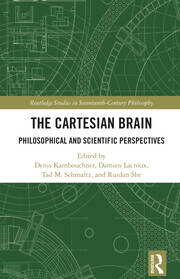
245 04|aThe Cartesian brain :|bphilosophical and scientific perspectives /|cedited by Denis Kambouchner, Damien Lacroux, Tad M. Schmaltz, and Ruidan She.
250 |a1.
264 1|aNew York, NY :|bRoutledge,|c2025.
300 |a1 online resource.
336 |atext|btxt|2rdacontent
337 |acomputer|bc|2rdamedia
338 |aonline resource|bcr|2rdacarrier
490 0 |aRoutledge studies in seventeenth-century philosophy
520 |a"This volume presents new research on Cartesian psychophysiology that combines historical and textual analysis with a consideration of recent advances in contemporary neuroscience research. It seeks to explain why the theory of the Cartesian brain and its communication with the mind still offers a remarkable model for cognitive studies. New research in the philosophy of mind and cognitive science has reignited interest in the role and the structure of the "Cartesian brain" among scholars of Descartes. This volume rethinks Cartesian psychology from the perspective of physiology, with the aim of redetermining the contributions of the brain and central nervous system to mental phenomena. The first part of the volume concerns the details of Descartes's own physiological account of the brain. The discussion covers his treatment not only of the anatomy of the brain, but also of the mode of interaction between mind and body, in which the pineal gland plays a central role, and of the relation between the brain and the rest of the body. The second part considers the reception and legacy of the Cartesian brain. The focus here is on understanding how Cartesian psychophysiology was received by Descartes's early modern contemporaries and immediate successors, as well as on the relevance of the Cartesian brain for contemporary neurophysiology and cognitive science. The Cartesian Brain is an essential resource for scholars and advanced students interested in Descartes, history of philosophy, history of science, philosophy of mind, and cognitive science"--|cProvided by publisher.
588 |aOCLC-licensed vendor bibliographic record.
600 10|aDescartes, René,|d1596-1650.
650 0|aPhilosophy of mind.
650 0|aPsychophysiology.
650 0|aPhilosophy and cognitive science.
650 7|aPHILOSOPHY / History & Surveys / Modern|2bisacsh
650 7|aPHILOSOPHY / Mind & Body|2bisacsh
700 1 |aKambouchner, Denis,|eeditor.|1https://id.oclc.org/worldcat/entity/E39PBJyGWttBkTm4pm8f7yHwG3
700 1 |aLacroux, Damien,|eeditor.
700 1 |aSchmaltz, Tad M.,|d1960-|eeditor.|1https://id.oclc.org/worldcat/entity/E39PBJmtypBR7dwrjyCqX6kVYP
700 1 |aShe, Ruidan,|eeditor.
856 40|3Taylor & Francis|uhttps://www.taylorfrancis.com/books/9781003425472
856 42|3OCLC metadata license agreement|uhttp://www.oclc.org/content/dam/oclc/forms/terms/vbrl-201703.pdf
901 |aTaylor & Francis