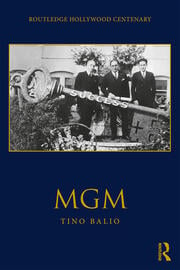
MGM.
Erişim Adresi
ISBN
9781315691299 (e-book : PDF)
9781317429661 (e-book: Mobi)
9781317429678 (e-book: ePub)
9781138913646 (hardback)
9781138913660 (paperback)
9781317429661 (e-book: Mobi)
9781317429678 (e-book: ePub)
9781138913646 (hardback)
9781138913660 (paperback)
Dil Kodu
İngilizce
Yazar
Basım Bildirimi
First edition.
Yayın Bilgisi
London : Taylor and Francis, 2018.
Fiziksel Niteleme
1 online resource.
Dizi
The Routledge Hollywood Centenary Series
İçindekiler Notu
chapter Introduction / Tino Balio -- chapter 1 Marcus Loew and the Founding of Metro-Goldwyn-Mayer (1905–24) / Tino Balio -- chapter 2 Building a Prestige Studio (1924–28) / Tino Balio -- chapter 3 MGM According to Irving Thalberg (1929–32) / Tino Balio -- chapter 4 Louis B. Mayer Reorganizes (1933–39) / Tino Balio -- chapter 5 MGM at the Home Front (1940–46) / Tino Balio -- chapter 6 Dore Schary -- ‘A new Thalberg’ (1947–58) / Tino Balio -- chapter 7 Adjusting to the Sixties (1959–69) / Tino Balio -- chapter 8 Kirk Kerkorian and the Buying and Selling of MGM, Part 1 (1969–85) / Tino Balio -- chapter 9 Kirk Kerkorian and the Buying and Selling of MGM, Part 2 (1985–2004) / Tino Balio -- chapter 10 MGM Holdings -- The coda (2004–15) / Tino Balio.
Özet, vb.
This is the first comprehensive history of MGM from its origins in 1905 to the present. Following a straightforward chronology corresponding to specific periods of film industry history, each chapter describes how successive managements adjusted their production strategies and business practices in response to evolving industrial and market conditions. As the production subsidiary of the Loew’s Incorporated theatre chain, MGM spent lavishly on its pictures and injected them with plenty of star power. The practice helped sustain MGM’s preeminent position during the heyday of Hollywood. But MGM was a conservative company and watched as other studios innovated with sound and widescreen, adjusted to television, and welcomed independent producers. By the 1960s, the company, sans its theatre chain, was in decline and was ripe for a takeover. A defining moment occurred in 1969, when Kirk Kerkorian, a Las Vegas entrepreneur, made a successful bid for the company. There followed a tumultuous thirty-six-year period when Kerkorian bought and sold MGM three times. Meanwhile, MGM never regained its former status and has functioned as a second-tier company to this day. Focusing on MGM’s top talent – such as Louis B. Mayer, Irving Thalberg, David O. Selznick, and Arthur Freed; directors King Vidor and Vincente Minnelli; and stars of the screen Greta Garbo, Judy Garland, Clark Gable, and Mickey Rooney – and award-winning films, this book highlights the studio’s artistic achievements and status within the industry.
Konu
Motion picture studios __ California __ Los Angeles __ History.
Motion picture studios.
Film History
Hollywood
Media Industries
Motion picture studios.
Film History
Hollywood
Media Industries
Veritabanı

Eseri Alıntıla
Referansları kullanmadan önce gözden geçirmeniz ve varsa gerekli düzeltmeleri yapmanız önerilir.
Dijital Kaynak
MARC Görünümü
LEADER 03509cam a2200361Ii 4500
001 803877
003 TR_AnAIT
005 20260124000326
008 180706s2018 xx ob 001 0 eng d
020 |a9781315691299|q(e-book : PDF)
020 |a9781317429661|q(e-book: Mobi)
020 |a9781317429678|q(e-book: ePub)
020 |z9781138913646|q(hardback)
020 |z9781138913660|q(paperback)
024 7 |a10.4324/9781315691299 |2doi
035 |a(OCoLC)1020563288
040 |aFlBoTFG|cFlBoTFG|erda
041 |aeng
049 |aTürk Tarih Kurumu Kütüphanesi
100 1 |aBalio, Tino,|eauthor.
245 10|aMGM.
250 |aFirst edition.
264 1|aLondon :|bTaylor and Francis,|c2018.
300 |a1 online resource.
336 |atext|2rdacontent
337 |acomputer|2rdamedia
338 |aonline resource|2rdacarrier
490 0 |aThe Routledge Hollywood Centenary Series
505 0 |tchapter Introduction /|rTino Balio -- |tchapter 1 Marcus Loew and the Founding of Metro-Goldwyn-Mayer (1905–24) /|rTino Balio -- |tchapter 2 Building a Prestige Studio (1924–28) /|rTino Balio -- |tchapter 3 MGM According to Irving Thalberg (1929–32) /|rTino Balio -- |tchapter 4 Louis B. Mayer Reorganizes (1933–39) /|rTino Balio -- |tchapter 5 MGM at the Home Front (1940–46) /|rTino Balio -- |tchapter 6 Dore Schary -- |t‘A new Thalberg’ (1947–58) /|rTino Balio -- |tchapter 7 Adjusting to the Sixties (1959–69) /|rTino Balio -- |tchapter 8 Kirk Kerkorian and the Buying and Selling of MGM, Part 1 (1969–85) /|rTino Balio -- |tchapter 9 Kirk Kerkorian and the Buying and Selling of MGM, Part 2 (1985–2004) /|rTino Balio -- |tchapter 10 MGM Holdings -- |tThe coda (2004–15) /|rTino Balio.
520 2 |aThis is the first comprehensive history of MGM from its origins in 1905 to the present. Following a straightforward chronology corresponding to specific periods of film industry history, each chapter describes how successive managements adjusted their production strategies and business practices in response to evolving industrial and market conditions. As the production subsidiary of the Loew’s Incorporated theatre chain, MGM spent lavishly on its pictures and injected them with plenty of star power. The practice helped sustain MGM’s preeminent position during the heyday of Hollywood. But MGM was a conservative company and watched as other studios innovated with sound and widescreen, adjusted to television, and welcomed independent producers. By the 1960s, the company, sans its theatre chain, was in decline and was ripe for a takeover. A defining moment occurred in 1969, when Kirk Kerkorian, a Las Vegas entrepreneur, made a successful bid for the company. There followed a tumultuous thirty-six-year period when Kerkorian bought and sold MGM three times. Meanwhile, MGM never regained its former status and has functioned as a second-tier company to this day. Focusing on MGM’s top talent – such as Louis B. Mayer, Irving Thalberg, David O. Selznick, and Arthur Freed; directors King Vidor and Vincente Minnelli; and stars of the screen Greta Garbo, Judy Garland, Clark Gable, and Mickey Rooney – and award-winning films, this book highlights the studio’s artistic achievements and status within the industry.
650 0|aMotion picture studios|zCalifornia|zLos Angeles|xHistory.
650 0|aMotion picture studios.
650 04|aFilm History
650 04|aHollywood
650 04|aMedia Industries
776 08|iPrint version: |z9781138913646
856 40|uhttps://www.taylorfrancis.com/books/9781315691299|zClick here to view.
901 |aTaylor & Francis
001 803877
003 TR_AnAIT
005 20260124000326
008 180706s2018 xx ob 001 0 eng d
020 |a9781315691299|q(e-book : PDF)
020 |a9781317429661|q(e-book: Mobi)
020 |a9781317429678|q(e-book: ePub)
020 |z9781138913646|q(hardback)
020 |z9781138913660|q(paperback)
024 7 |a10.4324/9781315691299 |2doi
035 |a(OCoLC)1020563288
040 |aFlBoTFG|cFlBoTFG|erda
041 |aeng
049 |aTürk Tarih Kurumu Kütüphanesi
100 1 |aBalio, Tino,|eauthor.
245 10|aMGM.
250 |aFirst edition.
264 1|aLondon :|bTaylor and Francis,|c2018.
300 |a1 online resource.
336 |atext|2rdacontent
337 |acomputer|2rdamedia
338 |aonline resource|2rdacarrier
490 0 |aThe Routledge Hollywood Centenary Series
505 0 |tchapter Introduction /|rTino Balio -- |tchapter 1 Marcus Loew and the Founding of Metro-Goldwyn-Mayer (1905–24) /|rTino Balio -- |tchapter 2 Building a Prestige Studio (1924–28) /|rTino Balio -- |tchapter 3 MGM According to Irving Thalberg (1929–32) /|rTino Balio -- |tchapter 4 Louis B. Mayer Reorganizes (1933–39) /|rTino Balio -- |tchapter 5 MGM at the Home Front (1940–46) /|rTino Balio -- |tchapter 6 Dore Schary -- |t‘A new Thalberg’ (1947–58) /|rTino Balio -- |tchapter 7 Adjusting to the Sixties (1959–69) /|rTino Balio -- |tchapter 8 Kirk Kerkorian and the Buying and Selling of MGM, Part 1 (1969–85) /|rTino Balio -- |tchapter 9 Kirk Kerkorian and the Buying and Selling of MGM, Part 2 (1985–2004) /|rTino Balio -- |tchapter 10 MGM Holdings -- |tThe coda (2004–15) /|rTino Balio.
520 2 |aThis is the first comprehensive history of MGM from its origins in 1905 to the present. Following a straightforward chronology corresponding to specific periods of film industry history, each chapter describes how successive managements adjusted their production strategies and business practices in response to evolving industrial and market conditions. As the production subsidiary of the Loew’s Incorporated theatre chain, MGM spent lavishly on its pictures and injected them with plenty of star power. The practice helped sustain MGM’s preeminent position during the heyday of Hollywood. But MGM was a conservative company and watched as other studios innovated with sound and widescreen, adjusted to television, and welcomed independent producers. By the 1960s, the company, sans its theatre chain, was in decline and was ripe for a takeover. A defining moment occurred in 1969, when Kirk Kerkorian, a Las Vegas entrepreneur, made a successful bid for the company. There followed a tumultuous thirty-six-year period when Kerkorian bought and sold MGM three times. Meanwhile, MGM never regained its former status and has functioned as a second-tier company to this day. Focusing on MGM’s top talent – such as Louis B. Mayer, Irving Thalberg, David O. Selznick, and Arthur Freed; directors King Vidor and Vincente Minnelli; and stars of the screen Greta Garbo, Judy Garland, Clark Gable, and Mickey Rooney – and award-winning films, this book highlights the studio’s artistic achievements and status within the industry.
650 0|aMotion picture studios|zCalifornia|zLos Angeles|xHistory.
650 0|aMotion picture studios.
650 04|aFilm History
650 04|aHollywood
650 04|aMedia Industries
776 08|iPrint version: |z9781138913646
856 40|uhttps://www.taylorfrancis.com/books/9781315691299|zClick here to view.
901 |aTaylor & Francis
Materyaller
Depodan talep edilen materyal sadece kütüphane içerisinde kullanılmaktadır.
Materyal dışarıya ödünç verilmemektedir.
