LEADER 03300cam a2200337Ii 4500
001 803926
003 TR_AnAIT
005 20260124000415
008 180706s2017 enka o 000 0 eng d
020 |a9781315121215|q(e-book : PDF)
020 |a9781351356084|q(e-book: Mobi)
020 |z9781138202498|q(hardback)
024 7 |a10.4324/9781315121215 |2doi
035 |a(OCoLC)1002202373
040 |aFlBoTFG|cFlBoTFG|erda
041 |aeng
043 |aa-ii---|aa-bg---
049 |aTürk Tarih Kurumu Kütüphanesi
050 4|aNB1912.S56|bK85 2017
082 04|a730.95484|bK963
100 1 |aKulshreshtha, Salila,|eauthor.
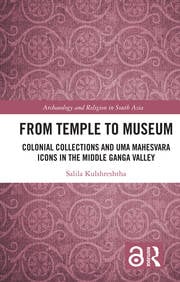
245 10|aFrom temple to museum :|bcolonial collections and Umā Maheśvar icons in the Middle Ganga Valley /|cSalila Kulshreshtha.
264 1|aLondon :|bRoutledge,|c2017.
300 |a1 online resource (320 pages)
336 |atext|2rdacontent
337 |acomputer|2rdamedia
338 |aonline resource|2rdacarrier
490 0 |aArchaeology and Religion in South Asia
505 0 |achapter Introduction -- part PART I The making of museum collections -- chapter 1 Creating identities -- chapter 2 Making of museums -- part PART II The icon in context -- chapter 3 Sacred sites -- chapter 4 The Uma Mahesvaramurti -- chapter 5 Shifting centres.
520 |a"Religious icons have been a contested terrain across the world. Their implications and understanding travel further than the artistic or the aesthetic and inform contemporary preoccupations.This book traces the lives of religious sculptures beyond the moment of their creation. It lays bare their purpose and evolution by contextualising them in their original architectural or ritual setting while also following their displacement. The work examines how these images may have moved during different spates of temple renovation and acquired new identities by being relocated either within sacred precincts or in private collections and museums, art markets or even desecrated and lost.The book highlights contentious issues in Indian archaeology such as renegotiating identities of religious images, reuse and sharing of sacred space by adherents of different faiths, rebuilding of temples and consequent reinvention of these sites. The author also engages with postcolonial debates surrounding history writing and knowledge creation in British India and how colonial archaeology, archival practices, official surveys and institutionalisation of museums has influenced the current understanding of religion, sacred space and religious icons. In doing so it bridges the historiographical divide between the ancient and the modern as well as socio-religious practices and their institutional memory and preservation. Drawn from a wide-ranging and interdisciplinary study of religious sculptures, classical texts, colonial archival records, British travelogues, official correspondences and fieldwork, the book will interest scholars and researchers of history, archaeology, religion, art history, museums studies, South Asian studies and Buddhist studies. "--Provided by publisher.
650 0|aSåitåa (Hindu deity)|xArt|xHistory.
650 0|aUma (Hindu deity)|xArt|xHistory.
650 0|aHindu sculpture|zGanges River Valley (India and Bangladesh)|xHistory.
776 08|iPrint version: |z9781138202498
856 40|uhttps://www.taylorfrancis.com/books/9781315121215|zClick here to view.
901 |aTaylor & Francis