

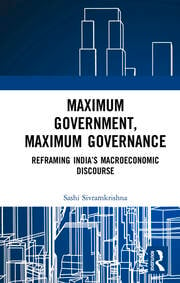
Maximum government, maximum governance : reframing India's macroeconomic discourse / Sashi Sivramkrishna.
ISBN
9780429261817 (electronic bk.)
0429261810 (electronic bk.)
9780429523939 (electronic bk.)
0429523939 (electronic bk.)
9780429552106 (electronic bk. : Mobipocket)
0429552106 (electronic bk. : Mobipocket)
9780429537400 (electronic bk. : EPUB)
0429537409 (electronic bk. : EPUB)
0367204908
9780367204907
0429261810 (electronic bk.)
9780429523939 (electronic bk.)
0429523939 (electronic bk.)
9780429552106 (electronic bk. : Mobipocket)
0429552106 (electronic bk. : Mobipocket)
9780429537400 (electronic bk. : EPUB)
0429537409 (electronic bk. : EPUB)
0367204908
9780367204907
Dil Kodu
İngilizce
Yazar
Yayın Bilgisi
London : Routledge, Taylor & Francis Group, [2019]
©2019
©2019
Fiziksel Niteleme
1 online resource (1 volume) : illustrations (black and white).
İçindekiler Notu
Cover; Half Title; Title; Copyright; Contents; List of Figures; Preface; Acknowledgements; Introduction; PART I: MAINSTREAM MACROECONOMIC DISCOURSE; 1. Economics and Macroeconomics; 2. The Classical and Keynesian Macroeconomic Paradigms; 3. The Neo-Keynesian Paradigm; 4. Monetarism and the Decline of Neo Keynesianism; 5. The 'New' Macroeconomics; 6. From Stabilization to Growth and Development; 7. A Summary of Neoliberal Macroeconomics; PART II: POPULAR MACROECONOMICS DISCOURSE IN INDIA; 8. Putting India's Current Macroeconomic Policies in Perspective; 9. India's Neoliberal Policy Framework
PART III: MODERN MONEY THEORY (MMT)10. Modern Money and Economic Sovereignty; 11. Fiscal Deficits in a Modern Money Economy; 12. The Hierarchy of Money; 13. Banking and Endogenous Money Theory; 14. Monetary Policy in the MMT Framework; 15. The Sectoral Financial Balances (SFB) Model; 16. A Summary of Insights from MMT; PART IV: REFRAMING INDIA'S MACROECONOMIC DISCOURSE; 17. Maximum Government, Maximum Governance; Bibliography; Index
PART III: MODERN MONEY THEORY (MMT)10. Modern Money and Economic Sovereignty; 11. Fiscal Deficits in a Modern Money Economy; 12. The Hierarchy of Money; 13. Banking and Endogenous Money Theory; 14. Monetary Policy in the MMT Framework; 15. The Sectoral Financial Balances (SFB) Model; 16. A Summary of Insights from MMT; PART IV: REFRAMING INDIA'S MACROECONOMIC DISCOURSE; 17. Maximum Government, Maximum Governance; Bibliography; Index
Özet, vb.
Austerity, fiscal consolidation, fiscal discipline and fiscal deficit targets have become the buzzwords of contemporary macroeconomic policy. By tracing the history of macroeconomic schools of thought, Maximum Government, Maximum Governance explores the origins, essence, shortcomings and deception of mainstream neoliberal macroeconomics. Arguing that economies are financially constrained, neoliberal macroeconomics dislodged full employment as the target of policy replacing it with a low and stable inflation target. Monetary policy under the control of an independent central bank became the primary instrument to assist free and globalized markets to propel economies towards full employment. However, the global financial crisis of 2008 and rising inequalities of income and wealth in the last decade within and across economies has led to rise of nationalist-populist leaders in many parts of the world. Although neoliberal economics has been put under the scanner by these leaders, their actions seem reactionary and without a coherent understanding of alternative schools of economic thought. An alternative based on sound economic reasoning and institutional realities is required to challenge neoliberal and arbitrary populist policies. Based on an introductory analysis of Modern Money Theory (MMT), this book seeks to present an alternative viewpoint on macroeconomics and macroeconomic policy to address the challenges of economic growth, unemployment and inequality. While adherents of MMT are convinced of its robustness, the challenge is to reframe macroeconomic discourse, which must essentially reject the notion that an economy is financially constrained and instead turn the spotlight on real resource and governance constraints. Please note: Taylor & Francis does not sell or distribute the Hardback in India, Pakistan, Nepal, Bhutan, Bangladesh and Sri Lanka
Konu
Macroeconomics.
BUSINESS & ECONOMICS / Industries / General __ bisacsh
BUSINESS & ECONOMICS / Economics / Macroeconomics __ bisacsh
SOCIAL SCIENCE / Ethnic Studies / General __ bisacsh
India __ Economic policy.
BUSINESS & ECONOMICS / Industries / General __ bisacsh
BUSINESS & ECONOMICS / Economics / Macroeconomics __ bisacsh
SOCIAL SCIENCE / Ethnic Studies / General __ bisacsh
India __ Economic policy.
Veritabanı
Eseri Alıntıla
Referansları kullanmadan önce gözden geçirmeniz ve varsa gerekli düzeltmeleri yapmanız önerilir.
Dijital Kaynak
MARC Görünümü
LEADER 04981cam a2200553Ki 4500
001 804069
003 TR_AnAIT
005 20260124000645
006 m o d
007 cr cnu---unuuu
008 190211s2019 enk ob 001 0 eng d
020 |a9780429261817|q(electronic bk.)
020 |a0429261810|q(electronic bk.)
020 |a9780429523939|q(electronic bk.)
020 |a0429523939|q(electronic bk.)
020 |a9780429552106|q(electronic bk. : Mobipocket)
020 |a0429552106|q(electronic bk. : Mobipocket)
020 |a9780429537400|q(electronic bk. : EPUB)
020 |a0429537409|q(electronic bk. : EPUB)
020 |z0367204908
020 |z9780367204907
035 |a(OCoLC)1085348990|z(OCoLC)1085585549
035 |a(OCoLC-P)1085348990
040 |aOCoLC-P|beng|erda|epn|cOCoLC-P
041 |aeng
049 |aTürk Tarih Kurumu Kütüphanesi
050 4|aHC435
072 7|aBUS|x070000|2bisacsh
072 7|aBUS|x039000|2bisacsh
072 7|aSOC|x008000|2bisacsh
072 7|aKCBM|2bicssc
082 04|a338.954|223
100 1 |aSivramkrishna, Sashi,|eauthor.
245 10|aMaximum government, maximum governance :|breframing India's macroeconomic discourse /|cSashi Sivramkrishna.
264 1|aLondon :|bRoutledge, Taylor & Francis Group,|c[2019]
264 4|c©2019
300 |a1 online resource (1 volume) :|billustrations (black and white).
336 |atext|btxt|2rdacontent
337 |acomputer|bc|2rdamedia
338 |aonline resource|bcr|2rdacarrier
505 0 |aCover; Half Title; Title; Copyright; Contents; List of Figures; Preface; Acknowledgements; Introduction; PART I: MAINSTREAM MACROECONOMIC DISCOURSE; 1. Economics and Macroeconomics; 2. The Classical and Keynesian Macroeconomic Paradigms; 3. The Neo-Keynesian Paradigm; 4. Monetarism and the Decline of Neo Keynesianism; 5. The 'New' Macroeconomics; 6. From Stabilization to Growth and Development; 7. A Summary of Neoliberal Macroeconomics; PART II: POPULAR MACROECONOMICS DISCOURSE IN INDIA; 8. Putting India's Current Macroeconomic Policies in Perspective; 9. India's Neoliberal Policy Framework
505 8 |aPART III: MODERN MONEY THEORY (MMT)10. Modern Money and Economic Sovereignty; 11. Fiscal Deficits in a Modern Money Economy; 12. The Hierarchy of Money; 13. Banking and Endogenous Money Theory; 14. Monetary Policy in the MMT Framework; 15. The Sectoral Financial Balances (SFB) Model; 16. A Summary of Insights from MMT; PART IV: REFRAMING INDIA'S MACROECONOMIC DISCOURSE; 17. Maximum Government, Maximum Governance; Bibliography; Index
520 |aAusterity, fiscal consolidation, fiscal discipline and fiscal deficit targets have become the buzzwords of contemporary macroeconomic policy. By tracing the history of macroeconomic schools of thought, Maximum Government, Maximum Governance explores the origins, essence, shortcomings and deception of mainstream neoliberal macroeconomics. Arguing that economies are financially constrained, neoliberal macroeconomics dislodged full employment as the target of policy replacing it with a low and stable inflation target. Monetary policy under the control of an independent central bank became the primary instrument to assist free and globalized markets to propel economies towards full employment. However, the global financial crisis of 2008 and rising inequalities of income and wealth in the last decade within and across economies has led to rise of nationalist-populist leaders in many parts of the world. Although neoliberal economics has been put under the scanner by these leaders, their actions seem reactionary and without a coherent understanding of alternative schools of economic thought. An alternative based on sound economic reasoning and institutional realities is required to challenge neoliberal and arbitrary populist policies. Based on an introductory analysis of Modern Money Theory (MMT), this book seeks to present an alternative viewpoint on macroeconomics and macroeconomic policy to address the challenges of economic growth, unemployment and inequality. While adherents of MMT are convinced of its robustness, the challenge is to reframe macroeconomic discourse, which must essentially reject the notion that an economy is financially constrained and instead turn the spotlight on real resource and governance constraints. Please note: Taylor & Francis does not sell or distribute the Hardback in India, Pakistan, Nepal, Bhutan, Bangladesh and Sri Lanka
588 |aOCLC-licensed vendor bibliographic record.
650 0|aMacroeconomics.
650 7|aBUSINESS & ECONOMICS / Industries / General|2bisacsh
650 7|aBUSINESS & ECONOMICS / Economics / Macroeconomics|2bisacsh
650 7|aSOCIAL SCIENCE / Ethnic Studies / General|2bisacsh
651 0|aIndia|xEconomic policy.
856 40|3Taylor & Francis|uhttps://www.taylorfrancis.com/books/9780429261817
856 42|3OCLC metadata license agreement|uhttp://www.oclc.org/content/dam/oclc/forms/terms/vbrl-201703.pdf
901 |aTaylor & Francis
001 804069
003 TR_AnAIT
005 20260124000645
006 m o d
007 cr cnu---unuuu
008 190211s2019 enk ob 001 0 eng d
020 |a9780429261817|q(electronic bk.)
020 |a0429261810|q(electronic bk.)
020 |a9780429523939|q(electronic bk.)
020 |a0429523939|q(electronic bk.)
020 |a9780429552106|q(electronic bk. : Mobipocket)
020 |a0429552106|q(electronic bk. : Mobipocket)
020 |a9780429537400|q(electronic bk. : EPUB)
020 |a0429537409|q(electronic bk. : EPUB)
020 |z0367204908
020 |z9780367204907
035 |a(OCoLC)1085348990|z(OCoLC)1085585549
035 |a(OCoLC-P)1085348990
040 |aOCoLC-P|beng|erda|epn|cOCoLC-P
041 |aeng
049 |aTürk Tarih Kurumu Kütüphanesi
050 4|aHC435
072 7|aBUS|x070000|2bisacsh
072 7|aBUS|x039000|2bisacsh
072 7|aSOC|x008000|2bisacsh
072 7|aKCBM|2bicssc
082 04|a338.954|223
100 1 |aSivramkrishna, Sashi,|eauthor.
245 10|aMaximum government, maximum governance :|breframing India's macroeconomic discourse /|cSashi Sivramkrishna.
264 1|aLondon :|bRoutledge, Taylor & Francis Group,|c[2019]
264 4|c©2019
300 |a1 online resource (1 volume) :|billustrations (black and white).
336 |atext|btxt|2rdacontent
337 |acomputer|bc|2rdamedia
338 |aonline resource|bcr|2rdacarrier
505 0 |aCover; Half Title; Title; Copyright; Contents; List of Figures; Preface; Acknowledgements; Introduction; PART I: MAINSTREAM MACROECONOMIC DISCOURSE; 1. Economics and Macroeconomics; 2. The Classical and Keynesian Macroeconomic Paradigms; 3. The Neo-Keynesian Paradigm; 4. Monetarism and the Decline of Neo Keynesianism; 5. The 'New' Macroeconomics; 6. From Stabilization to Growth and Development; 7. A Summary of Neoliberal Macroeconomics; PART II: POPULAR MACROECONOMICS DISCOURSE IN INDIA; 8. Putting India's Current Macroeconomic Policies in Perspective; 9. India's Neoliberal Policy Framework
505 8 |aPART III: MODERN MONEY THEORY (MMT)10. Modern Money and Economic Sovereignty; 11. Fiscal Deficits in a Modern Money Economy; 12. The Hierarchy of Money; 13. Banking and Endogenous Money Theory; 14. Monetary Policy in the MMT Framework; 15. The Sectoral Financial Balances (SFB) Model; 16. A Summary of Insights from MMT; PART IV: REFRAMING INDIA'S MACROECONOMIC DISCOURSE; 17. Maximum Government, Maximum Governance; Bibliography; Index
520 |aAusterity, fiscal consolidation, fiscal discipline and fiscal deficit targets have become the buzzwords of contemporary macroeconomic policy. By tracing the history of macroeconomic schools of thought, Maximum Government, Maximum Governance explores the origins, essence, shortcomings and deception of mainstream neoliberal macroeconomics. Arguing that economies are financially constrained, neoliberal macroeconomics dislodged full employment as the target of policy replacing it with a low and stable inflation target. Monetary policy under the control of an independent central bank became the primary instrument to assist free and globalized markets to propel economies towards full employment. However, the global financial crisis of 2008 and rising inequalities of income and wealth in the last decade within and across economies has led to rise of nationalist-populist leaders in many parts of the world. Although neoliberal economics has been put under the scanner by these leaders, their actions seem reactionary and without a coherent understanding of alternative schools of economic thought. An alternative based on sound economic reasoning and institutional realities is required to challenge neoliberal and arbitrary populist policies. Based on an introductory analysis of Modern Money Theory (MMT), this book seeks to present an alternative viewpoint on macroeconomics and macroeconomic policy to address the challenges of economic growth, unemployment and inequality. While adherents of MMT are convinced of its robustness, the challenge is to reframe macroeconomic discourse, which must essentially reject the notion that an economy is financially constrained and instead turn the spotlight on real resource and governance constraints. Please note: Taylor & Francis does not sell or distribute the Hardback in India, Pakistan, Nepal, Bhutan, Bangladesh and Sri Lanka
588 |aOCLC-licensed vendor bibliographic record.
650 0|aMacroeconomics.
650 7|aBUSINESS & ECONOMICS / Industries / General|2bisacsh
650 7|aBUSINESS & ECONOMICS / Economics / Macroeconomics|2bisacsh
650 7|aSOCIAL SCIENCE / Ethnic Studies / General|2bisacsh
651 0|aIndia|xEconomic policy.
856 40|3Taylor & Francis|uhttps://www.taylorfrancis.com/books/9780429261817
856 42|3OCLC metadata license agreement|uhttp://www.oclc.org/content/dam/oclc/forms/terms/vbrl-201703.pdf
901 |aTaylor & Francis
Materyaller
Depodan talep edilen materyal sadece kütüphane içerisinde kullanılmaktadır.
Materyal dışarıya ödünç verilmemektedir.
Materyal dışarıya ödünç verilmemektedir.
