

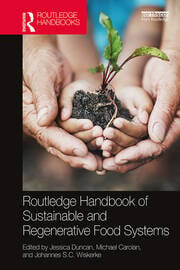
Routledge handbook of sustainable and regenerative food systems / edited by Jessica Duncan, Michael Carolan, and Johannes S.C. Wiskerke.
ISBN
9780429882791 electronic book
0429882793 electronic book
9780429466823 electronic book
042946682X electronic book
9780429882777 (electronic bk. : Mobipocket)
0429882777 (electronic bk. : Mobipocket)
9780429882784 (electronic bk. : EPUB)
0429882785 (electronic bk. : EPUB)
9781138608047 hardcover
0429882793 electronic book
9780429466823 electronic book
042946682X electronic book
9780429882777 (electronic bk. : Mobipocket)
0429882777 (electronic bk. : Mobipocket)
9780429882784 (electronic bk. : EPUB)
0429882785 (electronic bk. : EPUB)
9781138608047 hardcover
Dil Kodu
İngilizce
Yayın Bilgisi
Abingdon, Oxon ; New York, NY : Routledge, 2021.
©2021
©2021
Fiziksel Niteleme
1 online resource (xvi, 461 pages) : illustrations
Özet, vb.
"This Handbook includes contributions from established and emerging scholars from around the world and draws on multiple approaches and subjects to explore the socio-economic, cultural, ecological, institutional, legal and policy aspects of regenerative food practices. The future of food is uncertain. We are facing an overwhelming number of interconnected and complex challenges related to the ways we grow, distribute, access, eat, and dispose of food. Yet, there are stories of hope and opportunities for radical transition towards food systems that enhance the ability of living things to co-evolve. Given this, activities and imaginaries looking to improve, rather than just sustain, communities and ecosystems are needed, as are fresh perspectives and new terminology. The Routledge Handbook of Sustainable and Regenerative Food Systems addresses this need. The chapters cover diverse practices, geographies, scales and entry-points. They focus not only on the core requirements to deliver sustainable agriculture and food supply, but go beyond this to think about how these can also actively participate with social-ecological systems. The book is presented in an accessible way, with reflection questions meant to spark discussion and debate on how to transition to safe, just and healthy food systems. Taken together, the chapters in this Handbook highlight the consequences of current food practices and showcase the multiple ways that people are doing food differently. The Routledge Handbook of Sustainable and Regenerative Food Systems is essential reading for students and scholars interested in food systems, governance and practices, agroecology, rural sociology and socio-environmental studies"-- Provided by publisher.
Konu
Food security.
Food supply.
Sustainable agriculture.
SOCIAL SCIENCE / Sociology / Rural __ bisacsh
Food supply.
Sustainable agriculture.
SOCIAL SCIENCE / Sociology / Rural __ bisacsh
Diğer Yazarlar
Veritabanı
