

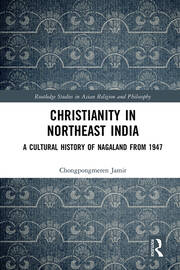
Christianity in Northeast India : a cultural history of Nagaland from 1947 / Chongpongmeren Jamir.
ISBN
9781003030904 (electronic bk.)
1003030904 (electronic bk.)
9781000057362 (electronic bk. : Mobipocket)
1000057364 (electronic bk. : Mobipocket)
9781000057386 (electronic bk. : EPUB)
1000057380 (electronic bk. : EPUB)
9781000057348 (electronic bk. : PDF)
1000057348 (electronic bk. : PDF)
9780367465629
0367465620
1003030904 (electronic bk.)
9781000057362 (electronic bk. : Mobipocket)
1000057364 (electronic bk. : Mobipocket)
9781000057386 (electronic bk. : EPUB)
1000057380 (electronic bk. : EPUB)
9781000057348 (electronic bk. : PDF)
1000057348 (electronic bk. : PDF)
9780367465629
0367465620
Dil Kodu
İngilizce
Yazar
Tekbiçim Eser Adı
Segmentation, unity, and a church divided
Yayın Bilgisi
Abingdon, Oxon ; New York, NY : Routledge, 2020.
Fiziksel Niteleme
1 online resource.
Dizi
Routledge studies in Asian religion and philosophy
Genel Not
Revision of the author's thesis (doctoral)--Middlesex University/Oxford Centre for Mission Studies, 2019, under the title: Segmentation, unity, and a church divided : a critical history of churches in Nagaland, 1947-2017.
Özet, vb.
"This book examines the distinctive formation of Christianity in Nagaland, Northeast India, since 1947. It argues that an understanding of the history of Christianity in the region can be found in its cultural milieu and the changing political, social and religious environment. In Nagaland, almost ninety per cent of the population are Christians. This book shows that segmentation as a cultural characteristic of the Naga society inspired both unity and divisiveness in the Naga churches, which subsequently shaped the beliefs and practices of the churches in the region. Using the methodology of cultural history, the author examines ecclesiastical events and suggests that the history of Christianity should be examined in the light of its interaction with its cultural context rather than as an isolated phenomenon. The book demonstrates that the ethnic status which the Christian faith assumed, the extent of its identification with the local culture, and the scope of the mission of the Naga churches as key stakeholders in society, offers a new angle on the history of Christianity in India. This book will be of interest to scholars and researchers of South Asian history, particularly those concerned with Northeast India and Christian history, historiography, cultural history, history of Christianity in India and faith-culture interface, religious studies, history and South Asian Studies"-- Provided by publisher.
Konu
Church history.
Christianity and culture __ India __ Nāgāland.
RELIGION / Christianity / General __ bisacsh
SOCIAL SCIENCE / Ethnic Studies / General __ bisacsh
Nāgāland (India) __ Church history.
Nāgāland (India) __ Religious life and customs.
Christianity and culture __ India __ Nāgāland.
RELIGION / Christianity / General __ bisacsh
SOCIAL SCIENCE / Ethnic Studies / General __ bisacsh
Nāgāland (India) __ Church history.
Nāgāland (India) __ Religious life and customs.
Veritabanı
