LEADER 03596cam a22005898i 4500
001 804600
003 TR_AnAIT
005 20260124001549
006 m o d
007 cr |||||||||||
008 250612s2026 enk ob 001 0 eng
020 |a9781003569671|qebook
020 |a1003569676
020 |a9781040392317|q(electronic bk. : EPUB)
020 |a1040392318|q(electronic bk. : EPUB)
020 |a9781040392294|q(electronic bk. : PDF)
020 |a1040392296|q(electronic bk. : PDF)
020 |z9781032942452|qhardback
020 |z9781032942483|qpaperback
024 7 |a10.4324/9781003569671|2doi
035 |a(OCoLC)1528575547
035 |a(OCoLC-P)1528575547
040 |aOCoLC-P|beng|erda|cOCoLC-P
041 |aeng
049 |aTürk Tarih Kurumu Kütüphanesi
050 00|aLC196
072 7|aGPS|2bicssc
072 7|aSOC019000|2bisacsh
072 7|aJNA|2bicssc
072 7|aRGC|2bicssc
072 7|aJNM|2bicssc
072 7|aJHM|2bicssc
072 7|aJHB|2bicssc
072 7|aJNF|2bicssc
072 7|aSOC026000|2bisacsh
082 00|a370.11/5|223/eng/20250811
100 1 |aO'Neill, Maggie,|eauthor.|4aut|4http://id.loc.gov/vocabulary/relators/aut|1https://id.oclc.org/worldcat/entity/E39PCjKDHt7pPMc6DFK99vCTVC|1http://id.loc.gov/rwo/agents/nb99036664
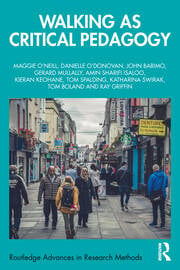
245 10|aWalking as critical pedagogy /|cMaggie O'Neill, Danielle O'Donovan, John Barimo, Gerard Mullally, Amin Sharifi Isaloo, Kieran Keohane, Tom Spalding, Katharina Swirak, Tom Boland, and Ray Griffin.
264 1|aAbingdon, Oxon ;|aNew York, NY :|bRoutledge,|c2026.
300 |a1 online resource
334 |asingle unit|bmono|0http://id.loc.gov/vocabulary/issuance/mono
336 |atext|btxt|2rdacontent
337 |acomputer|bc|2rdamedia
338 |aonline resource|bcr|2rdacarrier
353 |abibliography|bbibliography|0http://id.loc.gov/vocabulary/msupplcont/bibliography
353 |aindex|bindex|0http://id.loc.gov/vocabulary/msupplcont/index
520 |aDefining the principles and practices of walking as critical pedagogy, this book engages with social questions and challenges related to understandings of the Anthropocene.Through a series of chapters that operationalize walking as a form of participatory pedagogy, it explores issues including migration and borders, sustainability and climate change, gender and feminist thought, the labour market, crime and rehabilitation, and urban life and regeneration. Showing how walking enables us to learn creatively, convivially and critically on the move in city spaces, while thinking relationally, the authors demonstrate the importance of space, time and place: the layers of history embedded in the present, and the importance of active, embodied, participatory, collaborative, creative and place based learning.A pioneering approach to walking as a form of engagement and learning, Walking as Critical Pedagogy will appeal to researchers and students across the social sciences interested in new methods and research methodologies, and creative ways of teaching and learning about - and engaging with - major global issues in society.
588 |aOCLC-licensed vendor bibliographic record.
650 0|aCritical pedagogy.
650 0|aWalking|xSocial aspects.
758 |1http://id.loc.gov/resources/instances/24245274
758 |4http://id.loc.gov/ontologies/bibframe/instanceOf|1http://id.loc.gov/resources/works/24245274
856 40|3Taylor & Francis|uhttps://www.taylorfrancis.com/books/9781003569671
856 42|3OCLC metadata license agreement|uhttp://www.oclc.org/content/dam/oclc/forms/terms/vbrl-201703.pdf
901 |aTaylor & Francis