

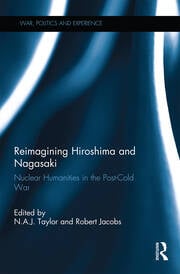
Reimagining Hiroshima and Nagasaki : nuclear humanities in the post-Cold War / edited by N.A.J. Taylor and Robert Jacobs.
Erişim Adresi
ISBN
9781315505572 (e-book : PDF)
9781315505541 (e-book: Mobi)
9781138201842 (hardback)
9781315505541 (e-book: Mobi)
9781138201842 (hardback)
Dil Kodu
İngilizce
Yayın Bilgisi
Abingdon, Oxon ; New York, NY : Routledge, 2017.
Fiziksel Niteleme
1 online resource (196 pages)
Dizi
War, politics and experience
İçindekiler Notu
Introduction: on Hiroshima becoming history / N.A.J. Taylor -- Contested spaces of ethnicity: Zainichi Korean accounts of the atomic bombings / Erik Ropers -- Memory and survival in everyday textures: Ishiuchi Miyako's Hiroshima / Makeda Best -- The most modern city in the world: Isamu Noguchi's cenotaph controversy and Hiroshima's city of peace / Ran Zwigenberg -- Nuclear cosmopolitan memory in the war game (1965) and "The museum of ante-memorials" (2012) / Jessica Rapson -- Nuclear memory / Stefanie Fishel -- Nagasaki re-imagined: the last shall be first / Kathleen Sullivan -- The atomic gaze and Ankoku Butoh in post-war Japan / Adam Broinowski -- Australian POW and occupation force experiences in Hiroshima and Nagasaki: a digital hyper-visualisation / Stuart Bender and Mick Broderick -- In the light of Hiroshima: banalizing violence and normalizing experiences of the atomic bombing / Yuki Miyamoto -- Hiroshima and the paradoxes of Japanese nuclear perplexity / Thomas E. Doyle, II -- For granting (a) voice / Marcel Quiroz -- Witnessing Nagasaki for the second time / Imafuku Ryuta -- Antimonument: a short reflection on writings by Marcela Quiroz and Ryuta Imafuku / Shinpei Takeda.
Özet, vb.
"This edited volume reconsiders the importance of the attacks on Hiroshima and Nagasaki from a post-Cold War perspective. It has been argued that during the Cold War era scholarship was limited by the anxiety that authors felt about the possibility of a global thermonuclear war, and the role their scholarship could play in obstructing such an event. The new scholarship of Nuclear Humanities approaches this history and its fallout with both more nuanced and integrative inquiries, paving the way towards a deeper integration of these seminal events beyond issues of policy and ethics. This volume, therefore, offers a distinctly post-Cold War perspective on the nuclear attacks on Hiroshima and Nagasaki. The chapters collected here address the memorialization and commemoration of Hiroshima and Nagasaki by officials and states, but also ordinary people's resentment, suffering, or forgiveness. The volume presents a variety of approaches with contributions from academics and contributions from authors who are strongly connected to the cities of Hiroshima and Nagasaki, and its people. In addition, the work branches out beyond the traditional subjects of social sciences and humanities to include contributions on art, photography, and design. This variety of approaches and perspectives provides moral and political insights on the full range of vulnerabilities--such as emotional, bodily, cognitive, and ecological--that pertains to nuclear harm. This book will be of much interest to students of critical war studies, nuclear weapons, World War II history, Asian History and International Relations in general."--Provided by publisher.
Konu
Atomic bomb __ History __ 20th century.
Hiroshima-shi (Japan) __ History __ Bombardment, 1945.
Nagasaki-shi (Japan) __ History __ Bombardment, 1945.
Hiroshima-shi (Japan) __ History __ Bombardment, 1945.
Nagasaki-shi (Japan) __ History __ Bombardment, 1945.
Diğer Yazarlar
Veritabanı
Eseri Alıntıla
Referansları kullanmadan önce gözden geçirmeniz ve varsa gerekli düzeltmeleri yapmanız önerilir.
Dijital Kaynak
MARC Görünümü
LEADER 04031cam a2200301Ii 4500
001 804759
003 TR_AnAIT
005 20260124001810
008 180706s2017 enka ob 001 0 eng d
020 |a9781315505572|q(e-book : PDF)
020 |a9781315505541|q(e-book: Mobi)
020 |z9781138201842|q(hardback)
024 7 |a10.4324/9781315505572 |2doi
035 |a(OCoLC)994609251
041 |aeng
043 |aa-ja---|an-us---
049 |aTürk Tarih Kurumu Kütüphanesi
050 4|aD767.25.H6|bR45 2017
082 04|a940.542521954|bT244
245 00|aReimagining Hiroshima and Nagasaki :|bnuclear humanities in the post-Cold War /|cedited by N.A.J. Taylor and Robert Jacobs.
264 1|aAbingdon, Oxon ;|aNew York, NY :|bRoutledge,|c2017.
300 |a1 online resource (196 pages)
490 0 |aWar, politics and experience
505 0 |aIntroduction: on Hiroshima becoming history / N.A.J. Taylor -- Contested spaces of ethnicity: Zainichi Korean accounts of the atomic bombings / Erik Ropers -- Memory and survival in everyday textures: Ishiuchi Miyako's Hiroshima / Makeda Best -- The most modern city in the world: Isamu Noguchi's cenotaph controversy and Hiroshima's city of peace / Ran Zwigenberg -- Nuclear cosmopolitan memory in the war game (1965) and "The museum of ante-memorials" (2012) / Jessica Rapson -- Nuclear memory / Stefanie Fishel -- Nagasaki re-imagined: the last shall be first / Kathleen Sullivan -- The atomic gaze and Ankoku Butoh in post-war Japan / Adam Broinowski -- Australian POW and occupation force experiences in Hiroshima and Nagasaki: a digital hyper-visualisation / Stuart Bender and Mick Broderick -- In the light of Hiroshima: banalizing violence and normalizing experiences of the atomic bombing / Yuki Miyamoto -- Hiroshima and the paradoxes of Japanese nuclear perplexity / Thomas E. Doyle, II -- For granting (a) voice / Marcel Quiroz -- Witnessing Nagasaki for the second time / Imafuku Ryuta -- Antimonument: a short reflection on writings by Marcela Quiroz and Ryuta Imafuku / Shinpei Takeda.
520 |a"This edited volume reconsiders the importance of the attacks on Hiroshima and Nagasaki from a post-Cold War perspective. It has been argued that during the Cold War era scholarship was limited by the anxiety that authors felt about the possibility of a global thermonuclear war, and the role their scholarship could play in obstructing such an event. The new scholarship of Nuclear Humanities approaches this history and its fallout with both more nuanced and integrative inquiries, paving the way towards a deeper integration of these seminal events beyond issues of policy and ethics. This volume, therefore, offers a distinctly post-Cold War perspective on the nuclear attacks on Hiroshima and Nagasaki. The chapters collected here address the memorialization and commemoration of Hiroshima and Nagasaki by officials and states, but also ordinary people's resentment, suffering, or forgiveness. The volume presents a variety of approaches with contributions from academics and contributions from authors who are strongly connected to the cities of Hiroshima and Nagasaki, and its people. In addition, the work branches out beyond the traditional subjects of social sciences and humanities to include contributions on art, photography, and design. This variety of approaches and perspectives provides moral and political insights on the full range of vulnerabilities--such as emotional, bodily, cognitive, and ecological--that pertains to nuclear harm. This book will be of much interest to students of critical war studies, nuclear weapons, World War II history, Asian History and International Relations in general."--Provided by publisher.
650 0|aAtomic bomb|xHistory|y20th century.
651 0|aHiroshima-shi (Japan)|xHistory|yBombardment, 1945.
651 0|aNagasaki-shi (Japan)|xHistory|yBombardment, 1945.
700 1 |aJacobs, Robert A.,|d1960-|eeditor.
700 1 |aTaylor, N. A. J.,|eeditor.
776 08|iPrint version: |z9781138201842|w(DLC) 2017021419
856 40|uhttps://www.taylorfrancis.com/books/9781315505572|zClick here to view.
901 |aTaylor & Francis
001 804759
003 TR_AnAIT
005 20260124001810
008 180706s2017 enka ob 001 0 eng d
020 |a9781315505572|q(e-book : PDF)
020 |a9781315505541|q(e-book: Mobi)
020 |z9781138201842|q(hardback)
024 7 |a10.4324/9781315505572 |2doi
035 |a(OCoLC)994609251
041 |aeng
043 |aa-ja---|an-us---
049 |aTürk Tarih Kurumu Kütüphanesi
050 4|aD767.25.H6|bR45 2017
082 04|a940.542521954|bT244
245 00|aReimagining Hiroshima and Nagasaki :|bnuclear humanities in the post-Cold War /|cedited by N.A.J. Taylor and Robert Jacobs.
264 1|aAbingdon, Oxon ;|aNew York, NY :|bRoutledge,|c2017.
300 |a1 online resource (196 pages)
490 0 |aWar, politics and experience
505 0 |aIntroduction: on Hiroshima becoming history / N.A.J. Taylor -- Contested spaces of ethnicity: Zainichi Korean accounts of the atomic bombings / Erik Ropers -- Memory and survival in everyday textures: Ishiuchi Miyako's Hiroshima / Makeda Best -- The most modern city in the world: Isamu Noguchi's cenotaph controversy and Hiroshima's city of peace / Ran Zwigenberg -- Nuclear cosmopolitan memory in the war game (1965) and "The museum of ante-memorials" (2012) / Jessica Rapson -- Nuclear memory / Stefanie Fishel -- Nagasaki re-imagined: the last shall be first / Kathleen Sullivan -- The atomic gaze and Ankoku Butoh in post-war Japan / Adam Broinowski -- Australian POW and occupation force experiences in Hiroshima and Nagasaki: a digital hyper-visualisation / Stuart Bender and Mick Broderick -- In the light of Hiroshima: banalizing violence and normalizing experiences of the atomic bombing / Yuki Miyamoto -- Hiroshima and the paradoxes of Japanese nuclear perplexity / Thomas E. Doyle, II -- For granting (a) voice / Marcel Quiroz -- Witnessing Nagasaki for the second time / Imafuku Ryuta -- Antimonument: a short reflection on writings by Marcela Quiroz and Ryuta Imafuku / Shinpei Takeda.
520 |a"This edited volume reconsiders the importance of the attacks on Hiroshima and Nagasaki from a post-Cold War perspective. It has been argued that during the Cold War era scholarship was limited by the anxiety that authors felt about the possibility of a global thermonuclear war, and the role their scholarship could play in obstructing such an event. The new scholarship of Nuclear Humanities approaches this history and its fallout with both more nuanced and integrative inquiries, paving the way towards a deeper integration of these seminal events beyond issues of policy and ethics. This volume, therefore, offers a distinctly post-Cold War perspective on the nuclear attacks on Hiroshima and Nagasaki. The chapters collected here address the memorialization and commemoration of Hiroshima and Nagasaki by officials and states, but also ordinary people's resentment, suffering, or forgiveness. The volume presents a variety of approaches with contributions from academics and contributions from authors who are strongly connected to the cities of Hiroshima and Nagasaki, and its people. In addition, the work branches out beyond the traditional subjects of social sciences and humanities to include contributions on art, photography, and design. This variety of approaches and perspectives provides moral and political insights on the full range of vulnerabilities--such as emotional, bodily, cognitive, and ecological--that pertains to nuclear harm. This book will be of much interest to students of critical war studies, nuclear weapons, World War II history, Asian History and International Relations in general."--Provided by publisher.
650 0|aAtomic bomb|xHistory|y20th century.
651 0|aHiroshima-shi (Japan)|xHistory|yBombardment, 1945.
651 0|aNagasaki-shi (Japan)|xHistory|yBombardment, 1945.
700 1 |aJacobs, Robert A.,|d1960-|eeditor.
700 1 |aTaylor, N. A. J.,|eeditor.
776 08|iPrint version: |z9781138201842|w(DLC) 2017021419
856 40|uhttps://www.taylorfrancis.com/books/9781315505572|zClick here to view.
901 |aTaylor & Francis
Materyaller
Depodan talep edilen materyal sadece kütüphane içerisinde kullanılmaktadır.
Materyal dışarıya ödünç verilmemektedir.
Materyal dışarıya ödünç verilmemektedir.
