LEADER 03652cam a2200337Ii 4500
001 804859
003 TR_AnAIT
005 20260124001934
008 180706s2015 nyua ob 001 0 eng d
020 |a9780203082522|q(e-book : PDF)
020 |a9781136179655|q(e-book: Mobi)
020 |a9781136179693|q(e-book: ePub)
020 |z9780415640770|q(hardback)
020 |z9781138065871|q(paperback)
024 7 |a10.4324/9780203082522 |2doi
035 |a(OCoLC)958102832
041 |aeng
043 |ae-uk---
049 |aTürk Tarih Kurumu Kütüphanesi
050 4|aHV9960.G7|bC436 2015
082 04|a345.410243|bC458
100 1 |aChanning, Iain.,|eauthor.
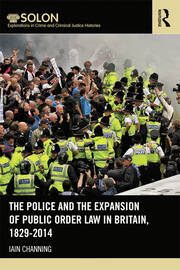
245 14|aThe police and the expansion of public order law in Britain, 1829-2014 /|cIain Channing.
250 |aFirst edition.
264 1|aNew York :|bRoutledge,|c2015.
300 |a1 online resource (xix, 252 pages)
490 1 |aRoutledge SOLON explorations in crime and criminal justice histories ;|v5
505 0 |a1. The development of public order law -- 2. 'I predict a breach of the peace' : police discretion and the tension between liberty and order -- 3. Riot and violent disorder : controlling spontaneous disorder and excessive violence -- 4. Freedom of assembly and public processions : regulation and policing before the Public Order Act 1936 -- 5. Freedom of assembly and public procession : regulation and policing after the Public Order Act 1936 -- Public meetings and freedom of expression : the criminalisation of words and political censorship -- 7. Public meetings held on private premises : the roles of the steward and the police -- 8. Dressed for disorder : the criminalisation of political uniforms.
520 |a"Incidences of public disorder, and the manner in which they have been suppressed, have repeatedly ignited debate on the role of policing, the effectiveness of current legislation and the implications for human rights and civil liberties. These same issues have reverberated throughout British history, and have frequently resulted in the enactment of new legislation that reactively aimed to counter the specific concern of that era. This book offers a detailed analysis on the expansion of public order law in the context of the historical and political developments in British society. The correlation of key historical events and the enactment of consequent legislation is a key theme that resonates throughout the book, and demonstrates the expanding influence of the law on public assemblies and protest, which has continued to criminalise and prohibit certain social behaviours. Crucial movements in Britain's social and political history who have all engaged in, or have provoked public disorder, are examined in the book. Other incidents of riot and disorder, such as the Featherstone Riot (1893), the Battle of Cable Street (1936), the Inner City Riots (1980s) and the UK riots (2011) are also covered. By positioning legal developments within their historical context it demonstrates the ebb and flow between the prominence of the competing demands of the liberties of free expression and assembly on the one hand and the protection of the general public and property on the other. This book is essential reading for academics and students in the fields of criminology, history and law"--|cProvided by publisher.
650 0|aCriminal justice, Administration of|zGreat Britain|xHistory.
650 0|aLaw enforcement|zGreat Britain|xHistory.
650 0|aPolice|zGreat Britain|xHistory.
776 08|iPrint version: |z9780415640770|w(DLC) 2014046012
830 0|aRoutledge SOLON explorations in crime and criminal justice histories ;|v5.
856 40|uhttps://www.taylorfrancis.com/books/9781136179709|zClick here to view.
901 |aTaylor & Francis