

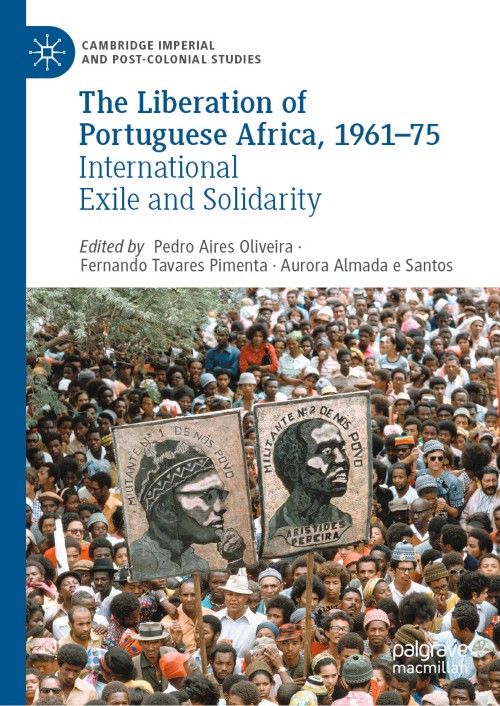
The Liberation of Portuguese Africa, 1961-75 [electronic resource] : International Exile and Solidarity / edited by Pedro Aires Oliveira, Fernando Tavares Pimenta, Aurora Almada e Santos.
Erişim Adresi
ISBN
9783031855818
Dil Kodu
İngilizce
Yer Numarası
DK/6266
Basım Bildirimi
1st ed. 2025.
Yayın Bilgisi
Cham : Springer Nature Switzerland : Imprint: Palgrave Macmillan, 2025.
Fiziksel Niteleme
XVII, 393 p. 2 illus., 1 illus. in color. online resource.
Dizi
Cambridge Imperial and Post-Colonial Studies, 2635-1641
İçindekiler Notu
1. Introduction; Pedro Aires Oliveira, Fernando Tavares Pimenta and Aurora Almada e Santos -- Part I. Cross-border Sanctuaries -- 2. Leopoldville: The Reception and the Crises in the Angolan Liberation Movements; Marcelo Bittencourt -- 3. The MPLA in Congo-Brazzaville, 1963–1975: The Tribulations of an Exile in a Revolutionary Land; Jean-Michel Mabeko-Tali -- 4. Conakry as a Hub of Exile, Anti-colonialism and the Decolonisation Process: The PAIGC and the Liberation of Guinea, 1959–1973; Julião Soares de Sousa -- 5. Dar es Salaam and Portuguese Decolonization in Africa: The Case of Mozambique; Arrigo Pallotti and Corrado Tornimbeni -- Part II. Regional Visions of Pan-Africanism -- 6. Cairo: A Haven for African Nationalism; Mário Machaqueiro -- 7. From Casablanca to Algiers: The Internationalisation and Solidarity with Anti-colonial Movements from Portuguese-Speaking Africa, 1961–1974; Susana Martins -- Part III. Ties to Socialist Cities -- 8. Networking Liberation, Translating Revolution: China’s Support of Anti-colonial Struggles in Lusophone Africa, 1954-1975; Jodie Yuzhou Sun and Mingqing Yuan -- 9. Moscow as an Anti-colonial Hub for Lusophone African Activists: Power Hierarchies and Solidarity Networks; Natalia Telepneva and Daria Zelenova -- Part IV. Incubators of Non-state Actors -- 10. New York as a Site of Activism against Portuguese Colonialism: 1961–1974; Aurora Almada e Santos -- 11. São Paulo: MABLA and the Support for the Angolan Liberation Struggle; Fernando Tavares Pimenta -- 12. Defying Portuguese Colonialism under the Shadow of the ‘Old Alliance’: London in the Long Sixties; Pedro Aires Oliveira -- 13. PAIGC Militants, Portuguese Exiles and Anti-colonial Activism in Paris; Víctor Barros -- Part V. Afterword -- 14. Afterword; Norrie MacQueen.
Özet, vb.
'This wide-ranging book takes us along the global itineraries of Lusophone Africa's exiled revolutionaries. By anchoring their activities in an archipelago of urban nodes of activism, the chapters here illuminate the strength and fragility of the international networks formed in the struggle against Portuguese imperialism in the midst of the Cold War.' —George Roberts, Lecturer in Modern History, University of Sheffield This book analyses the liberation struggles that took place in the Portuguese colonies of Angola, Mozambique, Guinea, Cabo Verde, and São Tomé e Príncipe during the second half of the twentieth century, highlighting how they unravelled and challenged colonialism in the international sphere. Activists established headquarters and training camps in various exile settings that were instrumental in their struggle for independence. Exile settings were places where the liberation movements worked with host countries, accessed representatives of foreign countries, made connections with nonstate actors and networks of support, and received political and military training. The complex networks of support formed by protestors around the globe operated on a transnational scale, using urban centres as sites of activism and arenas to promote a multiplicity of connections. Bringing together contributions from a range of skilled authors, the book explores selected hubs around the globe including those based in Kinshasa, Dar es Salaam, Cairo, Moscow, Beijing, New York, London, Paris, and São Paulo. Taking a comparative approach, this collection sheds light on the infrastructures of solidarity that were established by activists around the world, and highlights the transnational circulation of ideas around anticolonialism. Pedro Aires Oliveira is an Associate Professor in the History Department of the School of Humanities and Social Sciences at NOVA University of Lisbon, Portugal, where he is also a Researcher in the Institute of Contemporary History. Fernando Tavares Pimenta is a Researcher and President of the Scientific Council of the Centro de Estudos de História do Atlântico-Alberto Vieira (CEHA-AV/DRABL) in Madeira Island, as well as an Associate Fellow of the Institute of Contemporary History, NOVA University of Lisbon, Portugal. Aurora Almada e Santos is a Researcher in the Institute of Contemporary History, at NOVA University of Lisbon, Portugal.
Konu
Imperialism.
Europe __ History.
Social history.
World politics.
World history.
Imperialism and Colonialism.
European History.
Social History.
Political History.
World History, Global and Transnational History.
Europe __ History.
Social history.
World politics.
World history.
Imperialism and Colonialism.
European History.
Social History.
Political History.
World History, Global and Transnational History.
Kurum Adı
Eseri Alıntıla
Referansları kullanmadan önce gözden geçirmeniz ve varsa gerekli düzeltmeleri yapmanız önerilir.
Dijital Kaynak
MARC Görünümü
LEADER 07767nam a22007215i 4500
001 804939
003 TR_AnAIT
005 20260126235113
007 cr nn 008mamaa
008 250826s2025 sz | s |||| 0|eng d
020 |a9783031855818|9978-3-031-85581-8
024 7 |a10.1007/978-3-031-85581-8|2doi
041 |aeng
049 |aTürk Tarih Kurumu Kütüphanesi
050 4|aJV61-152
072 7|aHBTQ|2bicssc
072 7|aHIS000000|2bisacsh
072 7|aNHTQ|2thema
082 04|a325.3|223
090 |aDK/6266
245 14|aThe Liberation of Portuguese Africa, 1961-75|h[electronic resource] :|bInternational Exile and Solidarity /|cedited by Pedro Aires Oliveira, Fernando Tavares Pimenta, Aurora Almada e Santos.
250 |a1st ed. 2025.
264 1|aCham :|bSpringer Nature Switzerland :|bImprint: Palgrave Macmillan,|c2025.
300 |aXVII, 393 p. 2 illus., 1 illus. in color.|bonline resource.
336 |atext|btxt|2rdacontent
337 |acomputer|bc|2rdamedia
338 |aonline resource|bcr|2rdacarrier
341 0 |bPDF/UA-1|2onix
341 0 |bTable of contents navigation|2onix
341 0 |bSingle logical reading order|2onix
341 0 |bShort alternative textual descriptions|2onix
341 0 |bUse of color is not sole means of conveying information|2onix
341 0 |bUse of high contrast between text and background color|2onix
341 0 |bNext / Previous structural navigation|2onix
341 0 |bAll non-decorative content supports reading without sight|2onix
347 |atext file|bPDF|2rda
490 1 |aCambridge Imperial and Post-Colonial Studies,|x2635-1641
505 0 |a1. Introduction; Pedro Aires Oliveira, Fernando Tavares Pimenta and Aurora Almada e Santos -- Part I. Cross-border Sanctuaries -- 2. Leopoldville: The Reception and the Crises in the Angolan Liberation Movements; Marcelo Bittencourt -- 3. The MPLA in Congo-Brazzaville, 1963–1975: The Tribulations of an Exile in a Revolutionary Land; Jean-Michel Mabeko-Tali -- 4. Conakry as a Hub of Exile, Anti-colonialism and the Decolonisation Process: The PAIGC and the Liberation of Guinea, 1959–1973; Julião Soares de Sousa -- 5. Dar es Salaam and Portuguese Decolonization in Africa: The Case of Mozambique; Arrigo Pallotti and Corrado Tornimbeni -- Part II. Regional Visions of Pan-Africanism -- 6. Cairo: A Haven for African Nationalism; Mário Machaqueiro -- 7. From Casablanca to Algiers: The Internationalisation and Solidarity with Anti-colonial Movements from Portuguese-Speaking Africa, 1961–1974; Susana Martins -- Part III. Ties to Socialist Cities -- 8. Networking Liberation, Translating Revolution: China’s Support of Anti-colonial Struggles in Lusophone Africa, 1954-1975; Jodie Yuzhou Sun and Mingqing Yuan -- 9. Moscow as an Anti-colonial Hub for Lusophone African Activists: Power Hierarchies and Solidarity Networks; Natalia Telepneva and Daria Zelenova -- Part IV. Incubators of Non-state Actors -- 10. New York as a Site of Activism against Portuguese Colonialism: 1961–1974; Aurora Almada e Santos -- 11. São Paulo: MABLA and the Support for the Angolan Liberation Struggle; Fernando Tavares Pimenta -- 12. Defying Portuguese Colonialism under the Shadow of the ‘Old Alliance’: London in the Long Sixties; Pedro Aires Oliveira -- 13. PAIGC Militants, Portuguese Exiles and Anti-colonial Activism in Paris; Víctor Barros -- Part V. Afterword -- 14. Afterword; Norrie MacQueen.
520 |a'This wide-ranging book takes us along the global itineraries of Lusophone Africa's exiled revolutionaries. By anchoring their activities in an archipelago of urban nodes of activism, the chapters here illuminate the strength and fragility of the international networks formed in the struggle against Portuguese imperialism in the midst of the Cold War.' —George Roberts, Lecturer in Modern History, University of Sheffield This book analyses the liberation struggles that took place in the Portuguese colonies of Angola, Mozambique, Guinea, Cabo Verde, and São Tomé e Príncipe during the second half of the twentieth century, highlighting how they unravelled and challenged colonialism in the international sphere. Activists established headquarters and training camps in various exile settings that were instrumental in their struggle for independence. Exile settings were places where the liberation movements worked with host countries, accessed representatives of foreign countries, made connections with nonstate actors and networks of support, and received political and military training. The complex networks of support formed by protestors around the globe operated on a transnational scale, using urban centres as sites of activism and arenas to promote a multiplicity of connections. Bringing together contributions from a range of skilled authors, the book explores selected hubs around the globe including those based in Kinshasa, Dar es Salaam, Cairo, Moscow, Beijing, New York, London, Paris, and São Paulo. Taking a comparative approach, this collection sheds light on the infrastructures of solidarity that were established by activists around the world, and highlights the transnational circulation of ideas around anticolonialism. Pedro Aires Oliveira is an Associate Professor in the History Department of the School of Humanities and Social Sciences at NOVA University of Lisbon, Portugal, where he is also a Researcher in the Institute of Contemporary History. Fernando Tavares Pimenta is a Researcher and President of the Scientific Council of the Centro de Estudos de História do Atlântico-Alberto Vieira (CEHA-AV/DRABL) in Madeira Island, as well as an Associate Fellow of the Institute of Contemporary History, NOVA University of Lisbon, Portugal. Aurora Almada e Santos is a Researcher in the Institute of Contemporary History, at NOVA University of Lisbon, Portugal.
532 8 |aAccessibility summary: This PDF has been created in accordance with the PDF/UA-1 standard to enhance accessibility, including screen reader support, described non-text content (images, graphs), bookmarks for easy navigation, keyboard-friendly links and forms and searchable, selectable text. We recognize the importance of accessibility, and we welcome queries about accessibility for any of our products. If you have a question or an access need, please get in touch with us at accessibilitysupport@springernature.com. Please note that a more accessible version of this eBook is available as ePub.
532 8 |aNo reading system accessibility options actively disabled
532 8 |aPublisher contact for further accessibility information: accessibilitysupport@springernature.com
650 0|aImperialism.
650 0|aEurope|xHistory.
650 0|aSocial history.
650 0|aWorld politics.
650 0|aWorld history.
650 14|aImperialism and Colonialism.
650 24|aEuropean History.
650 24|aSocial History.
650 24|aPolitical History.
650 24|aWorld History, Global and Transnational History.
700 1 |aOliveira, Pedro Aires.|eeditor.|4edt|4http://id.loc.gov/vocabulary/relators/edt
700 1 |aPimenta, Fernando Tavares.|eeditor.|4edt|4http://id.loc.gov/vocabulary/relators/edt
700 1 |aSantos, Aurora Almada e.|eeditor.|4edt|4http://id.loc.gov/vocabulary/relators/edt
710 2 |aSpringerLink (Online service)
773 0 |tSpringer Nature eBook
776 08|iPrinted edition:|z9783031855801
776 08|iPrinted edition:|z9783031855825
776 08|iPrinted edition:|z9783031855832
830 0|aCambridge Imperial and Post-Colonial Studies,|x2635-1641
856 40|uhttps://doi.org/10.1007/978-3-031-85581-8
912 |aZDB-2-HTY
912 |aZDB-2-SXH
950 |aHistory (SpringerNature-41172)
950 |aHistory (R0) (SpringerNature-43722)
001 804939
003 TR_AnAIT
005 20260126235113
007 cr nn 008mamaa
008 250826s2025 sz | s |||| 0|eng d
020 |a9783031855818|9978-3-031-85581-8
024 7 |a10.1007/978-3-031-85581-8|2doi
041 |aeng
049 |aTürk Tarih Kurumu Kütüphanesi
050 4|aJV61-152
072 7|aHBTQ|2bicssc
072 7|aHIS000000|2bisacsh
072 7|aNHTQ|2thema
082 04|a325.3|223
090 |aDK/6266
245 14|aThe Liberation of Portuguese Africa, 1961-75|h[electronic resource] :|bInternational Exile and Solidarity /|cedited by Pedro Aires Oliveira, Fernando Tavares Pimenta, Aurora Almada e Santos.
250 |a1st ed. 2025.
264 1|aCham :|bSpringer Nature Switzerland :|bImprint: Palgrave Macmillan,|c2025.
300 |aXVII, 393 p. 2 illus., 1 illus. in color.|bonline resource.
336 |atext|btxt|2rdacontent
337 |acomputer|bc|2rdamedia
338 |aonline resource|bcr|2rdacarrier
341 0 |bPDF/UA-1|2onix
341 0 |bTable of contents navigation|2onix
341 0 |bSingle logical reading order|2onix
341 0 |bShort alternative textual descriptions|2onix
341 0 |bUse of color is not sole means of conveying information|2onix
341 0 |bUse of high contrast between text and background color|2onix
341 0 |bNext / Previous structural navigation|2onix
341 0 |bAll non-decorative content supports reading without sight|2onix
347 |atext file|bPDF|2rda
490 1 |aCambridge Imperial and Post-Colonial Studies,|x2635-1641
505 0 |a1. Introduction; Pedro Aires Oliveira, Fernando Tavares Pimenta and Aurora Almada e Santos -- Part I. Cross-border Sanctuaries -- 2. Leopoldville: The Reception and the Crises in the Angolan Liberation Movements; Marcelo Bittencourt -- 3. The MPLA in Congo-Brazzaville, 1963–1975: The Tribulations of an Exile in a Revolutionary Land; Jean-Michel Mabeko-Tali -- 4. Conakry as a Hub of Exile, Anti-colonialism and the Decolonisation Process: The PAIGC and the Liberation of Guinea, 1959–1973; Julião Soares de Sousa -- 5. Dar es Salaam and Portuguese Decolonization in Africa: The Case of Mozambique; Arrigo Pallotti and Corrado Tornimbeni -- Part II. Regional Visions of Pan-Africanism -- 6. Cairo: A Haven for African Nationalism; Mário Machaqueiro -- 7. From Casablanca to Algiers: The Internationalisation and Solidarity with Anti-colonial Movements from Portuguese-Speaking Africa, 1961–1974; Susana Martins -- Part III. Ties to Socialist Cities -- 8. Networking Liberation, Translating Revolution: China’s Support of Anti-colonial Struggles in Lusophone Africa, 1954-1975; Jodie Yuzhou Sun and Mingqing Yuan -- 9. Moscow as an Anti-colonial Hub for Lusophone African Activists: Power Hierarchies and Solidarity Networks; Natalia Telepneva and Daria Zelenova -- Part IV. Incubators of Non-state Actors -- 10. New York as a Site of Activism against Portuguese Colonialism: 1961–1974; Aurora Almada e Santos -- 11. São Paulo: MABLA and the Support for the Angolan Liberation Struggle; Fernando Tavares Pimenta -- 12. Defying Portuguese Colonialism under the Shadow of the ‘Old Alliance’: London in the Long Sixties; Pedro Aires Oliveira -- 13. PAIGC Militants, Portuguese Exiles and Anti-colonial Activism in Paris; Víctor Barros -- Part V. Afterword -- 14. Afterword; Norrie MacQueen.
520 |a'This wide-ranging book takes us along the global itineraries of Lusophone Africa's exiled revolutionaries. By anchoring their activities in an archipelago of urban nodes of activism, the chapters here illuminate the strength and fragility of the international networks formed in the struggle against Portuguese imperialism in the midst of the Cold War.' —George Roberts, Lecturer in Modern History, University of Sheffield This book analyses the liberation struggles that took place in the Portuguese colonies of Angola, Mozambique, Guinea, Cabo Verde, and São Tomé e Príncipe during the second half of the twentieth century, highlighting how they unravelled and challenged colonialism in the international sphere. Activists established headquarters and training camps in various exile settings that were instrumental in their struggle for independence. Exile settings were places where the liberation movements worked with host countries, accessed representatives of foreign countries, made connections with nonstate actors and networks of support, and received political and military training. The complex networks of support formed by protestors around the globe operated on a transnational scale, using urban centres as sites of activism and arenas to promote a multiplicity of connections. Bringing together contributions from a range of skilled authors, the book explores selected hubs around the globe including those based in Kinshasa, Dar es Salaam, Cairo, Moscow, Beijing, New York, London, Paris, and São Paulo. Taking a comparative approach, this collection sheds light on the infrastructures of solidarity that were established by activists around the world, and highlights the transnational circulation of ideas around anticolonialism. Pedro Aires Oliveira is an Associate Professor in the History Department of the School of Humanities and Social Sciences at NOVA University of Lisbon, Portugal, where he is also a Researcher in the Institute of Contemporary History. Fernando Tavares Pimenta is a Researcher and President of the Scientific Council of the Centro de Estudos de História do Atlântico-Alberto Vieira (CEHA-AV/DRABL) in Madeira Island, as well as an Associate Fellow of the Institute of Contemporary History, NOVA University of Lisbon, Portugal. Aurora Almada e Santos is a Researcher in the Institute of Contemporary History, at NOVA University of Lisbon, Portugal.
532 8 |aAccessibility summary: This PDF has been created in accordance with the PDF/UA-1 standard to enhance accessibility, including screen reader support, described non-text content (images, graphs), bookmarks for easy navigation, keyboard-friendly links and forms and searchable, selectable text. We recognize the importance of accessibility, and we welcome queries about accessibility for any of our products. If you have a question or an access need, please get in touch with us at accessibilitysupport@springernature.com. Please note that a more accessible version of this eBook is available as ePub.
532 8 |aNo reading system accessibility options actively disabled
532 8 |aPublisher contact for further accessibility information: accessibilitysupport@springernature.com
650 0|aImperialism.
650 0|aEurope|xHistory.
650 0|aSocial history.
650 0|aWorld politics.
650 0|aWorld history.
650 14|aImperialism and Colonialism.
650 24|aEuropean History.
650 24|aSocial History.
650 24|aPolitical History.
650 24|aWorld History, Global and Transnational History.
700 1 |aOliveira, Pedro Aires.|eeditor.|4edt|4http://id.loc.gov/vocabulary/relators/edt
700 1 |aPimenta, Fernando Tavares.|eeditor.|4edt|4http://id.loc.gov/vocabulary/relators/edt
700 1 |aSantos, Aurora Almada e.|eeditor.|4edt|4http://id.loc.gov/vocabulary/relators/edt
710 2 |aSpringerLink (Online service)
773 0 |tSpringer Nature eBook
776 08|iPrinted edition:|z9783031855801
776 08|iPrinted edition:|z9783031855825
776 08|iPrinted edition:|z9783031855832
830 0|aCambridge Imperial and Post-Colonial Studies,|x2635-1641
856 40|uhttps://doi.org/10.1007/978-3-031-85581-8
912 |aZDB-2-HTY
912 |aZDB-2-SXH
950 |aHistory (SpringerNature-41172)
950 |aHistory (R0) (SpringerNature-43722)
Materyaller
Depodan talep edilen materyal sadece kütüphane içerisinde kullanılmaktadır.
Materyal dışarıya ödünç verilmemektedir.
Materyal dışarıya ödünç verilmemektedir.
