

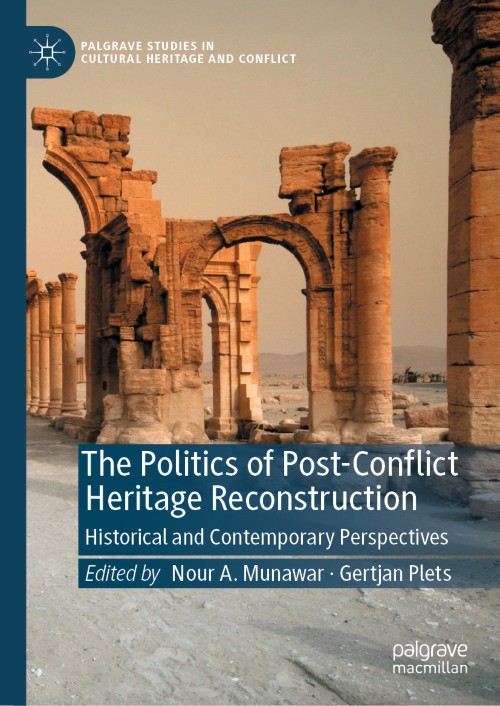
The Politics of Post-Conflict Heritage Reconstruction [electronic resource] : Historical and Contemporary Perspectives / edited by Nour A. Munawar, Gertjan Plets.
Erişim Adresi
ISBN
9783031810930
Dil Kodu
İngilizce
Yer Numarası
DK/6370
Basım Bildirimi
1st ed. 2025.
Yayın Bilgisi
Cham : Springer Nature Switzerland : Imprint: Palgrave Macmillan, 2025.
Fiziksel Niteleme
XVII, 258 p. 43 illus., 37 illus. in color. online resource.
Dizi
Palgrave Studies in Cultural Heritage and Conflict, 2634-6427
İçindekiler Notu
Chapter 1: Introduction: Theories and temporalities of post-conflict heritage: The importance of a normative approach -- Chapter 2: “We are the Masters” The prioritized reconstruction of Ypres (Belgium, World War I) -- Chapter 3: The quotidianisation of spaces of violence: On how spaces of violence from the Spanish Civil War became normalised by the active choice of “leaving them be” -- Chapter 4: Reconstructing the phantom: The imagined heritage of the Saxon Palace in Warsaw -- Chapter 5:The Bridge to Transition: Post-conflict heritage as a tool of development in Mostar (Bosnia and Herzegovina) -- Chapter 6: The roots of recovery: Àbàchà and the reconstruction of Intangible Heritage in postwar southeastern Nigeria -- Chapter 7: “Save Carthage”: Post-Conflict Reconstruction in Postcolonial Tunisia -- Chapter 8: Governing Cultural Heritage in Time of Crises: Case study: Borobudur, Indonesia -- Chapter 9: Post-conflict Risks to Built Heritage Through the Lens of the Libyan City of Benghazi -- Chapter 10: The Trojan Horse of St. George on Tbilisi’s Freedom Square and Lessons from Georgia's post-2003 Reconstruction -- Chapter 11: Postscript: The Battle for Ukrainian Heritage: Reconstruction and Memory-making.
Özet, vb.
This edited volume explores the politics and semantics of heritage rehabilitation practices such as conservation, archaeological excavation, memorialization and rebuilding programs. Recent conflicts in the Arab region and Ukraine have demonstrated how heritage is an intrinsic part of contemporary warfare. However, the politicization of heritage reconstruction after conflict receives less attention. While there is consensus on the benefits of reconstruction, a growing number of scholars are now exploring the political agendas encoded in reconstruction programs, and their long-term negative effects on societal recovery. Faced with a contemporary heritage reconstruction wave in the Arab region, but also in (post-)conflict zones like West-Africa and Ukraine, it is important we are aware of the politicking encoded in many heritage aid programs. Through a series of co-authored studies by experts from different disciplines this book aims to identify parameters, practices and institutional organizations that either promote or undermine long-term societal resilience. By combining insights from archaeology, anthropology, conflict and history, this book will explore how heritage reconstructions help to re-shape national and ethno-religious identities and multi-layered memories of affected communities. Nour A. Munawar is an archaeologist and UNESCO heritage expert and currently works as a research fellow at the University of Amsterdam (UvA). He is the principal investigator of the “Decolonial Futures: Heritage, Memory, and Narratives in the Making in MENA” research project funded by the Dutch Research Council (NWO). He also works as a UNESCO Researcher for the UNESCO Documentary Heritage Unit on the “Documentary Heritage for Intercultural dialogue – a case study of AlUla, Saudi Arabia”. Gertjan Plets is an associate professor in Cultural History and Heritage at Utrecht University. At Utrecht he coordinates and conducts research in the field of heritage politics, theoretical archaeology, corporate sponsorship and Russian cultural politics. He broadly approaches cultural heritage as a cultural expression and political statement. His regional focus is Russia and the post-colonial Netherlands.
Konu
Cultural property.
Cultural Heritage.
Cultural Heritage.
Diğer Yazarlar
Kurum Adı
Eseri Alıntıla
Referansları kullanmadan önce gözden geçirmeniz ve varsa gerekli düzeltmeleri yapmanız önerilir.
Dijital Kaynak
MARC Görünümü
LEADER 06664nam a22006255i 4500
001 805047
003 TR_AnAIT
005 20260126235331
007 cr nn 008mamaa
008 250613s2025 sz | s |||| 0|eng d
020 |a9783031810930|9978-3-031-81093-0
024 7 |a10.1007/978-3-031-81093-0|2doi
041 |aeng
049 |aTürk Tarih Kurumu Kütüphanesi
050 4|aD1-2027
072 7|aJFC|2bicssc
072 7|aGM|2bicssc
072 7|aSOC002010|2bisacsh
072 7|aJBCC|2thema
072 7|aGLZ|2thema
082 04|a363.69|223
090 |aDK/6370
245 14|aThe Politics of Post-Conflict Heritage Reconstruction|h[electronic resource] :|bHistorical and Contemporary Perspectives /|cedited by Nour A. Munawar, Gertjan Plets.
250 |a1st ed. 2025.
264 1|aCham :|bSpringer Nature Switzerland :|bImprint: Palgrave Macmillan,|c2025.
300 |aXVII, 258 p. 43 illus., 37 illus. in color.|bonline resource.
336 |atext|btxt|2rdacontent
337 |acomputer|bc|2rdamedia
338 |aonline resource|bcr|2rdacarrier
341 0 |bTable of contents navigation|2onix
341 0 |bSingle logical reading order|2onix
341 0 |bShort alternative textual descriptions|2onix
341 0 |bUse of color is not sole means of conveying information|2onix
341 0 |bUse of high contrast between text and background color|2onix
341 0 |bNext / Previous structural navigation|2onix
341 0 |bAll non-decorative content supports reading without sight|2onix
347 |atext file|bPDF|2rda
490 1 |aPalgrave Studies in Cultural Heritage and Conflict,|x2634-6427
505 0 |aChapter 1: Introduction: Theories and temporalities of post-conflict heritage: The importance of a normative approach -- Chapter 2: “We are the Masters” The prioritized reconstruction of Ypres (Belgium, World War I) -- Chapter 3: The quotidianisation of spaces of violence: On how spaces of violence from the Spanish Civil War became normalised by the active choice of “leaving them be” -- Chapter 4: Reconstructing the phantom: The imagined heritage of the Saxon Palace in Warsaw -- Chapter 5:The Bridge to Transition: Post-conflict heritage as a tool of development in Mostar (Bosnia and Herzegovina) -- Chapter 6: The roots of recovery: Àbàchà and the reconstruction of Intangible Heritage in postwar southeastern Nigeria -- Chapter 7: “Save Carthage”: Post-Conflict Reconstruction in Postcolonial Tunisia -- Chapter 8: Governing Cultural Heritage in Time of Crises: Case study: Borobudur, Indonesia -- Chapter 9: Post-conflict Risks to Built Heritage Through the Lens of the Libyan City of Benghazi -- Chapter 10: The Trojan Horse of St. George on Tbilisi’s Freedom Square and Lessons from Georgia's post-2003 Reconstruction -- Chapter 11: Postscript: The Battle for Ukrainian Heritage: Reconstruction and Memory-making.
520 |aThis edited volume explores the politics and semantics of heritage rehabilitation practices such as conservation, archaeological excavation, memorialization and rebuilding programs. Recent conflicts in the Arab region and Ukraine have demonstrated how heritage is an intrinsic part of contemporary warfare. However, the politicization of heritage reconstruction after conflict receives less attention. While there is consensus on the benefits of reconstruction, a growing number of scholars are now exploring the political agendas encoded in reconstruction programs, and their long-term negative effects on societal recovery. Faced with a contemporary heritage reconstruction wave in the Arab region, but also in (post-)conflict zones like West-Africa and Ukraine, it is important we are aware of the politicking encoded in many heritage aid programs. Through a series of co-authored studies by experts from different disciplines this book aims to identify parameters, practices and institutional organizations that either promote or undermine long-term societal resilience. By combining insights from archaeology, anthropology, conflict and history, this book will explore how heritage reconstructions help to re-shape national and ethno-religious identities and multi-layered memories of affected communities. Nour A. Munawar is an archaeologist and UNESCO heritage expert and currently works as a research fellow at the University of Amsterdam (UvA). He is the principal investigator of the “Decolonial Futures: Heritage, Memory, and Narratives in the Making in MENA” research project funded by the Dutch Research Council (NWO). He also works as a UNESCO Researcher for the UNESCO Documentary Heritage Unit on the “Documentary Heritage for Intercultural dialogue – a case study of AlUla, Saudi Arabia”. Gertjan Plets is an associate professor in Cultural History and Heritage at Utrecht University. At Utrecht he coordinates and conducts research in the field of heritage politics, theoretical archaeology, corporate sponsorship and Russian cultural politics. He broadly approaches cultural heritage as a cultural expression and political statement. His regional focus is Russia and the post-colonial Netherlands.
532 8 |aAccessibility summary: This PDF does not fully comply with PDF/UA standards, but does feature limited screen reader support, described non-text content (images, graphs), bookmarks for easy navigation and searchable, selectable text. Users of assistive technologies may experience difficulty navigating or interpreting content in this document. We recognize the importance of accessibility, and we welcome queries about accessibility for any of our products. If you have a question or an access need, please get in touch with us at accessibilitysupport@springernature.com.
532 8 |aNo reading system accessibility options actively disabled
532 8 |aPublisher contact for further accessibility information: accessibilitysupport@springernature.com
650 0|aCultural property.
650 14|aCultural Heritage.
700 1 |aMunawar, Nour A.|eeditor.|0(orcid)0000-0002-3229-0423|1https://orcid.org/0000-0002-3229-0423|4edt|4http://id.loc.gov/vocabulary/relators/edt
700 1 |aPlets, Gertjan.|eeditor.|4edt|4http://id.loc.gov/vocabulary/relators/edt
710 2 |aSpringerLink (Online service)
773 0 |tSpringer Nature eBook
776 08|iPrinted edition:|z9783031810923
776 08|iPrinted edition:|z9783031810947
776 08|iPrinted edition:|z9783031810954
830 0|aPalgrave Studies in Cultural Heritage and Conflict,|x2634-6427
856 40|uhttps://doi.org/10.1007/978-3-031-81093-0
912 |aZDB-2-HTY
912 |aZDB-2-SXH
950 |aHistory (SpringerNature-41172)
950 |aHistory (R0) (SpringerNature-43722)
001 805047
003 TR_AnAIT
005 20260126235331
007 cr nn 008mamaa
008 250613s2025 sz | s |||| 0|eng d
020 |a9783031810930|9978-3-031-81093-0
024 7 |a10.1007/978-3-031-81093-0|2doi
041 |aeng
049 |aTürk Tarih Kurumu Kütüphanesi
050 4|aD1-2027
072 7|aJFC|2bicssc
072 7|aGM|2bicssc
072 7|aSOC002010|2bisacsh
072 7|aJBCC|2thema
072 7|aGLZ|2thema
082 04|a363.69|223
090 |aDK/6370
245 14|aThe Politics of Post-Conflict Heritage Reconstruction|h[electronic resource] :|bHistorical and Contemporary Perspectives /|cedited by Nour A. Munawar, Gertjan Plets.
250 |a1st ed. 2025.
264 1|aCham :|bSpringer Nature Switzerland :|bImprint: Palgrave Macmillan,|c2025.
300 |aXVII, 258 p. 43 illus., 37 illus. in color.|bonline resource.
336 |atext|btxt|2rdacontent
337 |acomputer|bc|2rdamedia
338 |aonline resource|bcr|2rdacarrier
341 0 |bTable of contents navigation|2onix
341 0 |bSingle logical reading order|2onix
341 0 |bShort alternative textual descriptions|2onix
341 0 |bUse of color is not sole means of conveying information|2onix
341 0 |bUse of high contrast between text and background color|2onix
341 0 |bNext / Previous structural navigation|2onix
341 0 |bAll non-decorative content supports reading without sight|2onix
347 |atext file|bPDF|2rda
490 1 |aPalgrave Studies in Cultural Heritage and Conflict,|x2634-6427
505 0 |aChapter 1: Introduction: Theories and temporalities of post-conflict heritage: The importance of a normative approach -- Chapter 2: “We are the Masters” The prioritized reconstruction of Ypres (Belgium, World War I) -- Chapter 3: The quotidianisation of spaces of violence: On how spaces of violence from the Spanish Civil War became normalised by the active choice of “leaving them be” -- Chapter 4: Reconstructing the phantom: The imagined heritage of the Saxon Palace in Warsaw -- Chapter 5:The Bridge to Transition: Post-conflict heritage as a tool of development in Mostar (Bosnia and Herzegovina) -- Chapter 6: The roots of recovery: Àbàchà and the reconstruction of Intangible Heritage in postwar southeastern Nigeria -- Chapter 7: “Save Carthage”: Post-Conflict Reconstruction in Postcolonial Tunisia -- Chapter 8: Governing Cultural Heritage in Time of Crises: Case study: Borobudur, Indonesia -- Chapter 9: Post-conflict Risks to Built Heritage Through the Lens of the Libyan City of Benghazi -- Chapter 10: The Trojan Horse of St. George on Tbilisi’s Freedom Square and Lessons from Georgia's post-2003 Reconstruction -- Chapter 11: Postscript: The Battle for Ukrainian Heritage: Reconstruction and Memory-making.
520 |aThis edited volume explores the politics and semantics of heritage rehabilitation practices such as conservation, archaeological excavation, memorialization and rebuilding programs. Recent conflicts in the Arab region and Ukraine have demonstrated how heritage is an intrinsic part of contemporary warfare. However, the politicization of heritage reconstruction after conflict receives less attention. While there is consensus on the benefits of reconstruction, a growing number of scholars are now exploring the political agendas encoded in reconstruction programs, and their long-term negative effects on societal recovery. Faced with a contemporary heritage reconstruction wave in the Arab region, but also in (post-)conflict zones like West-Africa and Ukraine, it is important we are aware of the politicking encoded in many heritage aid programs. Through a series of co-authored studies by experts from different disciplines this book aims to identify parameters, practices and institutional organizations that either promote or undermine long-term societal resilience. By combining insights from archaeology, anthropology, conflict and history, this book will explore how heritage reconstructions help to re-shape national and ethno-religious identities and multi-layered memories of affected communities. Nour A. Munawar is an archaeologist and UNESCO heritage expert and currently works as a research fellow at the University of Amsterdam (UvA). He is the principal investigator of the “Decolonial Futures: Heritage, Memory, and Narratives in the Making in MENA” research project funded by the Dutch Research Council (NWO). He also works as a UNESCO Researcher for the UNESCO Documentary Heritage Unit on the “Documentary Heritage for Intercultural dialogue – a case study of AlUla, Saudi Arabia”. Gertjan Plets is an associate professor in Cultural History and Heritage at Utrecht University. At Utrecht he coordinates and conducts research in the field of heritage politics, theoretical archaeology, corporate sponsorship and Russian cultural politics. He broadly approaches cultural heritage as a cultural expression and political statement. His regional focus is Russia and the post-colonial Netherlands.
532 8 |aAccessibility summary: This PDF does not fully comply with PDF/UA standards, but does feature limited screen reader support, described non-text content (images, graphs), bookmarks for easy navigation and searchable, selectable text. Users of assistive technologies may experience difficulty navigating or interpreting content in this document. We recognize the importance of accessibility, and we welcome queries about accessibility for any of our products. If you have a question or an access need, please get in touch with us at accessibilitysupport@springernature.com.
532 8 |aNo reading system accessibility options actively disabled
532 8 |aPublisher contact for further accessibility information: accessibilitysupport@springernature.com
650 0|aCultural property.
650 14|aCultural Heritage.
700 1 |aMunawar, Nour A.|eeditor.|0(orcid)0000-0002-3229-0423|1https://orcid.org/0000-0002-3229-0423|4edt|4http://id.loc.gov/vocabulary/relators/edt
700 1 |aPlets, Gertjan.|eeditor.|4edt|4http://id.loc.gov/vocabulary/relators/edt
710 2 |aSpringerLink (Online service)
773 0 |tSpringer Nature eBook
776 08|iPrinted edition:|z9783031810923
776 08|iPrinted edition:|z9783031810947
776 08|iPrinted edition:|z9783031810954
830 0|aPalgrave Studies in Cultural Heritage and Conflict,|x2634-6427
856 40|uhttps://doi.org/10.1007/978-3-031-81093-0
912 |aZDB-2-HTY
912 |aZDB-2-SXH
950 |aHistory (SpringerNature-41172)
950 |aHistory (R0) (SpringerNature-43722)
Materyaller
Depodan talep edilen materyal sadece kütüphane içerisinde kullanılmaktadır.
Materyal dışarıya ödünç verilmemektedir.
Materyal dışarıya ödünç verilmemektedir.
