

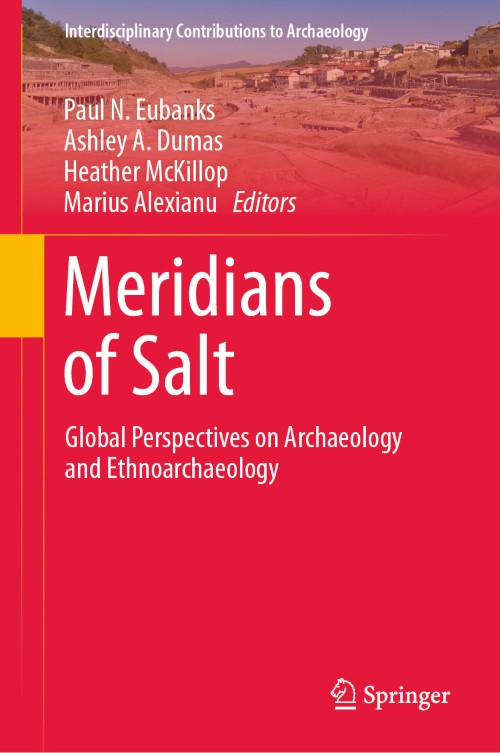
Meridians of Salt [electronic resource] : Global Perspectives on Archaeology and Ethnoarchaeology / edited by Paul N. Eubanks, Ashley A. Dumas, Heather McKillop, Marius Alexianu.
Erişim Adresi
ISBN
9783031966927
Dil Kodu
İngilizce
Yer Numarası
DK/6428
Basım Bildirimi
1st ed. 2025.
Yayın Bilgisi
Cham : Springer Nature Switzerland : Imprint: Springer, 2025.
Fiziksel Niteleme
XIV, 541 p. 191 illus., 150 illus. in color. online resource.
Dizi
Interdisciplinary Contributions to Archaeology, 2730-6984
İçindekiler Notu
Foreword (Ian W. Brown) -- Chapter 1. Introduction (Paul Eubanks, Ashley Dumas, Heather McKillop, and Marius Alexianu) -- Chapter 2. Desert Wealth: Ethnoarchaeology of the Afar Salt Trade, 450 BCE-1600 CE (Helina S. Woldekiros) -- Chapter 3. Resources, Exploitation, and Consumption of Salt in Anatolia (Türkiye) (Gonca Dardeniz) -- Chapter 4. Rock Salt Mining: Insights into Traditional and Ancient Exploitation Practices from Iran and Austria (Thomas Stöllner) -- Chapter 5. Salt Production and the Urban Center of Provadia-Solnitsata, Northeastern Bulgaria (5600 - 4350 BC) (Vassil Nikolov) -- Chapter 6. Salt Exploitation in Bosnia and Herzegovina (Ivana Pandzic) -- Chapter 7. Salt Exploitation from the Neolithic to the Roman Empire: Ocna Sibiului & Miercurea Sibiului (Romania). An Ethnoarchaeological Approach (Marius Alexianu, Andrei Asăndulesei, Felix-Adrian Tencariu, Mihaela Asăndulesei, Roxana-Gabriela Curcă) -- Chapter 8. Salt Exploitation in Ukraine (Svitlana Ivanova and Alexey G. Nikitin) -- Chapter 9. Salt and Power in Copper Age Iberia (Elisa Guerra-Doce, F. Javier Abarquero-Moras, and Germán Delibes-de Castro) -- Chapter 10. The Open-Pit Salt Mine in the Vall Salina of Cardona between 4200 and 3300 BC and the Socioeconomic Transformations in the Communities of the Catalan Middle Neolithic (Alfons Fíguls i Alonso) -- Chapter 11. Production and Demand of Salt in Ancient Italy from the Bronze Age to the Roman Period (Peter A. J. Attema, Luca Alessandri, Francesca Bulian, Jan Sevink, and Agostino Sotgia) -- Chapter 12. The Briquetage de la Seille (Lorraine, Eastern France) (Laurent Olivier) -- Chapter 13. Salt in the Old Continent: A Journey into Spain's Ancient Saltworks and Their Origins (Alberto Plata Montero) -- Chapter 14. Salt-making Traditions and Salt Trade in the Eastern Himalayas (Biswarup Ganguly and Bina Gandhi Deori) -- Chapter 15. Exploration, Discovery, and Foresight: Salt Production Archaeology in China (Li Shuicheng) -- Chapter 16. Archaeological Studies of Salt Production in Japan (Takamune Kawashima) -- Chapter 17. Salt Making Pottery in Prehistoric Japan: A Case Study from the Matsushima Coastal Area, Miyagi Prefecture (Itsuki Okamoto) -- Chapter 18. Unbroken Salt: Brine-boiling pottery and salt cakes in the Central Philippines (Andrea Yankowski) -- Chapter 19. Ethnohistory of Salt in the Mississippian and Contact-Era American Southeast (Ashley Dumas and Paul Eubanks) -- Chapter 20. The Precious Gift of Salt Woman: Ethnography and Archaeology of Salt in the American Southwest (Todd W. Bostwick) -- Chapter 21. Salt Archipelago: History and Archaeology of Salt Cultivation and Harvesting in the Caribbean (Konrad Antczak) -- Chapter 22. Salt Production Technology in Highland Central Mexico: Evolution and Adaptations Through Time (Blas Román Castellón Huerta) -- Chapter 23. Modeling the Economics of Salt Production from Wooden Architecture at the Paynes Creek Salt Works, Belize (Heather McKillop and E. Cory Sills) -- Chapter 24. One Step Closer to Knowing Ancient Salt Makers: New Insight into Pre-Hispanic Salt Workshops in Southeastern Mesoamerica (Akira Ichikawa) -- Chapter 25. Salt Production Studies in Colombia (Saul Alberto Torres Orjuela, Sonia Archila, and Marianne Cardale) -- Chapter 26. Conclusion: Salt in the Ancient World (Anthony Harding) -- Index.
Özet, vb.
This book explores the relationship between salt (sodium chloride) and the development of human societies from a cross-cultural and global perspective. Although it is not possible to discuss the importance of salt to all ancient and modern societies, the geographically and temporally diverse examples highlighted here are used to examine a series of related topics critical to understanding the economic, political, social, and religious impacts of salt through space and time. These topics include, among others, the techniques used to produce salt, the individuals responsible for its production, its cultural uses and applications, its role in cross-cultural exchange, and the impact of its circumscribed distribution on settlement patterns and developing complexity. In exploring these topics, the chapter authors rely on archaeological data to craft their interpretations, however, as salt itself is largely invisible in the archaeological record, other avenues of investigation such as ethnoarchaeology, ethnohistory, and experimental archaeology are necessary to gain a more complete understanding of this mineral’s influence on the development of human cultures. Each chapter includes a summary of seminal research within a particular geographic region along with a discussion of recent or on-going projects from that area. This volume is intended for a professional audience, but university students and graduates and readers with an interest in anthropology, archaeology, ethnoarchaeology, or history will find the chapters comprehensible and informative.
Konu
Archaeology.
Archaeology.
Archaeology.
Diğer Yazarlar
Kurum Adı
Eseri Alıntıla
Referansları kullanmadan önce gözden geçirmeniz ve varsa gerekli düzeltmeleri yapmanız önerilir.
Dijital Kaynak
MARC Görünümü
LEADER 08482nam a22006375i 4500
001 805105
003 TR_AnAIT
005 20260126235448
007 cr nn 008mamaa
008 250926s2025 sz | s |||| 0|eng d
020 |a9783031966927|9978-3-031-96692-7
024 7 |a10.1007/978-3-031-96692-7|2doi
041 |aeng
049 |aTürk Tarih Kurumu Kütüphanesi
050 4|aCC1-960
072 7|aHD|2bicssc
072 7|aSOC003000|2bisacsh
072 7|aNK|2thema
082 04|a930.1|223
090 |aDK/6428
245 10|aMeridians of Salt|h[electronic resource] :|bGlobal Perspectives on Archaeology and Ethnoarchaeology /|cedited by Paul N. Eubanks, Ashley A. Dumas, Heather McKillop, Marius Alexianu.
250 |a1st ed. 2025.
264 1|aCham :|bSpringer Nature Switzerland :|bImprint: Springer,|c2025.
300 |aXIV, 541 p. 191 illus., 150 illus. in color.|bonline resource.
336 |atext|btxt|2rdacontent
337 |acomputer|bc|2rdamedia
338 |aonline resource|bcr|2rdacarrier
341 0 |bPDF/UA-1|2onix
341 0 |bTable of contents navigation|2onix
341 0 |bSingle logical reading order|2onix
341 0 |bShort alternative textual descriptions|2onix
341 0 |bUse of color is not sole means of conveying information|2onix
341 0 |bUse of high contrast between text and background color|2onix
341 0 |bNext / Previous structural navigation|2onix
341 0 |bAll non-decorative content supports reading without sight|2onix
347 |atext file|bPDF|2rda
490 1 |aInterdisciplinary Contributions to Archaeology,|x2730-6984
505 0 |aForeword (Ian W. Brown) -- Chapter 1. Introduction (Paul Eubanks, Ashley Dumas, Heather McKillop, and Marius Alexianu) -- Chapter 2. Desert Wealth: Ethnoarchaeology of the Afar Salt Trade, 450 BCE-1600 CE (Helina S. Woldekiros) -- Chapter 3. Resources, Exploitation, and Consumption of Salt in Anatolia (Türkiye) (Gonca Dardeniz) -- Chapter 4. Rock Salt Mining: Insights into Traditional and Ancient Exploitation Practices from Iran and Austria (Thomas Stöllner) -- Chapter 5. Salt Production and the Urban Center of Provadia-Solnitsata, Northeastern Bulgaria (5600 - 4350 BC) (Vassil Nikolov) -- Chapter 6. Salt Exploitation in Bosnia and Herzegovina (Ivana Pandzic) -- Chapter 7. Salt Exploitation from the Neolithic to the Roman Empire: Ocna Sibiului & Miercurea Sibiului (Romania). An Ethnoarchaeological Approach (Marius Alexianu, Andrei Asăndulesei, Felix-Adrian Tencariu, Mihaela Asăndulesei, Roxana-Gabriela Curcă) -- Chapter 8. Salt Exploitation in Ukraine (Svitlana Ivanova and Alexey G. Nikitin) -- Chapter 9. Salt and Power in Copper Age Iberia (Elisa Guerra-Doce, F. Javier Abarquero-Moras, and Germán Delibes-de Castro) -- Chapter 10. The Open-Pit Salt Mine in the Vall Salina of Cardona between 4200 and 3300 BC and the Socioeconomic Transformations in the Communities of the Catalan Middle Neolithic (Alfons Fíguls i Alonso) -- Chapter 11. Production and Demand of Salt in Ancient Italy from the Bronze Age to the Roman Period (Peter A. J. Attema, Luca Alessandri, Francesca Bulian, Jan Sevink, and Agostino Sotgia) -- Chapter 12. The Briquetage de la Seille (Lorraine, Eastern France) (Laurent Olivier) -- Chapter 13. Salt in the Old Continent: A Journey into Spain's Ancient Saltworks and Their Origins (Alberto Plata Montero) -- Chapter 14. Salt-making Traditions and Salt Trade in the Eastern Himalayas (Biswarup Ganguly and Bina Gandhi Deori) -- Chapter 15. Exploration, Discovery, and Foresight: Salt Production Archaeology in China (Li Shuicheng) -- Chapter 16. Archaeological Studies of Salt Production in Japan (Takamune Kawashima) -- Chapter 17. Salt Making Pottery in Prehistoric Japan: A Case Study from the Matsushima Coastal Area, Miyagi Prefecture (Itsuki Okamoto) -- Chapter 18. Unbroken Salt: Brine-boiling pottery and salt cakes in the Central Philippines (Andrea Yankowski) -- Chapter 19. Ethnohistory of Salt in the Mississippian and Contact-Era American Southeast (Ashley Dumas and Paul Eubanks) -- Chapter 20. The Precious Gift of Salt Woman: Ethnography and Archaeology of Salt in the American Southwest (Todd W. Bostwick) -- Chapter 21. Salt Archipelago: History and Archaeology of Salt Cultivation and Harvesting in the Caribbean (Konrad Antczak) -- Chapter 22. Salt Production Technology in Highland Central Mexico: Evolution and Adaptations Through Time (Blas Román Castellón Huerta) -- Chapter 23. Modeling the Economics of Salt Production from Wooden Architecture at the Paynes Creek Salt Works, Belize (Heather McKillop and E. Cory Sills) -- Chapter 24. One Step Closer to Knowing Ancient Salt Makers: New Insight into Pre-Hispanic Salt Workshops in Southeastern Mesoamerica (Akira Ichikawa) -- Chapter 25. Salt Production Studies in Colombia (Saul Alberto Torres Orjuela, Sonia Archila, and Marianne Cardale) -- Chapter 26. Conclusion: Salt in the Ancient World (Anthony Harding) -- Index.
520 |aThis book explores the relationship between salt (sodium chloride) and the development of human societies from a cross-cultural and global perspective. Although it is not possible to discuss the importance of salt to all ancient and modern societies, the geographically and temporally diverse examples highlighted here are used to examine a series of related topics critical to understanding the economic, political, social, and religious impacts of salt through space and time. These topics include, among others, the techniques used to produce salt, the individuals responsible for its production, its cultural uses and applications, its role in cross-cultural exchange, and the impact of its circumscribed distribution on settlement patterns and developing complexity. In exploring these topics, the chapter authors rely on archaeological data to craft their interpretations, however, as salt itself is largely invisible in the archaeological record, other avenues of investigation such as ethnoarchaeology, ethnohistory, and experimental archaeology are necessary to gain a more complete understanding of this mineral’s influence on the development of human cultures. Each chapter includes a summary of seminal research within a particular geographic region along with a discussion of recent or on-going projects from that area. This volume is intended for a professional audience, but university students and graduates and readers with an interest in anthropology, archaeology, ethnoarchaeology, or history will find the chapters comprehensible and informative.
532 8 |aAccessibility summary: This PDF has been created in accordance with the PDF/UA-1 standard to enhance accessibility, including screen reader support, described non-text content (images, graphs), bookmarks for easy navigation, keyboard-friendly links and forms and searchable, selectable text. We recognize the importance of accessibility, and we welcome queries about accessibility for any of our products. If you have a question or an access need, please get in touch with us at accessibilitysupport@springernature.com. Please note that a more accessible version of this eBook is available as ePub.
532 8 |aNo reading system accessibility options actively disabled
532 8 |aPublisher contact for further accessibility information: accessibilitysupport@springernature.com
650 0|aArchaeology.
650 14|aArchaeology.
700 1 |aEubanks, Paul N.|eeditor.|0(orcid)0009-0003-5707-4350|1https://orcid.org/0009-0003-5707-4350|4edt|4http://id.loc.gov/vocabulary/relators/edt
700 1 |aDumas, Ashley A.|eeditor.|0(orcid)0009-0006-9314-5808|1https://orcid.org/0009-0006-9314-5808|4edt|4http://id.loc.gov/vocabulary/relators/edt
700 1 |aMcKillop, Heather.|eeditor.|0(orcid)0000-0002-0790-6417|1https://orcid.org/0000-0002-0790-6417|4edt|4http://id.loc.gov/vocabulary/relators/edt
700 1 |aAlexianu, Marius.|eeditor.|0(orcid)0000-0001-8581-5708|1https://orcid.org/0000-0001-8581-5708|4edt|4http://id.loc.gov/vocabulary/relators/edt
710 2 |aSpringerLink (Online service)
773 0 |tSpringer Nature eBook
776 08|iPrinted edition:|z9783031966910
776 08|iPrinted edition:|z9783031966934
776 08|iPrinted edition:|z9783031966941
830 0|aInterdisciplinary Contributions to Archaeology,|x2730-6984
856 40|uhttps://doi.org/10.1007/978-3-031-96692-7
912 |aZDB-2-HTY
912 |aZDB-2-SXH
950 |aHistory (SpringerNature-41172)
950 |aHistory (R0) (SpringerNature-43722)
001 805105
003 TR_AnAIT
005 20260126235448
007 cr nn 008mamaa
008 250926s2025 sz | s |||| 0|eng d
020 |a9783031966927|9978-3-031-96692-7
024 7 |a10.1007/978-3-031-96692-7|2doi
041 |aeng
049 |aTürk Tarih Kurumu Kütüphanesi
050 4|aCC1-960
072 7|aHD|2bicssc
072 7|aSOC003000|2bisacsh
072 7|aNK|2thema
082 04|a930.1|223
090 |aDK/6428
245 10|aMeridians of Salt|h[electronic resource] :|bGlobal Perspectives on Archaeology and Ethnoarchaeology /|cedited by Paul N. Eubanks, Ashley A. Dumas, Heather McKillop, Marius Alexianu.
250 |a1st ed. 2025.
264 1|aCham :|bSpringer Nature Switzerland :|bImprint: Springer,|c2025.
300 |aXIV, 541 p. 191 illus., 150 illus. in color.|bonline resource.
336 |atext|btxt|2rdacontent
337 |acomputer|bc|2rdamedia
338 |aonline resource|bcr|2rdacarrier
341 0 |bPDF/UA-1|2onix
341 0 |bTable of contents navigation|2onix
341 0 |bSingle logical reading order|2onix
341 0 |bShort alternative textual descriptions|2onix
341 0 |bUse of color is not sole means of conveying information|2onix
341 0 |bUse of high contrast between text and background color|2onix
341 0 |bNext / Previous structural navigation|2onix
341 0 |bAll non-decorative content supports reading without sight|2onix
347 |atext file|bPDF|2rda
490 1 |aInterdisciplinary Contributions to Archaeology,|x2730-6984
505 0 |aForeword (Ian W. Brown) -- Chapter 1. Introduction (Paul Eubanks, Ashley Dumas, Heather McKillop, and Marius Alexianu) -- Chapter 2. Desert Wealth: Ethnoarchaeology of the Afar Salt Trade, 450 BCE-1600 CE (Helina S. Woldekiros) -- Chapter 3. Resources, Exploitation, and Consumption of Salt in Anatolia (Türkiye) (Gonca Dardeniz) -- Chapter 4. Rock Salt Mining: Insights into Traditional and Ancient Exploitation Practices from Iran and Austria (Thomas Stöllner) -- Chapter 5. Salt Production and the Urban Center of Provadia-Solnitsata, Northeastern Bulgaria (5600 - 4350 BC) (Vassil Nikolov) -- Chapter 6. Salt Exploitation in Bosnia and Herzegovina (Ivana Pandzic) -- Chapter 7. Salt Exploitation from the Neolithic to the Roman Empire: Ocna Sibiului & Miercurea Sibiului (Romania). An Ethnoarchaeological Approach (Marius Alexianu, Andrei Asăndulesei, Felix-Adrian Tencariu, Mihaela Asăndulesei, Roxana-Gabriela Curcă) -- Chapter 8. Salt Exploitation in Ukraine (Svitlana Ivanova and Alexey G. Nikitin) -- Chapter 9. Salt and Power in Copper Age Iberia (Elisa Guerra-Doce, F. Javier Abarquero-Moras, and Germán Delibes-de Castro) -- Chapter 10. The Open-Pit Salt Mine in the Vall Salina of Cardona between 4200 and 3300 BC and the Socioeconomic Transformations in the Communities of the Catalan Middle Neolithic (Alfons Fíguls i Alonso) -- Chapter 11. Production and Demand of Salt in Ancient Italy from the Bronze Age to the Roman Period (Peter A. J. Attema, Luca Alessandri, Francesca Bulian, Jan Sevink, and Agostino Sotgia) -- Chapter 12. The Briquetage de la Seille (Lorraine, Eastern France) (Laurent Olivier) -- Chapter 13. Salt in the Old Continent: A Journey into Spain's Ancient Saltworks and Their Origins (Alberto Plata Montero) -- Chapter 14. Salt-making Traditions and Salt Trade in the Eastern Himalayas (Biswarup Ganguly and Bina Gandhi Deori) -- Chapter 15. Exploration, Discovery, and Foresight: Salt Production Archaeology in China (Li Shuicheng) -- Chapter 16. Archaeological Studies of Salt Production in Japan (Takamune Kawashima) -- Chapter 17. Salt Making Pottery in Prehistoric Japan: A Case Study from the Matsushima Coastal Area, Miyagi Prefecture (Itsuki Okamoto) -- Chapter 18. Unbroken Salt: Brine-boiling pottery and salt cakes in the Central Philippines (Andrea Yankowski) -- Chapter 19. Ethnohistory of Salt in the Mississippian and Contact-Era American Southeast (Ashley Dumas and Paul Eubanks) -- Chapter 20. The Precious Gift of Salt Woman: Ethnography and Archaeology of Salt in the American Southwest (Todd W. Bostwick) -- Chapter 21. Salt Archipelago: History and Archaeology of Salt Cultivation and Harvesting in the Caribbean (Konrad Antczak) -- Chapter 22. Salt Production Technology in Highland Central Mexico: Evolution and Adaptations Through Time (Blas Román Castellón Huerta) -- Chapter 23. Modeling the Economics of Salt Production from Wooden Architecture at the Paynes Creek Salt Works, Belize (Heather McKillop and E. Cory Sills) -- Chapter 24. One Step Closer to Knowing Ancient Salt Makers: New Insight into Pre-Hispanic Salt Workshops in Southeastern Mesoamerica (Akira Ichikawa) -- Chapter 25. Salt Production Studies in Colombia (Saul Alberto Torres Orjuela, Sonia Archila, and Marianne Cardale) -- Chapter 26. Conclusion: Salt in the Ancient World (Anthony Harding) -- Index.
520 |aThis book explores the relationship between salt (sodium chloride) and the development of human societies from a cross-cultural and global perspective. Although it is not possible to discuss the importance of salt to all ancient and modern societies, the geographically and temporally diverse examples highlighted here are used to examine a series of related topics critical to understanding the economic, political, social, and religious impacts of salt through space and time. These topics include, among others, the techniques used to produce salt, the individuals responsible for its production, its cultural uses and applications, its role in cross-cultural exchange, and the impact of its circumscribed distribution on settlement patterns and developing complexity. In exploring these topics, the chapter authors rely on archaeological data to craft their interpretations, however, as salt itself is largely invisible in the archaeological record, other avenues of investigation such as ethnoarchaeology, ethnohistory, and experimental archaeology are necessary to gain a more complete understanding of this mineral’s influence on the development of human cultures. Each chapter includes a summary of seminal research within a particular geographic region along with a discussion of recent or on-going projects from that area. This volume is intended for a professional audience, but university students and graduates and readers with an interest in anthropology, archaeology, ethnoarchaeology, or history will find the chapters comprehensible and informative.
532 8 |aAccessibility summary: This PDF has been created in accordance with the PDF/UA-1 standard to enhance accessibility, including screen reader support, described non-text content (images, graphs), bookmarks for easy navigation, keyboard-friendly links and forms and searchable, selectable text. We recognize the importance of accessibility, and we welcome queries about accessibility for any of our products. If you have a question or an access need, please get in touch with us at accessibilitysupport@springernature.com. Please note that a more accessible version of this eBook is available as ePub.
532 8 |aNo reading system accessibility options actively disabled
532 8 |aPublisher contact for further accessibility information: accessibilitysupport@springernature.com
650 0|aArchaeology.
650 14|aArchaeology.
700 1 |aEubanks, Paul N.|eeditor.|0(orcid)0009-0003-5707-4350|1https://orcid.org/0009-0003-5707-4350|4edt|4http://id.loc.gov/vocabulary/relators/edt
700 1 |aDumas, Ashley A.|eeditor.|0(orcid)0009-0006-9314-5808|1https://orcid.org/0009-0006-9314-5808|4edt|4http://id.loc.gov/vocabulary/relators/edt
700 1 |aMcKillop, Heather.|eeditor.|0(orcid)0000-0002-0790-6417|1https://orcid.org/0000-0002-0790-6417|4edt|4http://id.loc.gov/vocabulary/relators/edt
700 1 |aAlexianu, Marius.|eeditor.|0(orcid)0000-0001-8581-5708|1https://orcid.org/0000-0001-8581-5708|4edt|4http://id.loc.gov/vocabulary/relators/edt
710 2 |aSpringerLink (Online service)
773 0 |tSpringer Nature eBook
776 08|iPrinted edition:|z9783031966910
776 08|iPrinted edition:|z9783031966934
776 08|iPrinted edition:|z9783031966941
830 0|aInterdisciplinary Contributions to Archaeology,|x2730-6984
856 40|uhttps://doi.org/10.1007/978-3-031-96692-7
912 |aZDB-2-HTY
912 |aZDB-2-SXH
950 |aHistory (SpringerNature-41172)
950 |aHistory (R0) (SpringerNature-43722)
Materyaller
Depodan talep edilen materyal sadece kütüphane içerisinde kullanılmaktadır.
Materyal dışarıya ödünç verilmemektedir.
Materyal dışarıya ödünç verilmemektedir.
