

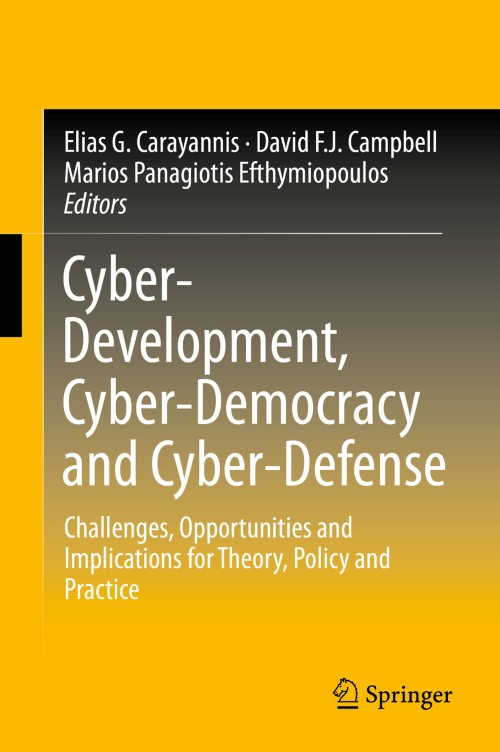
Cyber-Development, Cyber-Democracy and Cyber-Defense [electronic resource] : Challenges, Opportunities and Implications for Theory, Policy and Practice / edited by Elias G. Carayannis, David F. J. Campbell, Marios Panagiotis Efthymiopoulos.
Erişim Adresi
ISBN
9781493910281
Dil Kodu
İngilizce
Yer Numarası
DK/6494
Basım Bildirimi
1st ed. 2014.
Yayın Bilgisi
New York, NY : Springer New York : Imprint: Springer, 2014.
Fiziksel Niteleme
XV, 354 p. 39 illus., 25 illus. in color. online resource.
İçindekiler Notu
From Development as Democracy to Innovation as Development -- E-Development and Knowledge Economy: The Role of ICT and SME Incubation -- Addressing the Impact of E-Development in the Knowledge Economy and Society: Outputs, Outcomes and Impacts -- Explaining and Comparing Quality of Democracy in Quadruple Helix Structures -- The Effects of Cyber democracy on the Middle East: Egypt and Iran -- Democratization in the Middle East and North Africa: Tunisia, Egypt and Turkey -- Cyber Democracy: The Future of Democracy? -- Cyber Democracy and Cyber Crime: Two Sides of the Same Coin -- "Creating" a Public Sphere in Cyber Space: The Case of the EU -- Cyber Power and the State -- Cyber security in Europe: Cooperation and Investment -- NATO’s Cyber Defense as Methodology for Smart Defense -- The Security Culture of a Global and Multileveled Cyber Security -- The Relevance of Endpoint Security in Enterprise Networks.
Özet, vb.
In this volume, contributors from academia, industry, and policy explore the inter-connections among economic development, socio-political democracy, and defense and security in the context of a profound transformation, spurred by globalization and supported by the rapid development of information and communication technologies (ICT). This powerful combination of forces is changing the way we live, and redefining the way companies conduct business and national governments pursue strategies of innovation, economic growth, and diplomacy. Integrating theoretical frameworks, empirical research, and case studies, the editors and contributors have organized the chapters into three major sections, focusing on cyber-development, cyber-democracy, and cyber-defense. The authors define cyber-development as a set of tools, methodologies, and practices that leverage ICT to catalyze and accelerate social, political, and economic development, with an emphasis on making the transition to knowledge-based economies. One underlying understanding here is that knowledge, knowledge creation, knowledge production and knowledge application (innovation) behave as crucial drivers for enhancing democracy, society, and the economy. By promoting dissemination and sharing of knowledge, cyber-democracy allows a knowledge conversion of the local into the global (gloCal) and vice versa, resulting in a gloCal platform for communication and knowledge interaction and knowledge enhancement. Meanwhile, technology-enabled interconnectivity increases the need to adopt new methods and actions for protection against existing threats and possible challenges to emerge in the future. The final section contemplates themes of cyber-defense and security, as well as emerging theories and values, legal aspects, and trans-continental links (NATO, international organizations, and bilateral relations between states). Collectively, the authors present aunique collection of insights and perspectives on the challenges and opportunities inspired by connectivity.
Konu
International relations.
Political science.
Data protection.
International law.
International Relations.
Political Science.
Data and Information Security.
Public International Law.
Political science.
Data protection.
International law.
International Relations.
Political Science.
Data and Information Security.
Public International Law.
Diğer Yazarlar
Kurum Adı
Eseri Alıntıla
Referansları kullanmadan önce gözden geçirmeniz ve varsa gerekli düzeltmeleri yapmanız önerilir.
Dijital Kaynak
MARC Görünümü
LEADER 05202nam a22005415i 4500
001 805172
003 TR_AnAIT
005 20260126235618
007 cr nn 008mamaa
008 140814s2014 xxu| s |||| 0|eng d
020 |a9781493910281|9978-1-4939-1028-1
024 7 |a10.1007/978-1-4939-1028-1|2doi
041 |aeng
049 |aTürk Tarih Kurumu Kütüphanesi
050 4|aJZ2-6530
072 7|aJPS|2bicssc
072 7|aPOL011000|2bisacsh
072 7|aJPS|2thema
082 04|a327|223
090 |aDK/6494
245 10|aCyber-Development, Cyber-Democracy and Cyber-Defense|h[electronic resource] :|bChallenges, Opportunities and Implications for Theory, Policy and Practice /|cedited by Elias G. Carayannis, David F. J. Campbell, Marios Panagiotis Efthymiopoulos.
250 |a1st ed. 2014.
264 1|aNew York, NY :|bSpringer New York :|bImprint: Springer,|c2014.
300 |aXV, 354 p. 39 illus., 25 illus. in color.|bonline resource.
336 |atext|btxt|2rdacontent
337 |acomputer|bc|2rdamedia
338 |aonline resource|bcr|2rdacarrier
347 |atext file|bPDF|2rda
505 0 |aFrom Development as Democracy to Innovation as Development -- E-Development and Knowledge Economy: The Role of ICT and SME Incubation -- Addressing the Impact of E-Development in the Knowledge Economy and Society: Outputs, Outcomes and Impacts -- Explaining and Comparing Quality of Democracy in Quadruple Helix Structures -- The Effects of Cyber democracy on the Middle East: Egypt and Iran -- Democratization in the Middle East and North Africa: Tunisia, Egypt and Turkey -- Cyber Democracy: The Future of Democracy? -- Cyber Democracy and Cyber Crime: Two Sides of the Same Coin -- "Creating" a Public Sphere in Cyber Space: The Case of the EU -- Cyber Power and the State -- Cyber security in Europe: Cooperation and Investment -- NATO’s Cyber Defense as Methodology for Smart Defense -- The Security Culture of a Global and Multileveled Cyber Security -- The Relevance of Endpoint Security in Enterprise Networks.
520 |aIn this volume, contributors from academia, industry, and policy explore the inter-connections among economic development, socio-political democracy, and defense and security in the context of a profound transformation, spurred by globalization and supported by the rapid development of information and communication technologies (ICT). This powerful combination of forces is changing the way we live, and redefining the way companies conduct business and national governments pursue strategies of innovation, economic growth, and diplomacy. Integrating theoretical frameworks, empirical research, and case studies, the editors and contributors have organized the chapters into three major sections, focusing on cyber-development, cyber-democracy, and cyber-defense. The authors define cyber-development as a set of tools, methodologies, and practices that leverage ICT to catalyze and accelerate social, political, and economic development, with an emphasis on making the transition to knowledge-based economies. One underlying understanding here is that knowledge, knowledge creation, knowledge production and knowledge application (innovation) behave as crucial drivers for enhancing democracy, society, and the economy. By promoting dissemination and sharing of knowledge, cyber-democracy allows a knowledge conversion of the local into the global (gloCal) and vice versa, resulting in a gloCal platform for communication and knowledge interaction and knowledge enhancement. Meanwhile, technology-enabled interconnectivity increases the need to adopt new methods and actions for protection against existing threats and possible challenges to emerge in the future. The final section contemplates themes of cyber-defense and security, as well as emerging theories and values, legal aspects, and trans-continental links (NATO, international organizations, and bilateral relations between states). Collectively, the authors present aunique collection of insights and perspectives on the challenges and opportunities inspired by connectivity.
650 0|aInternational relations.
650 0|aPolitical science.
650 0|aData protection.
650 0|aInternational law.
650 14|aInternational Relations.
650 24|aPolitical Science.
650 24|aData and Information Security.
650 24|aPublic International Law.
700 1 |aCarayannis, Elias G.|eeditor.|0(orcid)0000-0003-2348-4311|1https://orcid.org/0000-0003-2348-4311|4edt|4http://id.loc.gov/vocabulary/relators/edt
700 1 |aCampbell, David F. J.|eeditor.|4edt|4http://id.loc.gov/vocabulary/relators/edt
700 1 |aEfthymiopoulos, Marios Panagiotis.|eeditor.|4edt|4http://id.loc.gov/vocabulary/relators/edt
710 2 |aSpringerLink (Online service)
773 0 |tSpringer Nature eBook
776 08|iPrinted edition:|z9781493910274
776 08|iPrinted edition:|z9781493910298
776 08|iPrinted edition:|z9781493952915
856 40|uhttps://doi.org/10.1007/978-1-4939-1028-1
912 |aZDB-2-SHU
912 |aZDB-2-SXPI
950 |aHumanities, Social Sciences and Law (SpringerNature-11648)
950 |aPolitical Science and International Studies (R0) (SpringerNature-43724)
001 805172
003 TR_AnAIT
005 20260126235618
007 cr nn 008mamaa
008 140814s2014 xxu| s |||| 0|eng d
020 |a9781493910281|9978-1-4939-1028-1
024 7 |a10.1007/978-1-4939-1028-1|2doi
041 |aeng
049 |aTürk Tarih Kurumu Kütüphanesi
050 4|aJZ2-6530
072 7|aJPS|2bicssc
072 7|aPOL011000|2bisacsh
072 7|aJPS|2thema
082 04|a327|223
090 |aDK/6494
245 10|aCyber-Development, Cyber-Democracy and Cyber-Defense|h[electronic resource] :|bChallenges, Opportunities and Implications for Theory, Policy and Practice /|cedited by Elias G. Carayannis, David F. J. Campbell, Marios Panagiotis Efthymiopoulos.
250 |a1st ed. 2014.
264 1|aNew York, NY :|bSpringer New York :|bImprint: Springer,|c2014.
300 |aXV, 354 p. 39 illus., 25 illus. in color.|bonline resource.
336 |atext|btxt|2rdacontent
337 |acomputer|bc|2rdamedia
338 |aonline resource|bcr|2rdacarrier
347 |atext file|bPDF|2rda
505 0 |aFrom Development as Democracy to Innovation as Development -- E-Development and Knowledge Economy: The Role of ICT and SME Incubation -- Addressing the Impact of E-Development in the Knowledge Economy and Society: Outputs, Outcomes and Impacts -- Explaining and Comparing Quality of Democracy in Quadruple Helix Structures -- The Effects of Cyber democracy on the Middle East: Egypt and Iran -- Democratization in the Middle East and North Africa: Tunisia, Egypt and Turkey -- Cyber Democracy: The Future of Democracy? -- Cyber Democracy and Cyber Crime: Two Sides of the Same Coin -- "Creating" a Public Sphere in Cyber Space: The Case of the EU -- Cyber Power and the State -- Cyber security in Europe: Cooperation and Investment -- NATO’s Cyber Defense as Methodology for Smart Defense -- The Security Culture of a Global and Multileveled Cyber Security -- The Relevance of Endpoint Security in Enterprise Networks.
520 |aIn this volume, contributors from academia, industry, and policy explore the inter-connections among economic development, socio-political democracy, and defense and security in the context of a profound transformation, spurred by globalization and supported by the rapid development of information and communication technologies (ICT). This powerful combination of forces is changing the way we live, and redefining the way companies conduct business and national governments pursue strategies of innovation, economic growth, and diplomacy. Integrating theoretical frameworks, empirical research, and case studies, the editors and contributors have organized the chapters into three major sections, focusing on cyber-development, cyber-democracy, and cyber-defense. The authors define cyber-development as a set of tools, methodologies, and practices that leverage ICT to catalyze and accelerate social, political, and economic development, with an emphasis on making the transition to knowledge-based economies. One underlying understanding here is that knowledge, knowledge creation, knowledge production and knowledge application (innovation) behave as crucial drivers for enhancing democracy, society, and the economy. By promoting dissemination and sharing of knowledge, cyber-democracy allows a knowledge conversion of the local into the global (gloCal) and vice versa, resulting in a gloCal platform for communication and knowledge interaction and knowledge enhancement. Meanwhile, technology-enabled interconnectivity increases the need to adopt new methods and actions for protection against existing threats and possible challenges to emerge in the future. The final section contemplates themes of cyber-defense and security, as well as emerging theories and values, legal aspects, and trans-continental links (NATO, international organizations, and bilateral relations between states). Collectively, the authors present aunique collection of insights and perspectives on the challenges and opportunities inspired by connectivity.
650 0|aInternational relations.
650 0|aPolitical science.
650 0|aData protection.
650 0|aInternational law.
650 14|aInternational Relations.
650 24|aPolitical Science.
650 24|aData and Information Security.
650 24|aPublic International Law.
700 1 |aCarayannis, Elias G.|eeditor.|0(orcid)0000-0003-2348-4311|1https://orcid.org/0000-0003-2348-4311|4edt|4http://id.loc.gov/vocabulary/relators/edt
700 1 |aCampbell, David F. J.|eeditor.|4edt|4http://id.loc.gov/vocabulary/relators/edt
700 1 |aEfthymiopoulos, Marios Panagiotis.|eeditor.|4edt|4http://id.loc.gov/vocabulary/relators/edt
710 2 |aSpringerLink (Online service)
773 0 |tSpringer Nature eBook
776 08|iPrinted edition:|z9781493910274
776 08|iPrinted edition:|z9781493910298
776 08|iPrinted edition:|z9781493952915
856 40|uhttps://doi.org/10.1007/978-1-4939-1028-1
912 |aZDB-2-SHU
912 |aZDB-2-SXPI
950 |aHumanities, Social Sciences and Law (SpringerNature-11648)
950 |aPolitical Science and International Studies (R0) (SpringerNature-43724)
Materyaller
Depodan talep edilen materyal sadece kütüphane içerisinde kullanılmaktadır.
Materyal dışarıya ödünç verilmemektedir.
Materyal dışarıya ödünç verilmemektedir.
