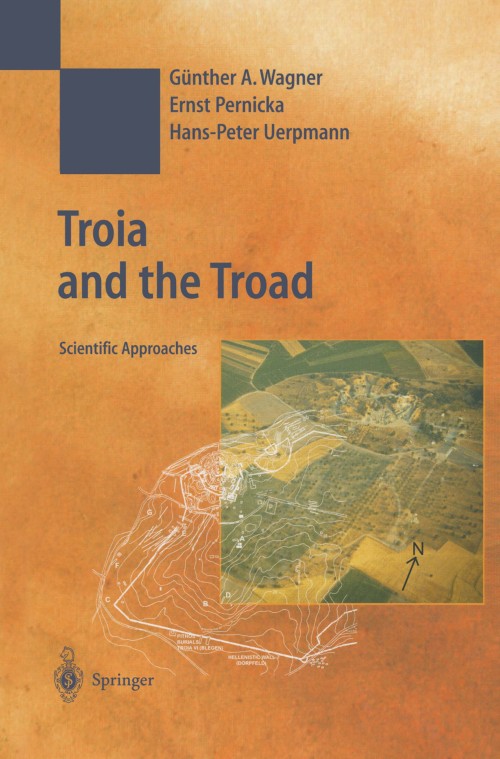
Troia and the Troad [electronic resource] : Scientific Approaches / edited by Günther A. Wagner, Ernst Pernicka, Hans-Peter Uerpmann.
Erişim Adresi
ISBN
9783662053089
Dil Kodu
İngilizce
Yer Numarası
DK/6502
Basım Bildirimi
1st ed. 2003.
Yayın Bilgisi
Berlin, Heidelberg : Springer Berlin Heidelberg : Imprint: Springer, 2003.
Fiziksel Niteleme
XVI, 449 p. 158 illus., 3 illus. in color. online resource.
Dizi
Natural Science in Archaeology
İçindekiler Notu
1 Introduction — Troia and Natural Sciences -- Historical and Geological Context of the Troad -- 2 The Case for Historical Significance in Homer’s Landmarks at Troia -- 3 The Relationship Between Man and Landscape in the Troad During the Ottoman Period -- 4 Heidelberg Radiocarbon Dates for Troia I to VIII and Kumtepe -- 5 Seismotectonics and Geology of Troia and Surrounding Areas, Northwest Anatolia -- 6 The Link Between the Black Sea and the Mediterranean Since the End of the Last Ice Age: Archaeology and Geology -- 7 On the Oscillations of the Black Sea Level in the Holocene Period from an Archaeological Viewpoint -- 8 The Black Sea, the Sea of Marmara and Bronze Age Archaeology — an Archaeological Predicament -- 9 Delta Evolution and Culture — Aspects of Geoarchaeological Research in Miletos and Priene -- Mineral Deposits and Materials -- 10 Early Bronze Age Metallurgy in the Northeast Aegean -- 11 On the Composition and Provenance of Metal Finds from Besiktepe (Troia) -- 12 Provenance of White Marble Building Stones in the Monuments of Ancient Troia -- 13 Provenance Studies of Pottery and Granite Columns in Troia -- 14 On the Origin of Coarse Wares of Troia VII -- Archaeobiology -- 15 Environmental Aspects of Economic Changes in Troia -- 16 Troia and Fallow Deer -- 17 Troian Bird Remains — Environment and Hunting -- 18 Proposal of an Effective Concept for the Troad — a Strategy for the Preservation of an Important Ecological Building Block in the International System of Bird Migration -- 19 Rural Plenty: the Result of Hard Work — Rich Middle Bronze Age Plant Remains from Agios Mamas, Chalkidike -- 20 Regional Palaeodemographic Aspects of Troia and Its Ecosystem -- Landscape Change of the Trojan Site and Plain -- 21 Some Open Questions About the Plain of Troia -- 22 TheGeophysical Mapping of the Lower City of Troia/Ilion -- 23 Stratigraphy, Geochemistry and Geochronometry of Sedimentary Archives Around Hisarhk Hill — a Pilot Study -- 24 Sedimentary Facies Patterns and the Interpretation of Paleogeographies of Ancient Troia -- 25 Geoarchaeological Interpretations of the “Troian Bay” -- References.
Özet, vb.
When reconstructing the past, the archaeologist needs to take into account all kinds of relevant information. Where no written sources are available, the natural sciences play an indispensable role. Troia is a remarkable site in this respect. The present excavation project at Troia, under the directorship of Manfred Korfmann, integrates various disciplines including geoarchaeology, archaeobotany, zooarchaeology, anthropology, geophysical prospection as well as chemical and technological studies of metal, stone and pottery. Hardly any other archaeological project is supported so intensely and on such a broad scale by archaeometric investigations as the international research group in Troia. In April 2001 an International Symposium was held in Heidelberg, Germany, with the aim of promoting scientific discussion and providing synopses of the various disciplines engaged in Troia. This volume contains most of the contributions presented at the symposium. Due to its broad natural scientific as well as its cultural-historic scope, not only will the specialist but also the interested layman find the book rewarding.
Konu
Archaeology.
Anthropology.
Geology.
Geography.
Archaeology.
Anthropology.
Geology.
Geography.
Anthropology.
Geology.
Geography.
Archaeology.
Anthropology.
Geology.
Geography.
Diğer Yazarlar
Kurum Adı

Eseri Alıntıla
Referansları kullanmadan önce gözden geçirmeniz ve varsa gerekli düzeltmeleri yapmanız önerilir.
Dijital Kaynak
MARC Görünümü
LEADER 06102nam a22006255i 4500
001 805180
003 TR_AnAIT
005 20260126235628
007 cr nn 008mamaa
008 130101s2003 gw | s |||| 0|eng d
020 |a9783662053089|9978-3-662-05308-9
024 7 |a10.1007/978-3-662-05308-9|2doi
041 |aeng
049 |aTürk Tarih Kurumu Kütüphanesi
050 4|aCC1-960
072 7|aHD|2bicssc
072 7|aSOC003000|2bisacsh
072 7|aNK|2thema
082 04|a930.1|223
090 |aDK/6502
245 10|aTroia and the Troad|h[electronic resource] :|bScientific Approaches /|cedited by Günther A. Wagner, Ernst Pernicka, Hans-Peter Uerpmann.
250 |a1st ed. 2003.
264 1|aBerlin, Heidelberg :|bSpringer Berlin Heidelberg :|bImprint: Springer,|c2003.
300 |aXVI, 449 p. 158 illus., 3 illus. in color.|bonline resource.
336 |atext|btxt|2rdacontent
337 |acomputer|bc|2rdamedia
338 |aonline resource|bcr|2rdacarrier
347 |atext file|bPDF|2rda
490 1 |aNatural Science in Archaeology
505 0 |a1 Introduction — Troia and Natural Sciences -- Historical and Geological Context of the Troad -- 2 The Case for Historical Significance in Homer’s Landmarks at Troia -- 3 The Relationship Between Man and Landscape in the Troad During the Ottoman Period -- 4 Heidelberg Radiocarbon Dates for Troia I to VIII and Kumtepe -- 5 Seismotectonics and Geology of Troia and Surrounding Areas, Northwest Anatolia -- 6 The Link Between the Black Sea and the Mediterranean Since the End of the Last Ice Age: Archaeology and Geology -- 7 On the Oscillations of the Black Sea Level in the Holocene Period from an Archaeological Viewpoint -- 8 The Black Sea, the Sea of Marmara and Bronze Age Archaeology — an Archaeological Predicament -- 9 Delta Evolution and Culture — Aspects of Geoarchaeological Research in Miletos and Priene -- Mineral Deposits and Materials -- 10 Early Bronze Age Metallurgy in the Northeast Aegean -- 11 On the Composition and Provenance of Metal Finds from Besiktepe (Troia) -- 12 Provenance of White Marble Building Stones in the Monuments of Ancient Troia -- 13 Provenance Studies of Pottery and Granite Columns in Troia -- 14 On the Origin of Coarse Wares of Troia VII -- Archaeobiology -- 15 Environmental Aspects of Economic Changes in Troia -- 16 Troia and Fallow Deer -- 17 Troian Bird Remains — Environment and Hunting -- 18 Proposal of an Effective Concept for the Troad — a Strategy for the Preservation of an Important Ecological Building Block in the International System of Bird Migration -- 19 Rural Plenty: the Result of Hard Work — Rich Middle Bronze Age Plant Remains from Agios Mamas, Chalkidike -- 20 Regional Palaeodemographic Aspects of Troia and Its Ecosystem -- Landscape Change of the Trojan Site and Plain -- 21 Some Open Questions About the Plain of Troia -- 22 TheGeophysical Mapping of the Lower City of Troia/Ilion -- 23 Stratigraphy, Geochemistry and Geochronometry of Sedimentary Archives Around Hisarhk Hill — a Pilot Study -- 24 Sedimentary Facies Patterns and the Interpretation of Paleogeographies of Ancient Troia -- 25 Geoarchaeological Interpretations of the “Troian Bay” -- References.
520 |aWhen reconstructing the past, the archaeologist needs to take into account all kinds of relevant information. Where no written sources are available, the natural sciences play an indispensable role. Troia is a remarkable site in this respect. The present excavation project at Troia, under the directorship of Manfred Korfmann, integrates various disciplines including geoarchaeology, archaeobotany, zooarchaeology, anthropology, geophysical prospection as well as chemical and technological studies of metal, stone and pottery. Hardly any other archaeological project is supported so intensely and on such a broad scale by archaeometric investigations as the international research group in Troia. In April 2001 an International Symposium was held in Heidelberg, Germany, with the aim of promoting scientific discussion and providing synopses of the various disciplines engaged in Troia. This volume contains most of the contributions presented at the symposium. Due to its broad natural scientific as well as its cultural-historic scope, not only will the specialist but also the interested layman find the book rewarding.
532 8 |aAccessibility summary: This PDF is not accessible. It is based on scanned pages and does not support features such as screen reader compatibility or described non-text content (images, graphs etc). However, it likely supports searchable and selectable text based on OCR (Optical Character Recognition). Users with accessibility needs may not be able to use this content effectively. Please contact us at accessibilitysupport@springernature.com if you require assistance or an alternative format.
532 8 |aInaccessible, or known limited accessibility
532 8 |aNo reading system accessibility options actively disabled
532 8 |aPublisher contact for further accessibility information: accessibilitysupport@springernature.com
650 0|aArchaeology.
650 0|aAnthropology.
650 0|aGeology.
650 0|aGeography.
650 14|aArchaeology.
650 24|aAnthropology.
650 24|aGeology.
650 24|aGeography.
700 1 |aWagner, Günther A.|eeditor.|4edt|4http://id.loc.gov/vocabulary/relators/edt
700 1 |aPernicka, Ernst.|eeditor.|4edt|4http://id.loc.gov/vocabulary/relators/edt
700 1 |aUerpmann, Hans-Peter.|eeditor.|4edt|4http://id.loc.gov/vocabulary/relators/edt
710 2 |aSpringerLink (Online service)
773 0 |tSpringer Nature eBook
776 08|iPrinted edition:|z9783540437116
776 08|iPrinted edition:|z9783642078323
776 08|iPrinted edition:|z9783662053096
830 0|aNatural Science in Archaeology
856 40|uhttps://doi.org/10.1007/978-3-662-05308-9
912 |aZDB-2-SHU
912 |aZDB-2-SXS
912 |aZDB-2-BAE
950 |aHumanities, Social Sciences and Law (SpringerNature-11648)
950 |aSocial Sciences (R0) (SpringerNature-43726)
001 805180
003 TR_AnAIT
005 20260126235628
007 cr nn 008mamaa
008 130101s2003 gw | s |||| 0|eng d
020 |a9783662053089|9978-3-662-05308-9
024 7 |a10.1007/978-3-662-05308-9|2doi
041 |aeng
049 |aTürk Tarih Kurumu Kütüphanesi
050 4|aCC1-960
072 7|aHD|2bicssc
072 7|aSOC003000|2bisacsh
072 7|aNK|2thema
082 04|a930.1|223
090 |aDK/6502
245 10|aTroia and the Troad|h[electronic resource] :|bScientific Approaches /|cedited by Günther A. Wagner, Ernst Pernicka, Hans-Peter Uerpmann.
250 |a1st ed. 2003.
264 1|aBerlin, Heidelberg :|bSpringer Berlin Heidelberg :|bImprint: Springer,|c2003.
300 |aXVI, 449 p. 158 illus., 3 illus. in color.|bonline resource.
336 |atext|btxt|2rdacontent
337 |acomputer|bc|2rdamedia
338 |aonline resource|bcr|2rdacarrier
347 |atext file|bPDF|2rda
490 1 |aNatural Science in Archaeology
505 0 |a1 Introduction — Troia and Natural Sciences -- Historical and Geological Context of the Troad -- 2 The Case for Historical Significance in Homer’s Landmarks at Troia -- 3 The Relationship Between Man and Landscape in the Troad During the Ottoman Period -- 4 Heidelberg Radiocarbon Dates for Troia I to VIII and Kumtepe -- 5 Seismotectonics and Geology of Troia and Surrounding Areas, Northwest Anatolia -- 6 The Link Between the Black Sea and the Mediterranean Since the End of the Last Ice Age: Archaeology and Geology -- 7 On the Oscillations of the Black Sea Level in the Holocene Period from an Archaeological Viewpoint -- 8 The Black Sea, the Sea of Marmara and Bronze Age Archaeology — an Archaeological Predicament -- 9 Delta Evolution and Culture — Aspects of Geoarchaeological Research in Miletos and Priene -- Mineral Deposits and Materials -- 10 Early Bronze Age Metallurgy in the Northeast Aegean -- 11 On the Composition and Provenance of Metal Finds from Besiktepe (Troia) -- 12 Provenance of White Marble Building Stones in the Monuments of Ancient Troia -- 13 Provenance Studies of Pottery and Granite Columns in Troia -- 14 On the Origin of Coarse Wares of Troia VII -- Archaeobiology -- 15 Environmental Aspects of Economic Changes in Troia -- 16 Troia and Fallow Deer -- 17 Troian Bird Remains — Environment and Hunting -- 18 Proposal of an Effective Concept for the Troad — a Strategy for the Preservation of an Important Ecological Building Block in the International System of Bird Migration -- 19 Rural Plenty: the Result of Hard Work — Rich Middle Bronze Age Plant Remains from Agios Mamas, Chalkidike -- 20 Regional Palaeodemographic Aspects of Troia and Its Ecosystem -- Landscape Change of the Trojan Site and Plain -- 21 Some Open Questions About the Plain of Troia -- 22 TheGeophysical Mapping of the Lower City of Troia/Ilion -- 23 Stratigraphy, Geochemistry and Geochronometry of Sedimentary Archives Around Hisarhk Hill — a Pilot Study -- 24 Sedimentary Facies Patterns and the Interpretation of Paleogeographies of Ancient Troia -- 25 Geoarchaeological Interpretations of the “Troian Bay” -- References.
520 |aWhen reconstructing the past, the archaeologist needs to take into account all kinds of relevant information. Where no written sources are available, the natural sciences play an indispensable role. Troia is a remarkable site in this respect. The present excavation project at Troia, under the directorship of Manfred Korfmann, integrates various disciplines including geoarchaeology, archaeobotany, zooarchaeology, anthropology, geophysical prospection as well as chemical and technological studies of metal, stone and pottery. Hardly any other archaeological project is supported so intensely and on such a broad scale by archaeometric investigations as the international research group in Troia. In April 2001 an International Symposium was held in Heidelberg, Germany, with the aim of promoting scientific discussion and providing synopses of the various disciplines engaged in Troia. This volume contains most of the contributions presented at the symposium. Due to its broad natural scientific as well as its cultural-historic scope, not only will the specialist but also the interested layman find the book rewarding.
532 8 |aAccessibility summary: This PDF is not accessible. It is based on scanned pages and does not support features such as screen reader compatibility or described non-text content (images, graphs etc). However, it likely supports searchable and selectable text based on OCR (Optical Character Recognition). Users with accessibility needs may not be able to use this content effectively. Please contact us at accessibilitysupport@springernature.com if you require assistance or an alternative format.
532 8 |aInaccessible, or known limited accessibility
532 8 |aNo reading system accessibility options actively disabled
532 8 |aPublisher contact for further accessibility information: accessibilitysupport@springernature.com
650 0|aArchaeology.
650 0|aAnthropology.
650 0|aGeology.
650 0|aGeography.
650 14|aArchaeology.
650 24|aAnthropology.
650 24|aGeology.
650 24|aGeography.
700 1 |aWagner, Günther A.|eeditor.|4edt|4http://id.loc.gov/vocabulary/relators/edt
700 1 |aPernicka, Ernst.|eeditor.|4edt|4http://id.loc.gov/vocabulary/relators/edt
700 1 |aUerpmann, Hans-Peter.|eeditor.|4edt|4http://id.loc.gov/vocabulary/relators/edt
710 2 |aSpringerLink (Online service)
773 0 |tSpringer Nature eBook
776 08|iPrinted edition:|z9783540437116
776 08|iPrinted edition:|z9783642078323
776 08|iPrinted edition:|z9783662053096
830 0|aNatural Science in Archaeology
856 40|uhttps://doi.org/10.1007/978-3-662-05308-9
912 |aZDB-2-SHU
912 |aZDB-2-SXS
912 |aZDB-2-BAE
950 |aHumanities, Social Sciences and Law (SpringerNature-11648)
950 |aSocial Sciences (R0) (SpringerNature-43726)
Materyaller
Depodan talep edilen materyal sadece kütüphane içerisinde kullanılmaktadır.
Materyal dışarıya ödünç verilmemektedir.
