

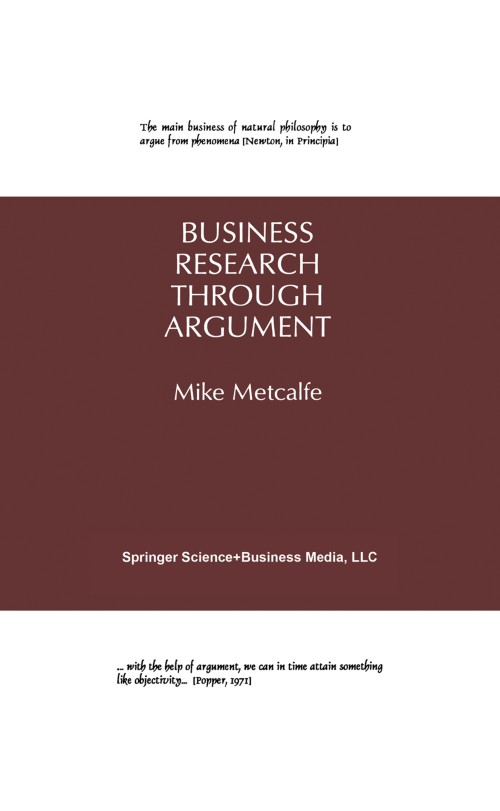
Business Research Through Argument [electronic resource] / by Mike Metcalfe.
Erişim Adresi
ISBN
9781461522911
Dil Kodu
İngilizce
Yer Numarası
DK/6538
Yazar
Basım Bildirimi
1st ed. 1996.
Yayın Bilgisi
New York, NY : Springer US : Imprint: Springer, 1996.
Fiziksel Niteleme
XV, 152 p. online resource.
İçindekiler Notu
Chp.1: Against Personal Objectivity -- Objectivity -- Some History -- Self - deception -- Appendix from Broad and Wane -- Objectivity and Group Argument -- Conclusion -- Chp.2: People Ain’t Molecules -- The Impact of the Observer -- Argument vs Observation -- Against the Dominance of Statistics -- Interpretive or Qualitative Methods -- Eclectic Methods -- Conclusion -- Chp.3: Argument -- Limits of Proof -- Argument for Objectivity -- Definition of Theory -- Commitment -- Bias Ethics -- Scientific Thinking -- Perelman & Olbrechts-Tyteca -- Source of Argument? -- Conclusion -- Chp.4: Argument Structure -- Specific vs General -- Motivation for the Study -- Parts of the Structure -- Unwanted Attributes? -- Conclusion -- Chp.5: Commentaries -- A: The Business Suit Theory -- B: The Lego Assignment -- C: The Austrian Experience -- Chp.6: Evidence from Interviews -- Who to Interview -- Intentions vs Opinions -- Concerned Persons -- Best Experts -- Unlearning and Anchoring -- Optimism -- Interaction Effects -- The Interview -- Problems with Human Judgment -- Chp.7: Evidence from Questionnaires -- Organization -- Data Types -- Annual Profit Questionale -- Questionnaire -- Tests -- Internal and External Validity -- Reference.
Özet, vb.
This book suggests that business research, in the collection, analysis, and communication of evidence, will benefit from explicit acceptance of research as argumentation. Argumentation is the process of compiling an argument through selection and organization of the relevant evidence. Recently, business research methods books have placed too much emphasis on the scientific method as brute empiricism, using only large sample statistical testing and demanding prediction through retesting old theories. Especially with regard to the study of human activity, there is now much evidence that there is not one special scientific method. This book argues that all types of empirical data, including statistics and personal experiences, be accepted as data, but that it is essential that these observations be explained. This book will provide researchers and postgraduate business students with a strategy for conducting research that encourages thought, provides a way of critically perceiving previous research, as well as suggesting a logical structure for communicating their research.
Konu
Sociology __ Methodology.
Operations research.
Business.
Management science.
Accounting.
Sociological Methods.
Operations Research and Decision Theory.
Business and Management.
Accounting.
Operations research.
Business.
Management science.
Accounting.
Sociological Methods.
Operations Research and Decision Theory.
Business and Management.
Accounting.
Kurum Adı
Eseri Alıntıla
Referansları kullanmadan önce gözden geçirmeniz ve varsa gerekli düzeltmeleri yapmanız önerilir.
Dijital Kaynak
MARC Görünümü
LEADER 04864nam a22005895i 4500
001 805216
003 TR_AnAIT
005 20260126235710
007 cr nn 008mamaa
008 121227s1996 xxu| s |||| 0|eng d
020 |a9781461522911|9978-1-4615-2291-1
024 7 |a10.1007/978-1-4615-2291-1|2doi
041 |aeng
049 |aTürk Tarih Kurumu Kütüphanesi
050 4|aHM511-538
072 7|aJHB|2bicssc
072 7|aSOC026000|2bisacsh
072 7|aJHB|2thema
082 04|a301.01|223
090 |aDK/6538
100 1 |aMetcalfe, Mike.|eauthor.|4aut|4http://id.loc.gov/vocabulary/relators/aut
245 10|aBusiness Research Through Argument|h[electronic resource] /|cby Mike Metcalfe.
250 |a1st ed. 1996.
264 1|aNew York, NY :|bSpringer US :|bImprint: Springer,|c1996.
300 |aXV, 152 p.|bonline resource.
336 |atext|btxt|2rdacontent
337 |acomputer|bc|2rdamedia
338 |aonline resource|bcr|2rdacarrier
347 |atext file|bPDF|2rda
505 0 |aChp.1: Against Personal Objectivity -- Objectivity -- Some History -- Self - deception -- Appendix from Broad and Wane -- Objectivity and Group Argument -- Conclusion -- Chp.2: People Ain’t Molecules -- The Impact of the Observer -- Argument vs Observation -- Against the Dominance of Statistics -- Interpretive or Qualitative Methods -- Eclectic Methods -- Conclusion -- Chp.3: Argument -- Limits of Proof -- Argument for Objectivity -- Definition of Theory -- Commitment -- Bias Ethics -- Scientific Thinking -- Perelman & Olbrechts-Tyteca -- Source of Argument? -- Conclusion -- Chp.4: Argument Structure -- Specific vs General -- Motivation for the Study -- Parts of the Structure -- Unwanted Attributes? -- Conclusion -- Chp.5: Commentaries -- A: The Business Suit Theory -- B: The Lego Assignment -- C: The Austrian Experience -- Chp.6: Evidence from Interviews -- Who to Interview -- Intentions vs Opinions -- Concerned Persons -- Best Experts -- Unlearning and Anchoring -- Optimism -- Interaction Effects -- The Interview -- Problems with Human Judgment -- Chp.7: Evidence from Questionnaires -- Organization -- Data Types -- Annual Profit Questionale -- Questionnaire -- Tests -- Internal and External Validity -- Reference.
520 |aThis book suggests that business research, in the collection, analysis, and communication of evidence, will benefit from explicit acceptance of research as argumentation. Argumentation is the process of compiling an argument through selection and organization of the relevant evidence. Recently, business research methods books have placed too much emphasis on the scientific method as brute empiricism, using only large sample statistical testing and demanding prediction through retesting old theories. Especially with regard to the study of human activity, there is now much evidence that there is not one special scientific method. This book argues that all types of empirical data, including statistics and personal experiences, be accepted as data, but that it is essential that these observations be explained. This book will provide researchers and postgraduate business students with a strategy for conducting research that encourages thought, provides a way of critically perceiving previous research, as well as suggesting a logical structure for communicating their research.
532 8 |aAccessibility summary: This PDF is not accessible. It is based on scanned pages and does not support features such as screen reader compatibility or described non-text content (images, graphs etc). However, it likely supports searchable and selectable text based on OCR (Optical Character Recognition). Users with accessibility needs may not be able to use this content effectively. Please contact us at accessibilitysupport@springernature.com if you require assistance or an alternative format.
532 8 |aInaccessible, or known limited accessibility
532 8 |aNo reading system accessibility options actively disabled
532 8 |aPublisher contact for further accessibility information: accessibilitysupport@springernature.com
650 0|aSociology|xMethodology.
650 0|aOperations research.
650 0|aBusiness.
650 0|aManagement science.
650 0|aAccounting.
650 14|aSociological Methods.
650 24|aOperations Research and Decision Theory.
650 24|aBusiness and Management.
650 24|aAccounting.
710 2 |aSpringerLink (Online service)
773 0 |tSpringer Nature eBook
776 08|iPrinted edition:|z9780792396161
776 08|iPrinted edition:|z9781461522928
776 08|iPrinted edition:|z9781461359678
856 40|uhttps://doi.org/10.1007/978-1-4615-2291-1
912 |aZDB-2-SHU
912 |aZDB-2-SXS
912 |aZDB-2-BAE
950 |aHumanities, Social Sciences and Law (SpringerNature-11648)
950 |aSocial Sciences (R0) (SpringerNature-43726)
001 805216
003 TR_AnAIT
005 20260126235710
007 cr nn 008mamaa
008 121227s1996 xxu| s |||| 0|eng d
020 |a9781461522911|9978-1-4615-2291-1
024 7 |a10.1007/978-1-4615-2291-1|2doi
041 |aeng
049 |aTürk Tarih Kurumu Kütüphanesi
050 4|aHM511-538
072 7|aJHB|2bicssc
072 7|aSOC026000|2bisacsh
072 7|aJHB|2thema
082 04|a301.01|223
090 |aDK/6538
100 1 |aMetcalfe, Mike.|eauthor.|4aut|4http://id.loc.gov/vocabulary/relators/aut
245 10|aBusiness Research Through Argument|h[electronic resource] /|cby Mike Metcalfe.
250 |a1st ed. 1996.
264 1|aNew York, NY :|bSpringer US :|bImprint: Springer,|c1996.
300 |aXV, 152 p.|bonline resource.
336 |atext|btxt|2rdacontent
337 |acomputer|bc|2rdamedia
338 |aonline resource|bcr|2rdacarrier
347 |atext file|bPDF|2rda
505 0 |aChp.1: Against Personal Objectivity -- Objectivity -- Some History -- Self - deception -- Appendix from Broad and Wane -- Objectivity and Group Argument -- Conclusion -- Chp.2: People Ain’t Molecules -- The Impact of the Observer -- Argument vs Observation -- Against the Dominance of Statistics -- Interpretive or Qualitative Methods -- Eclectic Methods -- Conclusion -- Chp.3: Argument -- Limits of Proof -- Argument for Objectivity -- Definition of Theory -- Commitment -- Bias Ethics -- Scientific Thinking -- Perelman & Olbrechts-Tyteca -- Source of Argument? -- Conclusion -- Chp.4: Argument Structure -- Specific vs General -- Motivation for the Study -- Parts of the Structure -- Unwanted Attributes? -- Conclusion -- Chp.5: Commentaries -- A: The Business Suit Theory -- B: The Lego Assignment -- C: The Austrian Experience -- Chp.6: Evidence from Interviews -- Who to Interview -- Intentions vs Opinions -- Concerned Persons -- Best Experts -- Unlearning and Anchoring -- Optimism -- Interaction Effects -- The Interview -- Problems with Human Judgment -- Chp.7: Evidence from Questionnaires -- Organization -- Data Types -- Annual Profit Questionale -- Questionnaire -- Tests -- Internal and External Validity -- Reference.
520 |aThis book suggests that business research, in the collection, analysis, and communication of evidence, will benefit from explicit acceptance of research as argumentation. Argumentation is the process of compiling an argument through selection and organization of the relevant evidence. Recently, business research methods books have placed too much emphasis on the scientific method as brute empiricism, using only large sample statistical testing and demanding prediction through retesting old theories. Especially with regard to the study of human activity, there is now much evidence that there is not one special scientific method. This book argues that all types of empirical data, including statistics and personal experiences, be accepted as data, but that it is essential that these observations be explained. This book will provide researchers and postgraduate business students with a strategy for conducting research that encourages thought, provides a way of critically perceiving previous research, as well as suggesting a logical structure for communicating their research.
532 8 |aAccessibility summary: This PDF is not accessible. It is based on scanned pages and does not support features such as screen reader compatibility or described non-text content (images, graphs etc). However, it likely supports searchable and selectable text based on OCR (Optical Character Recognition). Users with accessibility needs may not be able to use this content effectively. Please contact us at accessibilitysupport@springernature.com if you require assistance or an alternative format.
532 8 |aInaccessible, or known limited accessibility
532 8 |aNo reading system accessibility options actively disabled
532 8 |aPublisher contact for further accessibility information: accessibilitysupport@springernature.com
650 0|aSociology|xMethodology.
650 0|aOperations research.
650 0|aBusiness.
650 0|aManagement science.
650 0|aAccounting.
650 14|aSociological Methods.
650 24|aOperations Research and Decision Theory.
650 24|aBusiness and Management.
650 24|aAccounting.
710 2 |aSpringerLink (Online service)
773 0 |tSpringer Nature eBook
776 08|iPrinted edition:|z9780792396161
776 08|iPrinted edition:|z9781461522928
776 08|iPrinted edition:|z9781461359678
856 40|uhttps://doi.org/10.1007/978-1-4615-2291-1
912 |aZDB-2-SHU
912 |aZDB-2-SXS
912 |aZDB-2-BAE
950 |aHumanities, Social Sciences and Law (SpringerNature-11648)
950 |aSocial Sciences (R0) (SpringerNature-43726)
Materyaller
Depodan talep edilen materyal sadece kütüphane içerisinde kullanılmaktadır.
Materyal dışarıya ödünç verilmemektedir.
Materyal dışarıya ödünç verilmemektedir.
