

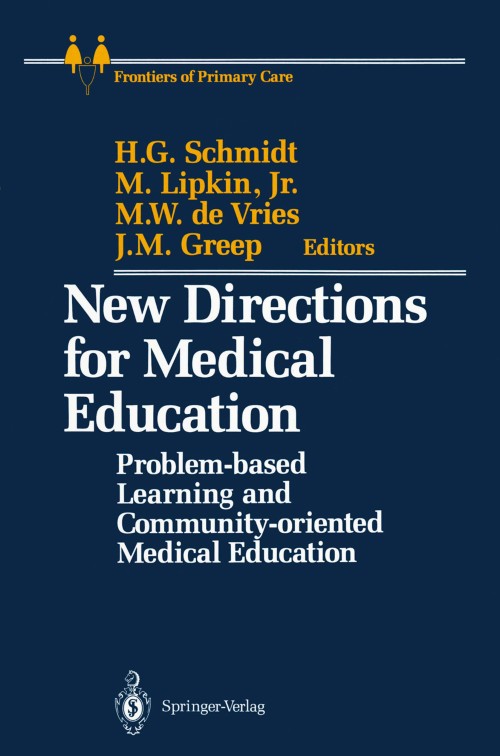
New Directions for Medical Education [electronic resource] : Problem-based Learning and Community-oriented Medical Education / edited by Henk G. Schmidt, Mack Jr. Lipkin, Marten W. de Vries, Jacobus M. Greep.
Erişim Adresi
ISBN
9781461234722
Dil Kodu
İngilizce
Yer Numarası
DK/6539
Basım Bildirimi
1st ed. 1989.
Yayın Bilgisi
New York, NY : Springer New York : Imprint: Springer, 1989.
Fiziksel Niteleme
XX, 300 p. online resource.
Dizi
Frontiers of Primary Care
İçindekiler Notu
I The Need: New Ways to Train Doctors -- 1 Towards the Education of Doctors Who Care for the Needs of the People: Innovative Approaches in Medical Education -- 2 Needed: A New Way to Train Doctors -- 3 A Medical School for the Future -- II Community-oriented Medical Education Today -- 4 Important Issues in Community-oriented Medical Education -- 5 Implementation of a Community-oriented Curriculum: The Task and the Problems -- 6 Medical Education in Action: Community-based Experience and Service in Nigeria -- 7 Community-based Medical Education in Nigeria: The Case of Bayero University -- III Problem-based Learning: Rationale and Examples -- 8 The Rationale Behind Problem-based Learning -- 9 Problem-based Medical Education: The Newcastle Approach -- 10 Toward an Emphasis on Problem Solving in Teaching and Learning: The McMaster Experience -- IV Evaluation in Innovative Medical Education -- 11 Evaluation of Health Sciences Education Programs: Program and Student Assessment at McMaster University -- 12 The Evaluation System at the Maastricht Medical School -- 13 Issues and Guidelines for Student and Program Evaluation -- 14 Teaching and Measuring Interviewing Skills in the Maastricht Medical Curriculum -- 15 How Effective Are Problem-based, Community-oriented Curricula: Experienced Evidence -- 16 Dutch Comparisons: Cognitive and Motivational Effects of Problem-based Learning on Medical Students -- V Faculty Development -- 17 Attitude Change Among Medical Teachers: Effects of a Workshop on Tutorials -- 18 Training Medical Teachers: Rationale and Outcomes -- 19 Preparing Faculty and Students for Problem-based Learning -- 20 Introducing Problem-based Learning into a Conventional Curriculum -- Conclusions -- Appendix A The Network Jacobus M. Greep and Henk G. Schmidt -- Appendix B List of Members of theNetwork of Community-oriented Educational Institutions for Health Sciences.
Özet, vb.
Primary care medicine is the new frontier in medicine. Every nation in the world has recognized the necessity to deliver personal and primary care to its people. This includes first-contact care, care based in a positive and caring personal rela tionship, care by a single healthcare provider for the majority of the patient's prob lems, coordination of all care by the patient's personal provider, advocacy for the patient by the provider, the provision of preventive care and psychosocial care, as well as care for episodes of acute and chronic illness. These facets of care work most effectively when they are embedded in a coherent integrated approach. The support for primary care derives from several significant trends. First, technologically based care costs have rocketed beyond reason or availability, occurring in the face of exploding populations and diminishing real resources in many parts of the world, even in the wealthier nations. Simultaneously, the primary care disciplines-general internal medicine and pediatrics and family medicine-have matured significantly. They have become viable alternatives to the specialty approach to care with its potential dehumanization, coordination problems, and increased cost.
Konu
Medical education.
Public health.
Family medicine.
Internal medicine.
Pediatrics.
Medical Education.
Public Health.
General Practice and Family Medicine.
Internal Medicine.
Pediatrics.
Public health.
Family medicine.
Internal medicine.
Pediatrics.
Medical Education.
Public Health.
General Practice and Family Medicine.
Internal Medicine.
Pediatrics.
Kurum Adı
Eseri Alıntıla
Referansları kullanmadan önce gözden geçirmeniz ve varsa gerekli düzeltmeleri yapmanız önerilir.
Dijital Kaynak
MARC Görünümü
LEADER 06238nam a22006855i 4500
001 805217
003 TR_AnAIT
005 20260126235711
007 cr nn 008mamaa
008 121227s1989 xxu| s |||| 0|eng d
020 |a9781461234722|9978-1-4612-3472-2
024 7 |a10.1007/978-1-4612-3472-2|2doi
041 |aeng
049 |aTürk Tarih Kurumu Kütüphanesi
050 4|aR735-845
072 7|aJNU|2bicssc
072 7|aMB|2bicssc
072 7|aMED024000|2bisacsh
072 7|aJNU|2thema
072 7|aMB|2thema
082 04|a610.71|223
090 |aDK/6539
245 10|aNew Directions for Medical Education|h[electronic resource] :|bProblem-based Learning and Community-oriented Medical Education /|cedited by Henk G. Schmidt, Mack Jr. Lipkin, Marten W. de Vries, Jacobus M. Greep.
250 |a1st ed. 1989.
264 1|aNew York, NY :|bSpringer New York :|bImprint: Springer,|c1989.
300 |aXX, 300 p.|bonline resource.
336 |atext|btxt|2rdacontent
337 |acomputer|bc|2rdamedia
338 |aonline resource|bcr|2rdacarrier
347 |atext file|bPDF|2rda
490 1 |aFrontiers of Primary Care
505 0 |aI The Need: New Ways to Train Doctors -- 1 Towards the Education of Doctors Who Care for the Needs of the People: Innovative Approaches in Medical Education -- 2 Needed: A New Way to Train Doctors -- 3 A Medical School for the Future -- II Community-oriented Medical Education Today -- 4 Important Issues in Community-oriented Medical Education -- 5 Implementation of a Community-oriented Curriculum: The Task and the Problems -- 6 Medical Education in Action: Community-based Experience and Service in Nigeria -- 7 Community-based Medical Education in Nigeria: The Case of Bayero University -- III Problem-based Learning: Rationale and Examples -- 8 The Rationale Behind Problem-based Learning -- 9 Problem-based Medical Education: The Newcastle Approach -- 10 Toward an Emphasis on Problem Solving in Teaching and Learning: The McMaster Experience -- IV Evaluation in Innovative Medical Education -- 11 Evaluation of Health Sciences Education Programs: Program and Student Assessment at McMaster University -- 12 The Evaluation System at the Maastricht Medical School -- 13 Issues and Guidelines for Student and Program Evaluation -- 14 Teaching and Measuring Interviewing Skills in the Maastricht Medical Curriculum -- 15 How Effective Are Problem-based, Community-oriented Curricula: Experienced Evidence -- 16 Dutch Comparisons: Cognitive and Motivational Effects of Problem-based Learning on Medical Students -- V Faculty Development -- 17 Attitude Change Among Medical Teachers: Effects of a Workshop on Tutorials -- 18 Training Medical Teachers: Rationale and Outcomes -- 19 Preparing Faculty and Students for Problem-based Learning -- 20 Introducing Problem-based Learning into a Conventional Curriculum -- Conclusions -- Appendix A The Network Jacobus M. Greep and Henk G. Schmidt -- Appendix B List of Members of theNetwork of Community-oriented Educational Institutions for Health Sciences.
520 |aPrimary care medicine is the new frontier in medicine. Every nation in the world has recognized the necessity to deliver personal and primary care to its people. This includes first-contact care, care based in a positive and caring personal rela tionship, care by a single healthcare provider for the majority of the patient's prob lems, coordination of all care by the patient's personal provider, advocacy for the patient by the provider, the provision of preventive care and psychosocial care, as well as care for episodes of acute and chronic illness. These facets of care work most effectively when they are embedded in a coherent integrated approach. The support for primary care derives from several significant trends. First, technologically based care costs have rocketed beyond reason or availability, occurring in the face of exploding populations and diminishing real resources in many parts of the world, even in the wealthier nations. Simultaneously, the primary care disciplines-general internal medicine and pediatrics and family medicine-have matured significantly. They have become viable alternatives to the specialty approach to care with its potential dehumanization, coordination problems, and increased cost.
532 8 |aAccessibility summary: This PDF is not accessible. It is based on scanned pages and does not support features such as screen reader compatibility or described non-text content (images, graphs etc). However, it likely supports searchable and selectable text based on OCR (Optical Character Recognition). Users with accessibility needs may not be able to use this content effectively. Please contact us at accessibilitysupport@springernature.com if you require assistance or an alternative format.
532 8 |aInaccessible, or known limited accessibility
532 8 |aNo reading system accessibility options actively disabled
532 8 |aPublisher contact for further accessibility information: accessibilitysupport@springernature.com
650 0|aMedical education.
650 0|aPublic health.
650 0|aFamily medicine.
650 0|aInternal medicine.
650 0|aPediatrics.
650 14|aMedical Education.
650 24|aPublic Health.
650 24|aGeneral Practice and Family Medicine.
650 24|aInternal Medicine.
650 24|aPediatrics.
700 1 |aSchmidt, Henk G.|eeditor.|4edt|4http://id.loc.gov/vocabulary/relators/edt
700 1 |aLipkin, Mack Jr.|eeditor.|4edt|4http://id.loc.gov/vocabulary/relators/edt
700 1 |aVries, Marten W. de.|eeditor.|4edt|4http://id.loc.gov/vocabulary/relators/edt
700 1 |aGreep, Jacobus M.|eeditor.|4edt|4http://id.loc.gov/vocabulary/relators/edt
710 2 |aSpringerLink (Online service)
773 0 |tSpringer Nature eBook
776 08|iPrinted edition:|z9780387963907
776 08|iPrinted edition:|z9781461234739
776 08|iPrinted edition:|z9781461281146
830 0|aFrontiers of Primary Care
856 40|uhttps://doi.org/10.1007/978-1-4612-3472-2
912 |aZDB-2-SHU
912 |aZDB-2-SXED
912 |aZDB-2-BAE
950 |aHumanities, Social Sciences and Law (SpringerNature-11648)
950 |aEducation (R0) (SpringerNature-43721)
001 805217
003 TR_AnAIT
005 20260126235711
007 cr nn 008mamaa
008 121227s1989 xxu| s |||| 0|eng d
020 |a9781461234722|9978-1-4612-3472-2
024 7 |a10.1007/978-1-4612-3472-2|2doi
041 |aeng
049 |aTürk Tarih Kurumu Kütüphanesi
050 4|aR735-845
072 7|aJNU|2bicssc
072 7|aMB|2bicssc
072 7|aMED024000|2bisacsh
072 7|aJNU|2thema
072 7|aMB|2thema
082 04|a610.71|223
090 |aDK/6539
245 10|aNew Directions for Medical Education|h[electronic resource] :|bProblem-based Learning and Community-oriented Medical Education /|cedited by Henk G. Schmidt, Mack Jr. Lipkin, Marten W. de Vries, Jacobus M. Greep.
250 |a1st ed. 1989.
264 1|aNew York, NY :|bSpringer New York :|bImprint: Springer,|c1989.
300 |aXX, 300 p.|bonline resource.
336 |atext|btxt|2rdacontent
337 |acomputer|bc|2rdamedia
338 |aonline resource|bcr|2rdacarrier
347 |atext file|bPDF|2rda
490 1 |aFrontiers of Primary Care
505 0 |aI The Need: New Ways to Train Doctors -- 1 Towards the Education of Doctors Who Care for the Needs of the People: Innovative Approaches in Medical Education -- 2 Needed: A New Way to Train Doctors -- 3 A Medical School for the Future -- II Community-oriented Medical Education Today -- 4 Important Issues in Community-oriented Medical Education -- 5 Implementation of a Community-oriented Curriculum: The Task and the Problems -- 6 Medical Education in Action: Community-based Experience and Service in Nigeria -- 7 Community-based Medical Education in Nigeria: The Case of Bayero University -- III Problem-based Learning: Rationale and Examples -- 8 The Rationale Behind Problem-based Learning -- 9 Problem-based Medical Education: The Newcastle Approach -- 10 Toward an Emphasis on Problem Solving in Teaching and Learning: The McMaster Experience -- IV Evaluation in Innovative Medical Education -- 11 Evaluation of Health Sciences Education Programs: Program and Student Assessment at McMaster University -- 12 The Evaluation System at the Maastricht Medical School -- 13 Issues and Guidelines for Student and Program Evaluation -- 14 Teaching and Measuring Interviewing Skills in the Maastricht Medical Curriculum -- 15 How Effective Are Problem-based, Community-oriented Curricula: Experienced Evidence -- 16 Dutch Comparisons: Cognitive and Motivational Effects of Problem-based Learning on Medical Students -- V Faculty Development -- 17 Attitude Change Among Medical Teachers: Effects of a Workshop on Tutorials -- 18 Training Medical Teachers: Rationale and Outcomes -- 19 Preparing Faculty and Students for Problem-based Learning -- 20 Introducing Problem-based Learning into a Conventional Curriculum -- Conclusions -- Appendix A The Network Jacobus M. Greep and Henk G. Schmidt -- Appendix B List of Members of theNetwork of Community-oriented Educational Institutions for Health Sciences.
520 |aPrimary care medicine is the new frontier in medicine. Every nation in the world has recognized the necessity to deliver personal and primary care to its people. This includes first-contact care, care based in a positive and caring personal rela tionship, care by a single healthcare provider for the majority of the patient's prob lems, coordination of all care by the patient's personal provider, advocacy for the patient by the provider, the provision of preventive care and psychosocial care, as well as care for episodes of acute and chronic illness. These facets of care work most effectively when they are embedded in a coherent integrated approach. The support for primary care derives from several significant trends. First, technologically based care costs have rocketed beyond reason or availability, occurring in the face of exploding populations and diminishing real resources in many parts of the world, even in the wealthier nations. Simultaneously, the primary care disciplines-general internal medicine and pediatrics and family medicine-have matured significantly. They have become viable alternatives to the specialty approach to care with its potential dehumanization, coordination problems, and increased cost.
532 8 |aAccessibility summary: This PDF is not accessible. It is based on scanned pages and does not support features such as screen reader compatibility or described non-text content (images, graphs etc). However, it likely supports searchable and selectable text based on OCR (Optical Character Recognition). Users with accessibility needs may not be able to use this content effectively. Please contact us at accessibilitysupport@springernature.com if you require assistance or an alternative format.
532 8 |aInaccessible, or known limited accessibility
532 8 |aNo reading system accessibility options actively disabled
532 8 |aPublisher contact for further accessibility information: accessibilitysupport@springernature.com
650 0|aMedical education.
650 0|aPublic health.
650 0|aFamily medicine.
650 0|aInternal medicine.
650 0|aPediatrics.
650 14|aMedical Education.
650 24|aPublic Health.
650 24|aGeneral Practice and Family Medicine.
650 24|aInternal Medicine.
650 24|aPediatrics.
700 1 |aSchmidt, Henk G.|eeditor.|4edt|4http://id.loc.gov/vocabulary/relators/edt
700 1 |aLipkin, Mack Jr.|eeditor.|4edt|4http://id.loc.gov/vocabulary/relators/edt
700 1 |aVries, Marten W. de.|eeditor.|4edt|4http://id.loc.gov/vocabulary/relators/edt
700 1 |aGreep, Jacobus M.|eeditor.|4edt|4http://id.loc.gov/vocabulary/relators/edt
710 2 |aSpringerLink (Online service)
773 0 |tSpringer Nature eBook
776 08|iPrinted edition:|z9780387963907
776 08|iPrinted edition:|z9781461234739
776 08|iPrinted edition:|z9781461281146
830 0|aFrontiers of Primary Care
856 40|uhttps://doi.org/10.1007/978-1-4612-3472-2
912 |aZDB-2-SHU
912 |aZDB-2-SXED
912 |aZDB-2-BAE
950 |aHumanities, Social Sciences and Law (SpringerNature-11648)
950 |aEducation (R0) (SpringerNature-43721)
Materyaller
Depodan talep edilen materyal sadece kütüphane içerisinde kullanılmaktadır.
Materyal dışarıya ödünç verilmemektedir.
Materyal dışarıya ödünç verilmemektedir.
