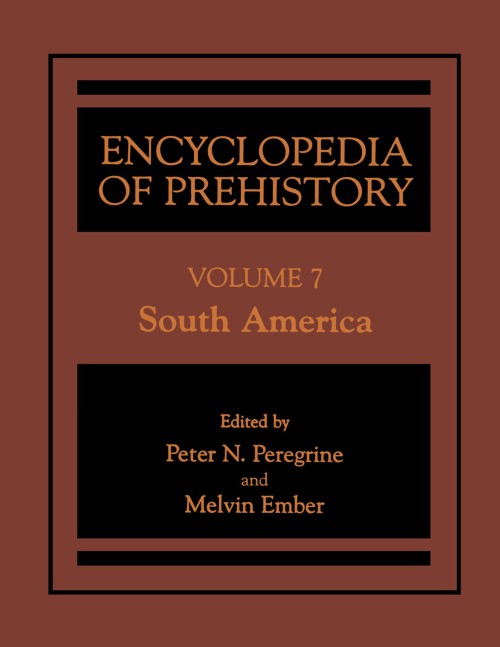
Encyclopedia of Prehistory [electronic resource] : Volume 7: South America / edited by Peter N. Peregrine, Melvin Ember.
Erişim Adresi
ISBN
9781461505211
Dil Kodu
İngilizce
Yer Numarası
DK/6546
Basım Bildirimi
1st ed. 2001.
Yayın Bilgisi
New York, NY : Springer US : Imprint: Springer, 2001.
Fiziksel Niteleme
XXIX, 379 p. 9 illus. online resource.
İçindekiler Notu
Andean Regional Development -- Andean Regional States -- Aymara Kingdoms -- Chavín -- Chimú -- Coastal Andean Archaic -- Early Amazonian -- Early Coastal Andean Formative -- Early East Brazilian Uplands -- Early Highland Andean Archaic -- Early Parana-Pampean -- Highland Andean Formative -- Huari -- Inca -- Late Amazonian -- Late Andean Hunting-Collecting -- Late Coastal Andean Formative -- Late East Brazilian Uplands -- Late Highland Andean Archaic -- Late Parana-Pampean -- Magellan-Fuegan -- Moche -- Nasca (Nazca) -- Old Amazonian Collecting-Hunting -- Old South American Hunting-Collecting -- Sambaqui -- South Andean Ceramic -- Tiwanaku -- Tupi.
Özet, vb.
temporal dimension. Major traditions are The Encyclopedia of Prehistory represents an attempt to provide basic information also defined by a somewhat different set of on all archaeologically known cultures, sociocultural characteristics than are eth covering the entire globe and the entire nological cultures. Major traditions are prehistory of humankind. It is designed as defined based on common subsistence a tool to assist in doing comparative practices, sociopolitical organization, and research on the peoples of the past. Most material industries, but language, ideology, of the entries are written by the world's and kinship ties play little or no part in foremost experts on the particular areas their definition because they are virtually and time periods. unrecoverable from archaeological con The Encyclopedia is organized accord texts. In contrast, language, ideology, and ing to major traditions. A major tradition kinship ties are central to defining ethno is defined as a group of populations sharing logical cultures. similar subsistence practices, technology, There are three types of entries in the and forms of sociopolitical organization, Encyclopedia: the major tradition entry, which are spatially contiguous over a rela the regional subtradition entry, and the tively large area and which endure tempo site entry. Each contains different types of rally for a relatively long period. Minimal information, and each is intended to be areal coverage for a major tradition can used in a different way.
Konu
Archaeology.
Anthropology.
Archaeology.
Anthropology.
Anthropology.
Archaeology.
Anthropology.
Diğer Yazarlar
Kurum Adı

Eseri Alıntıla
Referansları kullanmadan önce gözden geçirmeniz ve varsa gerekli düzeltmeleri yapmanız önerilir.
Dijital Kaynak
MARC Görünümü
LEADER 04661nam a22005415i 4500
001 805224
003 TR_AnAIT
005 20260126235721
007 cr nn 008mamaa
008 121227s2001 xxu| s |||| 0|eng d
020 |a9781461505211|9978-1-4615-0521-1
024 7 |a10.1007/978-1-4615-0521-1|2doi
041 |aeng
049 |aTürk Tarih Kurumu Kütüphanesi
050 4|aCC1-960
072 7|aHD|2bicssc
072 7|aSOC003000|2bisacsh
072 7|aNK|2thema
082 04|a930.1|223
090 |aDK/6546
245 10|aEncyclopedia of Prehistory|h[electronic resource] :|bVolume 7: South America /|cedited by Peter N. Peregrine, Melvin Ember.
250 |a1st ed. 2001.
264 1|aNew York, NY :|bSpringer US :|bImprint: Springer,|c2001.
300 |aXXIX, 379 p. 9 illus.|bonline resource.
336 |atext|btxt|2rdacontent
337 |acomputer|bc|2rdamedia
338 |aonline resource|bcr|2rdacarrier
347 |atext file|bPDF|2rda
505 0 |aAndean Regional Development -- Andean Regional States -- Aymara Kingdoms -- Chavín -- Chimú -- Coastal Andean Archaic -- Early Amazonian -- Early Coastal Andean Formative -- Early East Brazilian Uplands -- Early Highland Andean Archaic -- Early Parana-Pampean -- Highland Andean Formative -- Huari -- Inca -- Late Amazonian -- Late Andean Hunting-Collecting -- Late Coastal Andean Formative -- Late East Brazilian Uplands -- Late Highland Andean Archaic -- Late Parana-Pampean -- Magellan-Fuegan -- Moche -- Nasca (Nazca) -- Old Amazonian Collecting-Hunting -- Old South American Hunting-Collecting -- Sambaqui -- South Andean Ceramic -- Tiwanaku -- Tupi.
520 |atemporal dimension. Major traditions are The Encyclopedia of Prehistory represents an attempt to provide basic information also defined by a somewhat different set of on all archaeologically known cultures, sociocultural characteristics than are eth covering the entire globe and the entire nological cultures. Major traditions are prehistory of humankind. It is designed as defined based on common subsistence a tool to assist in doing comparative practices, sociopolitical organization, and research on the peoples of the past. Most material industries, but language, ideology, of the entries are written by the world's and kinship ties play little or no part in foremost experts on the particular areas their definition because they are virtually and time periods. unrecoverable from archaeological con The Encyclopedia is organized accord texts. In contrast, language, ideology, and ing to major traditions. A major tradition kinship ties are central to defining ethno is defined as a group of populations sharing logical cultures. similar subsistence practices, technology, There are three types of entries in the and forms of sociopolitical organization, Encyclopedia: the major tradition entry, which are spatially contiguous over a rela the regional subtradition entry, and the tively large area and which endure tempo site entry. Each contains different types of rally for a relatively long period. Minimal information, and each is intended to be areal coverage for a major tradition can used in a different way.
532 8 |aAccessibility summary: This PDF is not accessible. It is based on scanned pages and does not support features such as screen reader compatibility or described non-text content (images, graphs etc). However, it likely supports searchable and selectable text based on OCR (Optical Character Recognition). Users with accessibility needs may not be able to use this content effectively. Please contact us at accessibilitysupport@springernature.com if you require assistance or an alternative format.
532 8 |aInaccessible, or known limited accessibility
532 8 |aNo reading system accessibility options actively disabled
532 8 |aPublisher contact for further accessibility information: accessibilitysupport@springernature.com
650 0|aArchaeology.
650 0|aAnthropology.
650 14|aArchaeology.
650 24|aAnthropology.
700 1 |aPeregrine, Peter N.|eeditor.|4edt|4http://id.loc.gov/vocabulary/relators/edt
700 1 |aEmber, Melvin.|eeditor.|4edt|4http://id.loc.gov/vocabulary/relators/edt
710 2 |aSpringerLink (Online service)
773 0 |tSpringer Nature eBook
776 08|iPrinted edition:|z9780306462610
776 08|iPrinted edition:|z9781461505228
776 08|iPrinted edition:|z9781468471342
856 40|uhttps://doi.org/10.1007/978-1-4615-0521-1
912 |aZDB-2-SHU
912 |aZDB-2-SXS
912 |aZDB-2-BAE
950 |aHumanities, Social Sciences and Law (SpringerNature-11648)
950 |aSocial Sciences (R0) (SpringerNature-43726)
001 805224
003 TR_AnAIT
005 20260126235721
007 cr nn 008mamaa
008 121227s2001 xxu| s |||| 0|eng d
020 |a9781461505211|9978-1-4615-0521-1
024 7 |a10.1007/978-1-4615-0521-1|2doi
041 |aeng
049 |aTürk Tarih Kurumu Kütüphanesi
050 4|aCC1-960
072 7|aHD|2bicssc
072 7|aSOC003000|2bisacsh
072 7|aNK|2thema
082 04|a930.1|223
090 |aDK/6546
245 10|aEncyclopedia of Prehistory|h[electronic resource] :|bVolume 7: South America /|cedited by Peter N. Peregrine, Melvin Ember.
250 |a1st ed. 2001.
264 1|aNew York, NY :|bSpringer US :|bImprint: Springer,|c2001.
300 |aXXIX, 379 p. 9 illus.|bonline resource.
336 |atext|btxt|2rdacontent
337 |acomputer|bc|2rdamedia
338 |aonline resource|bcr|2rdacarrier
347 |atext file|bPDF|2rda
505 0 |aAndean Regional Development -- Andean Regional States -- Aymara Kingdoms -- Chavín -- Chimú -- Coastal Andean Archaic -- Early Amazonian -- Early Coastal Andean Formative -- Early East Brazilian Uplands -- Early Highland Andean Archaic -- Early Parana-Pampean -- Highland Andean Formative -- Huari -- Inca -- Late Amazonian -- Late Andean Hunting-Collecting -- Late Coastal Andean Formative -- Late East Brazilian Uplands -- Late Highland Andean Archaic -- Late Parana-Pampean -- Magellan-Fuegan -- Moche -- Nasca (Nazca) -- Old Amazonian Collecting-Hunting -- Old South American Hunting-Collecting -- Sambaqui -- South Andean Ceramic -- Tiwanaku -- Tupi.
520 |atemporal dimension. Major traditions are The Encyclopedia of Prehistory represents an attempt to provide basic information also defined by a somewhat different set of on all archaeologically known cultures, sociocultural characteristics than are eth covering the entire globe and the entire nological cultures. Major traditions are prehistory of humankind. It is designed as defined based on common subsistence a tool to assist in doing comparative practices, sociopolitical organization, and research on the peoples of the past. Most material industries, but language, ideology, of the entries are written by the world's and kinship ties play little or no part in foremost experts on the particular areas their definition because they are virtually and time periods. unrecoverable from archaeological con The Encyclopedia is organized accord texts. In contrast, language, ideology, and ing to major traditions. A major tradition kinship ties are central to defining ethno is defined as a group of populations sharing logical cultures. similar subsistence practices, technology, There are three types of entries in the and forms of sociopolitical organization, Encyclopedia: the major tradition entry, which are spatially contiguous over a rela the regional subtradition entry, and the tively large area and which endure tempo site entry. Each contains different types of rally for a relatively long period. Minimal information, and each is intended to be areal coverage for a major tradition can used in a different way.
532 8 |aAccessibility summary: This PDF is not accessible. It is based on scanned pages and does not support features such as screen reader compatibility or described non-text content (images, graphs etc). However, it likely supports searchable and selectable text based on OCR (Optical Character Recognition). Users with accessibility needs may not be able to use this content effectively. Please contact us at accessibilitysupport@springernature.com if you require assistance or an alternative format.
532 8 |aInaccessible, or known limited accessibility
532 8 |aNo reading system accessibility options actively disabled
532 8 |aPublisher contact for further accessibility information: accessibilitysupport@springernature.com
650 0|aArchaeology.
650 0|aAnthropology.
650 14|aArchaeology.
650 24|aAnthropology.
700 1 |aPeregrine, Peter N.|eeditor.|4edt|4http://id.loc.gov/vocabulary/relators/edt
700 1 |aEmber, Melvin.|eeditor.|4edt|4http://id.loc.gov/vocabulary/relators/edt
710 2 |aSpringerLink (Online service)
773 0 |tSpringer Nature eBook
776 08|iPrinted edition:|z9780306462610
776 08|iPrinted edition:|z9781461505228
776 08|iPrinted edition:|z9781468471342
856 40|uhttps://doi.org/10.1007/978-1-4615-0521-1
912 |aZDB-2-SHU
912 |aZDB-2-SXS
912 |aZDB-2-BAE
950 |aHumanities, Social Sciences and Law (SpringerNature-11648)
950 |aSocial Sciences (R0) (SpringerNature-43726)
Materyaller
Depodan talep edilen materyal sadece kütüphane içerisinde kullanılmaktadır.
Materyal dışarıya ödünç verilmemektedir.
