LEADER 04451nam a22005175i 4500
001 805232
003 TR_AnAIT
005 20260126235731
007 cr nn 008mamaa
008 121227s1974 ne | s |||| 0|eng d
020 |a9789401016575|9978-94-010-1657-5
024 7 |a10.1007/978-94-010-1657-5|2doi
041 |aeng
049 |aTürk Tarih Kurumu Kütüphanesi
050 4|aB800.2-804
072 7|aHPCD|2bicssc
072 7|aPHI016000|2bisacsh
072 7|aQDH|2thema
082 04|a190.903|223
090 |aDK/6554
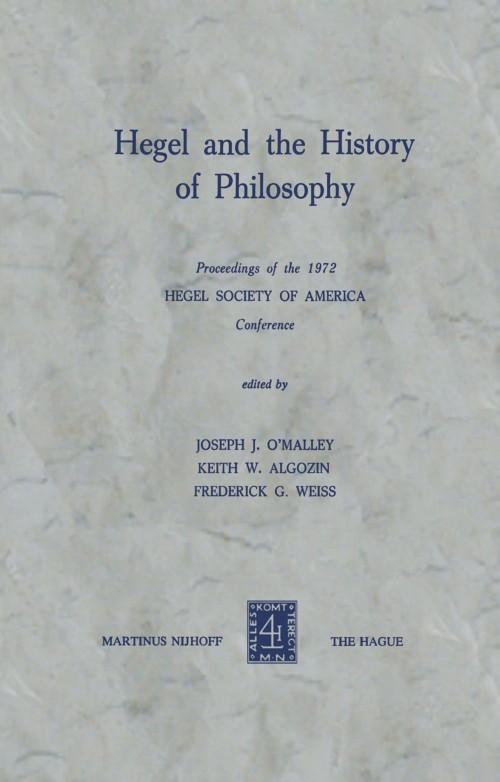
245 10|aHegel and the History of Philosophy|h[electronic resource] :|bProceedings of the 1972 HEGEL SOCIETY OF AMERICA Conference /|cedited by J.J. O'Malley, K.W. Algozin, F.G. Weiss.
250 |a1st ed. 1974.
264 1|aDordrecht :|bSpringer Netherlands :|bImprint: Springer,|c1974.
300 |aVIII, 242 p.|bonline resource.
336 |atext|btxt|2rdacontent
337 |acomputer|bc|2rdamedia
338 |aonline resource|bcr|2rdacarrier
347 |atext file|bPDF|2rda
505 0 |aI. “The Pilgrimage of Truth through Time: The Conception of the History of Philosophy in G.W.F. Hegel” -- II. “Hegel as Historian of Philosophy” -- III. “The History of Philosophy and the Phenomenology of Spirit” -- IV. “Hegelianism and Platonism” -- V. “On Hegel’s Platonism” -- VI. “Cartesian Doubt and Hegelian Negation” -- VII. “Liebniz and Hegel on Language” -- VIII. “Hegel’s Critique of Kant” -- IX. “Kant and Hegel on Practical Reason” -- X. “Moral Autonomy in Kant and Hegel” -- XI. “Hegel and Solovyov” -- XII. “Hegel and Peirce”.
520 |aThe papers published here were given at the second biennial conference of the Hegel Society of America, held at the University of Notre Dame, November 9-11, 1972. They appear in an order which reflects roughly two headings: (1) Hegel's conception of the history of philosophy in general, and (2) his relation to individual thinkers both before and after him. Given the importance of the history of philosophy for Hegel, and the far-reaching impact of his thought upon subsequent philosophy, it becomes immediately apparent that we have here only a beginning. At the conference, cries went up "Why not Hegel and Aristotle, Aquinas, HusserI and Hart mann?" Indeed, why not? The answer, of course, might be given by Hegel himself : if we wish to accomplish anything, we have to limit ourselves. We trust that future conferences and scholarship will bring to light these relationships and the many more which testify to Hegel's profound presence in the mainstream of past and present thought. It is furthermore no accident that the renaissance of Hegelian studies has brought with it a rebirth of the history of philosophy as something relevant to our own problems. For Hegel, the object of philosophy is alone the truth, the history of philosophy is philosophy itself, and this truth which it gives us cannot be what has passed away.
532 8 |aAccessibility summary: This PDF is not accessible. It is based on scanned pages and does not support features such as screen reader compatibility or described non-text content (images, graphs etc). However, it likely supports searchable and selectable text based on OCR (Optical Character Recognition). Users with accessibility needs may not be able to use this content effectively. Please contact us at accessibilitysupport@springernature.com if you require assistance or an alternative format.
532 8 |aInaccessible, or known limited accessibility
532 8 |aNo reading system accessibility options actively disabled
532 8 |aPublisher contact for further accessibility information: accessibilitysupport@springernature.com
650 0|aPhilosophy, Modern.
650 14|aEarly Modern Philosophy.
700 1 |aO'Malley, J.J.|eeditor.|4edt|4http://id.loc.gov/vocabulary/relators/edt
700 1 |aAlgozin, K.W.|eeditor.|4edt|4http://id.loc.gov/vocabulary/relators/edt
700 1 |aWeiss, F.G.|eeditor.|4edt|4http://id.loc.gov/vocabulary/relators/edt
710 2 |aSpringerLink (Online service)
773 0 |tSpringer Nature eBook
776 08|iPrinted edition:|z9789024717125
776 08|iPrinted edition:|z9789401016582
856 40|uhttps://doi.org/10.1007/978-94-010-1657-5
912 |aZDB-2-SHU
912 |aZDB-2-SXPR
912 |aZDB-2-BAE
950 |aHumanities, Social Sciences and Law (SpringerNature-11648)
950 |aPhilosophy and Religion (R0) (SpringerNature-43725)