

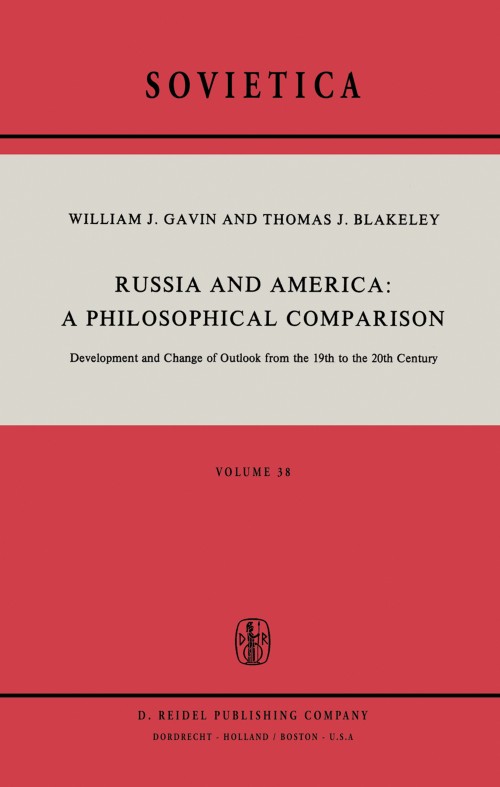
Russia and America: A Philosophical Comparison [electronic resource] : Development and Change of Outlook from the 19th to the 20th Century / by W.J. Gavin, J.E. Blakeley.
Erişim Adresi
ISBN
9789401015141
Dil Kodu
İngilizce
Yer Numarası
DK/6599
Yazar
Basım Bildirimi
1st ed. 1976.
Yayın Bilgisi
Dordrecht : Springer Netherlands : Imprint: Springer, 1976.
Fiziksel Niteleme
IX, 116 p. online resource.
Dizi
Sovietica ; 38
İçindekiler Notu
I: The Cultural Beginnings -- I / The Importance of Ambiguity in Russian and American Culture -- II / Chaadayev and Emerson — Two Mystical Pragmatists -- III / Herzen and James: Freedom as Radical -- IV / Royce and Khomyakov on Community as Process -- V / Art vs. Science in Dewey and Chernyshevsky -- VI / Underlying Themes and the Present Cultural Context -- II: Contemporary Soviet Reactions -- VII / Marxist-Leninist Philosophy and Social History -- VIII / Soviet Reaction to Some Nineteenth-Century Philosophers -- IX / Underlying Themes in Contemporary Marxist-Leninist Philosophy -- Epilogue: Final Thoughts -- Notes -- Index of Names and Titles.
Özet, vb.
In this year of bicentennial celebration, there will no doubt take place several cultural analyses of the American tradition. This is only as it should be, for without an extensive, broad-based inquiry into where we have come from, we shall surely not foresee where we might go. Nonetheless, most cultural analyses of the American context suffer from a common fault - the lack of a different context to use for purposes of comparison. True, American values and ideals were partly inherited from the European tradition. But that tradition is in many ways an inadequate mode of comparison. Without going too far afield, let us note two points: first, European culture was the proud inheritor of the Renaissance tradition, and, going back still further, of classical culture; second, the European countries are compact. Their land masses are such that the notion of "frontier" simply would not have arisen in the same way as it did in America. On the other side of the globe, however, there does exist a country capable of serving as a suitable mirror. We speak, of course, of Russia. That country also came relatively late onto the cultural horizon, and was not privy to the Renaissance tradition. Furthermore, her land mass is such as to be "experi mentally infmite" in character - not unlike the American frontier. It is hoped that much can be leamed about the present cultural context by com paring the two countries in their youthful stages.
Konu
Ethnology.
Culture.
Regional Cultural Studies.
Culture.
Regional Cultural Studies.
Diğer Yazarlar
Kurum Adı
Eseri Alıntıla
Referansları kullanmadan önce gözden geçirmeniz ve varsa gerekli düzeltmeleri yapmanız önerilir.
Dijital Kaynak
MARC Görünümü
LEADER 04681nam a22005535i 4500
001 805279
003 TR_AnAIT
005 20260126235825
007 cr nn 008mamaa
008 121227s1976 ne | s |||| 0|eng d
020 |a9789401015141|9978-94-010-1514-1
024 7 |a10.1007/978-94-010-1514-1|2doi
041 |aeng
049 |aTürk Tarih Kurumu Kütüphanesi
050 4|aGN550-674
072 7|aJFC|2bicssc
072 7|aSOC053000|2bisacsh
072 7|aJBCC|2thema
082 04|a306.091|223
090 |aDK/6599
100 1 |aGavin, W.J.|eauthor.|4aut|4http://id.loc.gov/vocabulary/relators/aut
245 10|aRussia and America: A Philosophical Comparison|h[electronic resource] :|bDevelopment and Change of Outlook from the 19th to the 20th Century /|cby W.J. Gavin, J.E. Blakeley.
250 |a1st ed. 1976.
264 1|aDordrecht :|bSpringer Netherlands :|bImprint: Springer,|c1976.
300 |aIX, 116 p.|bonline resource.
336 |atext|btxt|2rdacontent
337 |acomputer|bc|2rdamedia
338 |aonline resource|bcr|2rdacarrier
347 |atext file|bPDF|2rda
490 1 |aSovietica ;|v38
505 0 |aI: The Cultural Beginnings -- I / The Importance of Ambiguity in Russian and American Culture -- II / Chaadayev and Emerson — Two Mystical Pragmatists -- III / Herzen and James: Freedom as Radical -- IV / Royce and Khomyakov on Community as Process -- V / Art vs. Science in Dewey and Chernyshevsky -- VI / Underlying Themes and the Present Cultural Context -- II: Contemporary Soviet Reactions -- VII / Marxist-Leninist Philosophy and Social History -- VIII / Soviet Reaction to Some Nineteenth-Century Philosophers -- IX / Underlying Themes in Contemporary Marxist-Leninist Philosophy -- Epilogue: Final Thoughts -- Notes -- Index of Names and Titles.
520 |aIn this year of bicentennial celebration, there will no doubt take place several cultural analyses of the American tradition. This is only as it should be, for without an extensive, broad-based inquiry into where we have come from, we shall surely not foresee where we might go. Nonetheless, most cultural analyses of the American context suffer from a common fault - the lack of a different context to use for purposes of comparison. True, American values and ideals were partly inherited from the European tradition. But that tradition is in many ways an inadequate mode of comparison. Without going too far afield, let us note two points: first, European culture was the proud inheritor of the Renaissance tradition, and, going back still further, of classical culture; second, the European countries are compact. Their land masses are such that the notion of "frontier" simply would not have arisen in the same way as it did in America. On the other side of the globe, however, there does exist a country capable of serving as a suitable mirror. We speak, of course, of Russia. That country also came relatively late onto the cultural horizon, and was not privy to the Renaissance tradition. Furthermore, her land mass is such as to be "experi mentally infmite" in character - not unlike the American frontier. It is hoped that much can be leamed about the present cultural context by com paring the two countries in their youthful stages.
532 8 |aAccessibility summary: This PDF is not accessible. It is based on scanned pages and does not support features such as screen reader compatibility or described non-text content (images, graphs etc). However, it likely supports searchable and selectable text based on OCR (Optical Character Recognition). Users with accessibility needs may not be able to use this content effectively. Please contact us at accessibilitysupport@springernature.com if you require assistance or an alternative format.
532 8 |aInaccessible, or known limited accessibility
532 8 |aNo reading system accessibility options actively disabled
532 8 |aPublisher contact for further accessibility information: accessibilitysupport@springernature.com
650 0|aEthnology.
650 0|aCulture.
650 14|aRegional Cultural Studies.
700 1 |aBlakeley, J.E.|eauthor.|4aut|4http://id.loc.gov/vocabulary/relators/aut
710 2 |aSpringerLink (Online service)
773 0 |tSpringer Nature eBook
776 08|iPrinted edition:|z9789027707499
776 08|iPrinted edition:|z9789401015158
776 08|iPrinted edition:|z9789401015165
830 0|aSovietica ;|v38
856 40|uhttps://doi.org/10.1007/978-94-010-1514-1
912 |aZDB-2-SHU
912 |aZDB-2-SXL
912 |aZDB-2-BAE
950 |aHumanities, Social Sciences and Law (SpringerNature-11648)
950 |aLiterature, Cultural and Media Studies (R0) (SpringerNature-43723)
001 805279
003 TR_AnAIT
005 20260126235825
007 cr nn 008mamaa
008 121227s1976 ne | s |||| 0|eng d
020 |a9789401015141|9978-94-010-1514-1
024 7 |a10.1007/978-94-010-1514-1|2doi
041 |aeng
049 |aTürk Tarih Kurumu Kütüphanesi
050 4|aGN550-674
072 7|aJFC|2bicssc
072 7|aSOC053000|2bisacsh
072 7|aJBCC|2thema
082 04|a306.091|223
090 |aDK/6599
100 1 |aGavin, W.J.|eauthor.|4aut|4http://id.loc.gov/vocabulary/relators/aut
245 10|aRussia and America: A Philosophical Comparison|h[electronic resource] :|bDevelopment and Change of Outlook from the 19th to the 20th Century /|cby W.J. Gavin, J.E. Blakeley.
250 |a1st ed. 1976.
264 1|aDordrecht :|bSpringer Netherlands :|bImprint: Springer,|c1976.
300 |aIX, 116 p.|bonline resource.
336 |atext|btxt|2rdacontent
337 |acomputer|bc|2rdamedia
338 |aonline resource|bcr|2rdacarrier
347 |atext file|bPDF|2rda
490 1 |aSovietica ;|v38
505 0 |aI: The Cultural Beginnings -- I / The Importance of Ambiguity in Russian and American Culture -- II / Chaadayev and Emerson — Two Mystical Pragmatists -- III / Herzen and James: Freedom as Radical -- IV / Royce and Khomyakov on Community as Process -- V / Art vs. Science in Dewey and Chernyshevsky -- VI / Underlying Themes and the Present Cultural Context -- II: Contemporary Soviet Reactions -- VII / Marxist-Leninist Philosophy and Social History -- VIII / Soviet Reaction to Some Nineteenth-Century Philosophers -- IX / Underlying Themes in Contemporary Marxist-Leninist Philosophy -- Epilogue: Final Thoughts -- Notes -- Index of Names and Titles.
520 |aIn this year of bicentennial celebration, there will no doubt take place several cultural analyses of the American tradition. This is only as it should be, for without an extensive, broad-based inquiry into where we have come from, we shall surely not foresee where we might go. Nonetheless, most cultural analyses of the American context suffer from a common fault - the lack of a different context to use for purposes of comparison. True, American values and ideals were partly inherited from the European tradition. But that tradition is in many ways an inadequate mode of comparison. Without going too far afield, let us note two points: first, European culture was the proud inheritor of the Renaissance tradition, and, going back still further, of classical culture; second, the European countries are compact. Their land masses are such that the notion of "frontier" simply would not have arisen in the same way as it did in America. On the other side of the globe, however, there does exist a country capable of serving as a suitable mirror. We speak, of course, of Russia. That country also came relatively late onto the cultural horizon, and was not privy to the Renaissance tradition. Furthermore, her land mass is such as to be "experi mentally infmite" in character - not unlike the American frontier. It is hoped that much can be leamed about the present cultural context by com paring the two countries in their youthful stages.
532 8 |aAccessibility summary: This PDF is not accessible. It is based on scanned pages and does not support features such as screen reader compatibility or described non-text content (images, graphs etc). However, it likely supports searchable and selectable text based on OCR (Optical Character Recognition). Users with accessibility needs may not be able to use this content effectively. Please contact us at accessibilitysupport@springernature.com if you require assistance or an alternative format.
532 8 |aInaccessible, or known limited accessibility
532 8 |aNo reading system accessibility options actively disabled
532 8 |aPublisher contact for further accessibility information: accessibilitysupport@springernature.com
650 0|aEthnology.
650 0|aCulture.
650 14|aRegional Cultural Studies.
700 1 |aBlakeley, J.E.|eauthor.|4aut|4http://id.loc.gov/vocabulary/relators/aut
710 2 |aSpringerLink (Online service)
773 0 |tSpringer Nature eBook
776 08|iPrinted edition:|z9789027707499
776 08|iPrinted edition:|z9789401015158
776 08|iPrinted edition:|z9789401015165
830 0|aSovietica ;|v38
856 40|uhttps://doi.org/10.1007/978-94-010-1514-1
912 |aZDB-2-SHU
912 |aZDB-2-SXL
912 |aZDB-2-BAE
950 |aHumanities, Social Sciences and Law (SpringerNature-11648)
950 |aLiterature, Cultural and Media Studies (R0) (SpringerNature-43723)
Materyaller
Depodan talep edilen materyal sadece kütüphane içerisinde kullanılmaktadır.
Materyal dışarıya ödünç verilmemektedir.
Materyal dışarıya ödünç verilmemektedir.
