LEADER 03744nam a22005055i 4500
001 805290
003 TR_AnAIT
005 20260126235839
007 cr nn 008mamaa
008 130321s2013 xxu| s |||| 0|eng d
020 |a9781461457022|9978-1-4614-5702-2
024 7 |a10.1007/978-1-4614-5702-2|2doi
041 |aeng
049 |aTürk Tarih Kurumu Kütüphanesi
050 4|aGN
072 7|aJHM|2bicssc
072 7|aSOC002000|2bisacsh
072 7|aJHM|2thema
082 04|a301|223
090 |aDK/6610
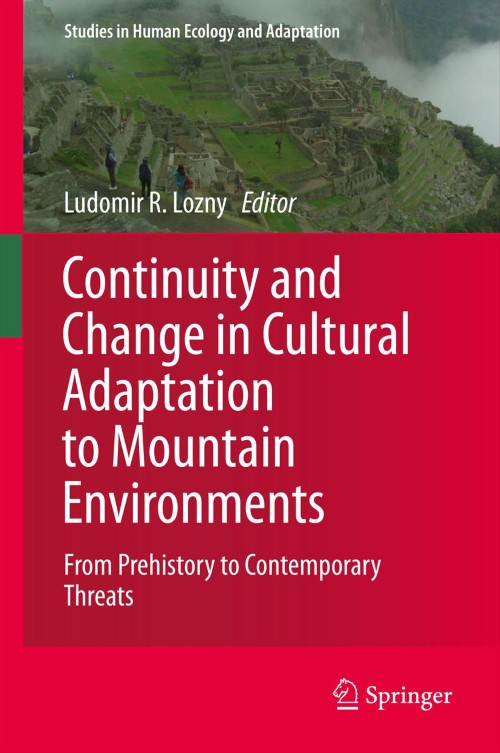
245 10|aContinuity and Change in Cultural Adaptation to Mountain Environments|h[electronic resource] :|bFrom Prehistory to Contemporary Threats /|cedited by Ludomir R Lozny.
250 |a1st ed. 2013.
264 1|aNew York, NY :|bSpringer New York :|bImprint: Springer,|c2013.
300 |aX, 410 p.|bonline resource.
336 |atext|btxt|2rdacontent
337 |acomputer|bc|2rdamedia
338 |aonline resource|bcr|2rdacarrier
347 |atext file|bPDF|2rda
490 1 |aStudies in Human Ecology and Adaptation ;|v7
520 |aContinuity and Change in Cultural Mountain Adaptations: From Prehistory to Contemporary Threats presents an international and interdisciplinary account of human cultural adaptation to mountainous environments over time. Mountain ecosystems are critical to the wellbeing of sizable populations in Eurasia, the Americas, and Africa. The book presents the evidence on continuity of human cultural adaptation to mountain ecosystems and also on contemporary threats and vulnerabilities caused by intensification in mining, agriculture, and tourism. The essays collected here discuss human responses to key physical and cultural stressors impacting human wellbeing in mountain ecosystems, such as aridity, quality of soils, steep slopes, industrialization and infrastructural change, low productivity, adverse effects of centralized political decision-making, deforestation and erosion, tourism, and the possible effects of climate change. The contributors who are cultural anthropologists, geographers, archaeologists, ecologists, and cultural resource managers and planners all point out that mountain populations cope with the stressors by adopting specific cultural strategies, such as seasonal migrations, integration of pastoral and agricultural production, animal crossbreeding, use of crop varieties, a mixture of communal and household control of land, trade, crop diversity, diversification of activities, and technological innovations and innovative scheduling of productive activities. Continuity and Change in Cultural Mountain Adaptations: From Prehistory to Contemporary Threats will be of interest to archaeologists, cultural resource managers, anthropologists, ecologists, climatologists, and geologists because mountainous ecosystems change fast, and cultures disappear and they need to be recorded. Most importantly, cultural responses of mountain populations provide clues for us all in this time of environmental change.
650 0|aAnthropology.
650 0|aBiotic communities.
650 0|aHuman geography.
650 14|aAnthropology.
650 24|aEcosystems.
650 24|aHuman Geography.
700 1 |aLozny, Ludomir R.|eeditor.|4edt|4http://id.loc.gov/vocabulary/relators/edt
710 2 |aSpringerLink (Online service)
773 0 |tSpringer Nature eBook
776 08|iPrinted edition:|z9781461457015
776 08|iPrinted edition:|z9781461457039
776 08|iPrinted edition:|z9781489994851
830 0|aStudies in Human Ecology and Adaptation ;|v7
856 40|uhttps://doi.org/10.1007/978-1-4614-5702-2
912 |aZDB-2-SHU
912 |aZDB-2-SXS
950 |aHumanities, Social Sciences and Law (SpringerNature-11648)
950 |aSocial Sciences (R0) (SpringerNature-43726)