

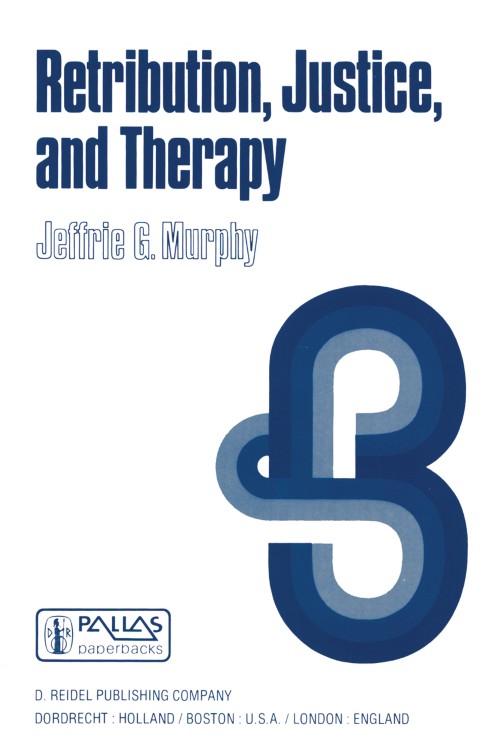
Retribution, Justice, and Therapy [electronic resource] : Essays in the Philosophy of Law / by J.G. Murphy.
Erişim Adresi
ISBN
9789400994614
Dil Kodu
İngilizce
Yer Numarası
DK/6671
Yazar
Basım Bildirimi
1st ed. 1979.
Yayın Bilgisi
Dordrecht : Springer Netherlands : Imprint: Springer, 1979.
Fiziksel Niteleme
XX, 255 p. online resource.
Dizi
Philosophical Studies Series, 2542-8349 ; 16
İçindekiler Notu
One: Rights, Justice, and the Social Contract -- The Killing of the Innocent -- Rights and Borderline Cases -- Violence and the Socratic Theory of Legal Fidelity -- Hume and Kant on the Social Contract -- Two: Punishment and Responsibility -- Three Mistakes About Retributivism -- Kant’s Theory of Criminal Punishment -- Marxism and Retribution -- Involuntary Acts and Criminal Liability -- Moral Death: A Kantian Essay on Psychopathy -- Three: Therapeutic Intervention -- Criminal Punishment and Psychiatric Fallacies -- Preventive Detention and Psychiatry -- Incompetence and Paternalism -- Total Institutions and the Possibility of Consent to Organic Therapies -- Four: Death and the Supreme Court -- Rationality and the Fear of Death -- Cruel and Unusual Punishments -- Legal Cases Cited -- Name Index.
Özet, vb.
One might legitimately ask what reasons other than vanity could prompt an author to issue a collection of his previously published essays. The best reason, I think, is the belief that the essays hang together in such a way that, as a book, they produce a whole which is in a sense greater than the sum of its parts. When this happens, as I hope it does in the present case, it is because the essays pursue related themes in such a way that, together, they at least form a start toward the development of a systematic theory on the common foundations supporting the particular claims in the particular articles. With respect to this collection, the essays can all be read as particular ways of pursuing the following general pattern of thought: that a commitment to justice and a respect for rights (and not social utility) must be the foundation of any morally acceptable legal order; that a social contractarian model is the best way to illuminate this foundation; that a retributive theory of punish ment is the only theory of punishment resting on such a foundation and thus is the only morally acceptable theory of punishment; that the twentieth century's faddish movement toward a "scientific" or therapeutic response to crime runs grave risks of undermining the foundations of justice and rights on which the legal order ought to rest; and, finally, that the legitimate worry about the tendency of the behavioral sciences to undermine the values of.
Konu
Law __ Philosophy.
Philosophy of Law.
Philosophy of Law.
Kurum Adı
Eseri Alıntıla
Referansları kullanmadan önce gözden geçirmeniz ve varsa gerekli düzeltmeleri yapmanız önerilir.
Dijital Kaynak
MARC Görünümü
LEADER 04711nam a22005295i 4500
001 805351
003 TR_AnAIT
005 20260126235945
007 cr nn 008mamaa
008 121227s1979 ne | s |||| 0|eng d
020 |a9789400994614|9978-94-009-9461-4
024 7 |a10.1007/978-94-009-9461-4|2doi
041 |aeng
049 |aTürk Tarih Kurumu Kütüphanesi
050 4|aK201-487
072 7|aLAB|2bicssc
072 7|aPHI000000|2bisacsh
072 7|aLAB|2thema
082 04|a340.1|223
090 |aDK/6671
100 1 |aMurphy, J.G.|eauthor.|4aut|4http://id.loc.gov/vocabulary/relators/aut
245 10|aRetribution, Justice, and Therapy|h[electronic resource] :|bEssays in the Philosophy of Law /|cby J.G. Murphy.
250 |a1st ed. 1979.
264 1|aDordrecht :|bSpringer Netherlands :|bImprint: Springer,|c1979.
300 |aXX, 255 p.|bonline resource.
336 |atext|btxt|2rdacontent
337 |acomputer|bc|2rdamedia
338 |aonline resource|bcr|2rdacarrier
347 |atext file|bPDF|2rda
490 1 |aPhilosophical Studies Series,|x2542-8349 ;|v16
505 0 |aOne: Rights, Justice, and the Social Contract -- The Killing of the Innocent -- Rights and Borderline Cases -- Violence and the Socratic Theory of Legal Fidelity -- Hume and Kant on the Social Contract -- Two: Punishment and Responsibility -- Three Mistakes About Retributivism -- Kant’s Theory of Criminal Punishment -- Marxism and Retribution -- Involuntary Acts and Criminal Liability -- Moral Death: A Kantian Essay on Psychopathy -- Three: Therapeutic Intervention -- Criminal Punishment and Psychiatric Fallacies -- Preventive Detention and Psychiatry -- Incompetence and Paternalism -- Total Institutions and the Possibility of Consent to Organic Therapies -- Four: Death and the Supreme Court -- Rationality and the Fear of Death -- Cruel and Unusual Punishments -- Legal Cases Cited -- Name Index.
520 |aOne might legitimately ask what reasons other than vanity could prompt an author to issue a collection of his previously published essays. The best reason, I think, is the belief that the essays hang together in such a way that, as a book, they produce a whole which is in a sense greater than the sum of its parts. When this happens, as I hope it does in the present case, it is because the essays pursue related themes in such a way that, together, they at least form a start toward the development of a systematic theory on the common foundations supporting the particular claims in the particular articles. With respect to this collection, the essays can all be read as particular ways of pursuing the following general pattern of thought: that a commitment to justice and a respect for rights (and not social utility) must be the foundation of any morally acceptable legal order; that a social contractarian model is the best way to illuminate this foundation; that a retributive theory of punish ment is the only theory of punishment resting on such a foundation and thus is the only morally acceptable theory of punishment; that the twentieth century's faddish movement toward a "scientific" or therapeutic response to crime runs grave risks of undermining the foundations of justice and rights on which the legal order ought to rest; and, finally, that the legitimate worry about the tendency of the behavioral sciences to undermine the values of.
532 8 |aAccessibility summary: This PDF is not accessible. It is based on scanned pages and does not support features such as screen reader compatibility or described non-text content (images, graphs etc). However, it likely supports searchable and selectable text based on OCR (Optical Character Recognition). Users with accessibility needs may not be able to use this content effectively. Please contact us at accessibilitysupport@springernature.com if you require assistance or an alternative format.
532 8 |aInaccessible, or known limited accessibility
532 8 |aNo reading system accessibility options actively disabled
532 8 |aPublisher contact for further accessibility information: accessibilitysupport@springernature.com
650 0|aLaw|xPhilosophy.
650 14|aPhilosophy of Law.
710 2 |aSpringerLink (Online service)
773 0 |tSpringer Nature eBook
776 08|iPrinted edition:|z9789027709981
776 08|iPrinted edition:|z9789027709998
776 08|iPrinted edition:|z9789400994621
830 0|aPhilosophical Studies Series,|x2542-8349 ;|v16
856 40|uhttps://doi.org/10.1007/978-94-009-9461-4
912 |aZDB-2-SHU
912 |aZDB-2-SXPR
912 |aZDB-2-BAE
950 |aHumanities, Social Sciences and Law (SpringerNature-11648)
950 |aPhilosophy and Religion (R0) (SpringerNature-43725)
001 805351
003 TR_AnAIT
005 20260126235945
007 cr nn 008mamaa
008 121227s1979 ne | s |||| 0|eng d
020 |a9789400994614|9978-94-009-9461-4
024 7 |a10.1007/978-94-009-9461-4|2doi
041 |aeng
049 |aTürk Tarih Kurumu Kütüphanesi
050 4|aK201-487
072 7|aLAB|2bicssc
072 7|aPHI000000|2bisacsh
072 7|aLAB|2thema
082 04|a340.1|223
090 |aDK/6671
100 1 |aMurphy, J.G.|eauthor.|4aut|4http://id.loc.gov/vocabulary/relators/aut
245 10|aRetribution, Justice, and Therapy|h[electronic resource] :|bEssays in the Philosophy of Law /|cby J.G. Murphy.
250 |a1st ed. 1979.
264 1|aDordrecht :|bSpringer Netherlands :|bImprint: Springer,|c1979.
300 |aXX, 255 p.|bonline resource.
336 |atext|btxt|2rdacontent
337 |acomputer|bc|2rdamedia
338 |aonline resource|bcr|2rdacarrier
347 |atext file|bPDF|2rda
490 1 |aPhilosophical Studies Series,|x2542-8349 ;|v16
505 0 |aOne: Rights, Justice, and the Social Contract -- The Killing of the Innocent -- Rights and Borderline Cases -- Violence and the Socratic Theory of Legal Fidelity -- Hume and Kant on the Social Contract -- Two: Punishment and Responsibility -- Three Mistakes About Retributivism -- Kant’s Theory of Criminal Punishment -- Marxism and Retribution -- Involuntary Acts and Criminal Liability -- Moral Death: A Kantian Essay on Psychopathy -- Three: Therapeutic Intervention -- Criminal Punishment and Psychiatric Fallacies -- Preventive Detention and Psychiatry -- Incompetence and Paternalism -- Total Institutions and the Possibility of Consent to Organic Therapies -- Four: Death and the Supreme Court -- Rationality and the Fear of Death -- Cruel and Unusual Punishments -- Legal Cases Cited -- Name Index.
520 |aOne might legitimately ask what reasons other than vanity could prompt an author to issue a collection of his previously published essays. The best reason, I think, is the belief that the essays hang together in such a way that, as a book, they produce a whole which is in a sense greater than the sum of its parts. When this happens, as I hope it does in the present case, it is because the essays pursue related themes in such a way that, together, they at least form a start toward the development of a systematic theory on the common foundations supporting the particular claims in the particular articles. With respect to this collection, the essays can all be read as particular ways of pursuing the following general pattern of thought: that a commitment to justice and a respect for rights (and not social utility) must be the foundation of any morally acceptable legal order; that a social contractarian model is the best way to illuminate this foundation; that a retributive theory of punish ment is the only theory of punishment resting on such a foundation and thus is the only morally acceptable theory of punishment; that the twentieth century's faddish movement toward a "scientific" or therapeutic response to crime runs grave risks of undermining the foundations of justice and rights on which the legal order ought to rest; and, finally, that the legitimate worry about the tendency of the behavioral sciences to undermine the values of.
532 8 |aAccessibility summary: This PDF is not accessible. It is based on scanned pages and does not support features such as screen reader compatibility or described non-text content (images, graphs etc). However, it likely supports searchable and selectable text based on OCR (Optical Character Recognition). Users with accessibility needs may not be able to use this content effectively. Please contact us at accessibilitysupport@springernature.com if you require assistance or an alternative format.
532 8 |aInaccessible, or known limited accessibility
532 8 |aNo reading system accessibility options actively disabled
532 8 |aPublisher contact for further accessibility information: accessibilitysupport@springernature.com
650 0|aLaw|xPhilosophy.
650 14|aPhilosophy of Law.
710 2 |aSpringerLink (Online service)
773 0 |tSpringer Nature eBook
776 08|iPrinted edition:|z9789027709981
776 08|iPrinted edition:|z9789027709998
776 08|iPrinted edition:|z9789400994621
830 0|aPhilosophical Studies Series,|x2542-8349 ;|v16
856 40|uhttps://doi.org/10.1007/978-94-009-9461-4
912 |aZDB-2-SHU
912 |aZDB-2-SXPR
912 |aZDB-2-BAE
950 |aHumanities, Social Sciences and Law (SpringerNature-11648)
950 |aPhilosophy and Religion (R0) (SpringerNature-43725)
Materyaller
Depodan talep edilen materyal sadece kütüphane içerisinde kullanılmaktadır.
Materyal dışarıya ödünç verilmemektedir.
Materyal dışarıya ödünç verilmemektedir.
