

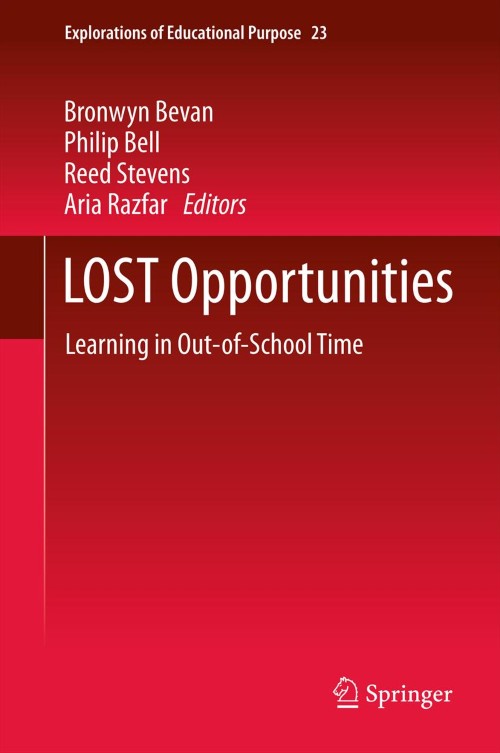
LOST Opportunities [electronic resource] : Learning in Out-of-School Time / edited by Bronwyn Bevan, Philip Bell, Reed Stevens, Aria Razfar.
Erişim Adresi
ISBN
9789400743045
Dil Kodu
İngilizce
Yer Numarası
DK/6675
Basım Bildirimi
1st ed. 2013.
Yayın Bilgisi
Dordrecht : Springer Netherlands : Imprint: Springer, 2013.
Fiziksel Niteleme
XIV, 298 p. online resource.
Dizi
Explorations of Educational Purpose, 1875-4457 ; 23
İçindekiler Notu
Preface: Learning about Out of School Time (LOST) Learning Opportunities, Bronwyn Bevan, Reed Stevens, Philip Bell, Aria Razfar -- Part I -- Introduction: What counts as math and science?, Reed Stevens -- Chapter 1: Math I Am: What We Learn from Stories that People Tell about Math in their Lives, Indigo Esmonde1, Kristen Pilner Blair, Shelley Goldman, Lee Martin, Osvaldo Jimenez, Roy Pea -- Chapter 2: What Counts as Science in Everyday and Family Interactions?, Maureen Callanan, Megan Luce, Lara Triona, Jennifer Rigney, Deborah Siegel, Jennifer Jipson -- Chapter 3: What Counts as Mathematics when ‘We All Use Math Everyday’?: A Look at NUMB3RS, Indigo Esmonde -- Chapter 4: What Counts Too Much and Too Little as Math. Reed Stevens -- Chapter 5: When Is Mathematics, and Who Says So?, Ray McDermott -- Part II -- Introduction: Understanding How and Why People Learn Across Settings as an Educational Equity Strategy, Philip Bell -- Chapter 6: Creating within and across life spaces: The role of a computer clubhouse in a child’s learning ecology, Brigid Barron, Susie Wise, Caitlin K. Martin -- Chapter 7: Discovering and Supporting Successful Learning Pathways of Youth In and Out Of School: Accounting for the Development of Everyday Expertise Across Settings, Philip Bell, Leah Bricker, Suzanne Reeve, Heather Toomey Zimmerman, Carrie Tzou -- Chapter 8: Doing Science with Others at Preschool and at Home: A Comparison of Contextually Situated Interactional Configurations and their Implications for Learning, Siri Mehus, Reed Stevens, Linda Grigholm -- Chapter 9: Shifting Languages, Spaces, and Leaner Identities: Learning Mathematics After School, Aria Razfar -- Chapter 10: Expanding Methodologies to Account For Expansive Views of Learning: A Commentary on Section II, Kris Gutiérrez -- Part III -- Introduction: STEM in the Organized Out-of-School-Time Setting, Bronwyn Bevan -- Chapter 11: Out-Of-School-Time STEM:It’s Not What You Think, Bronwyn Bevan, Vera Michalchik -- Chapter 12: Examining Youth's Mathematics Practices in an After School Robotics Team, John Baker, Janine Remillard, Vivian Lim -- Chapter 13: After-school: An Innovative Model to Better Understand the Mathematics Learning of Latinas/Os, Lena Licón Khisty, Craig Willey -- Chapter 14: Teacher Development in After-school Mathematics Contexts: Insights from projects that capitalize on Latinas/os’ linguistic and cultural resources, Eugenia Vomvoridi-Ivanović, Maura Varley, Gabriel Viego, Ksenija Simić-Muller, Lena Licón Khisty -- Chapter 15: How "Hands-On" Implicitly Informs "What Counts" as Science, Rhiannon Crain, Molly Loomis, Rodney T. Ogawa -- Chapter 16: Thoughts on Science Education During the Afterschool Hours, Michael Cole.
Özet, vb.
Learning in informal settings is attracting growing attention from policymakers and researchers, yet there remains, at the moment, a dearth of literature on the topic. Thus this volume, which examines how science and mathematics are experienced in everyday and out-of-school-time (OST) settings, makes an important contribution to the field of the learning sciences. Conducting research on OST learning requires us to broaden and deepen our conceptions of learning as well as to better identify the unique and common qualities of different learning settings. We must also find better ways to analyze the interplay between OST and school-based learning. In this volume, scholars develop theoretical structures that are useful not only for understanding learning processes, but also for helping to create and support new opportunities for learning, whether they are in or out of school, or bridging a range of settings. The chapters in this volume include studies of everyday and situated processes that facilitate science and mathematics learning. They also feature new theoretical and empirical frameworks for studying learning pathways that span both in- and out-of-school time and settings. Contributors also examine structured OST programs in which everyday and situated modes of learning are leveraged in support of more disciplined practices and conceptions of science and mathematics. Fortifying much of this work is a leading focus on educational equity—a desire to foster more socially supportive and intellectually engaging science and mathematics learning opportunities for youth from historically non-dominant communities. Full of compelling examples and revealing analysis, this book is a vital addition to the literature on a subject with a fast-rising profile. I believe that the studies represented in this volume will move our work forward as we seek to understand better which social ecologies support -- indeed, ratchet up -- learning and givemeaning for youth, especially those from non-dominant communities. Kris Gutiérrez, University of Colorado at Boulder For someone who has long been interested in afterschool educational activities as a promising supplement to formal, in-school education, this book provides rich opportunities to think about the promise and the problems that such programs offer to those concerned with the infusion of science into the learning and development of their participants. Mike Cole, University of California, San Diego.
Konu
Science __ Study and teaching.
Mathematics __ Study and teaching .
Learning, Psychology of.
Science Education.
Mathematics Education.
Instructional Psychology.
Mathematics __ Study and teaching .
Learning, Psychology of.
Science Education.
Mathematics Education.
Instructional Psychology.
Diğer Yazarlar
Kurum Adı
Eseri Alıntıla
Referansları kullanmadan önce gözden geçirmeniz ve varsa gerekli düzeltmeleri yapmanız önerilir.
Dijital Kaynak
MARC Görünümü
LEADER 07424nam a22005775i 4500
001 805355
003 TR_AnAIT
005 20260126235950
007 cr nn 008mamaa
008 120725s2013 ne | s |||| 0|eng d
020 |a9789400743045|9978-94-007-4304-5
024 7 |a10.1007/978-94-007-4304-5|2doi
041 |aeng
049 |aTürk Tarih Kurumu Kütüphanesi
050 4|aQ181-183.4
072 7|aJNU|2bicssc
072 7|aPD|2bicssc
072 7|aSCI063000|2bisacsh
072 7|aJNU|2thema
072 7|aPD|2thema
082 04|a507.1|223
090 |aDK/6675
245 10|aLOST Opportunities|h[electronic resource] :|bLearning in Out-of-School Time /|cedited by Bronwyn Bevan, Philip Bell, Reed Stevens, Aria Razfar.
250 |a1st ed. 2013.
264 1|aDordrecht :|bSpringer Netherlands :|bImprint: Springer,|c2013.
300 |aXIV, 298 p.|bonline resource.
336 |atext|btxt|2rdacontent
337 |acomputer|bc|2rdamedia
338 |aonline resource|bcr|2rdacarrier
347 |atext file|bPDF|2rda
490 1 |aExplorations of Educational Purpose,|x1875-4457 ;|v23
505 0 |aPreface: Learning about Out of School Time (LOST) Learning Opportunities, Bronwyn Bevan, Reed Stevens, Philip Bell, Aria Razfar -- Part I -- Introduction: What counts as math and science?, Reed Stevens -- Chapter 1: Math I Am: What We Learn from Stories that People Tell about Math in their Lives, Indigo Esmonde1, Kristen Pilner Blair, Shelley Goldman, Lee Martin, Osvaldo Jimenez, Roy Pea -- Chapter 2: What Counts as Science in Everyday and Family Interactions?, Maureen Callanan, Megan Luce, Lara Triona, Jennifer Rigney, Deborah Siegel, Jennifer Jipson -- Chapter 3: What Counts as Mathematics when ‘We All Use Math Everyday’?: A Look at NUMB3RS, Indigo Esmonde -- Chapter 4: What Counts Too Much and Too Little as Math. Reed Stevens -- Chapter 5: When Is Mathematics, and Who Says So?, Ray McDermott -- Part II -- Introduction: Understanding How and Why People Learn Across Settings as an Educational Equity Strategy, Philip Bell -- Chapter 6: Creating within and across life spaces: The role of a computer clubhouse in a child’s learning ecology, Brigid Barron, Susie Wise, Caitlin K. Martin -- Chapter 7: Discovering and Supporting Successful Learning Pathways of Youth In and Out Of School: Accounting for the Development of Everyday Expertise Across Settings, Philip Bell, Leah Bricker, Suzanne Reeve, Heather Toomey Zimmerman, Carrie Tzou -- Chapter 8: Doing Science with Others at Preschool and at Home: A Comparison of Contextually Situated Interactional Configurations and their Implications for Learning, Siri Mehus, Reed Stevens, Linda Grigholm -- Chapter 9: Shifting Languages, Spaces, and Leaner Identities: Learning Mathematics After School, Aria Razfar -- Chapter 10: Expanding Methodologies to Account For Expansive Views of Learning: A Commentary on Section II, Kris Gutiérrez -- Part III -- Introduction: STEM in the Organized Out-of-School-Time Setting, Bronwyn Bevan -- Chapter 11: Out-Of-School-Time STEM:It’s Not What You Think, Bronwyn Bevan, Vera Michalchik -- Chapter 12: Examining Youth's Mathematics Practices in an After School Robotics Team, John Baker, Janine Remillard, Vivian Lim -- Chapter 13: After-school: An Innovative Model to Better Understand the Mathematics Learning of Latinas/Os, Lena Licón Khisty, Craig Willey -- Chapter 14: Teacher Development in After-school Mathematics Contexts: Insights from projects that capitalize on Latinas/os’ linguistic and cultural resources, Eugenia Vomvoridi-Ivanović, Maura Varley, Gabriel Viego, Ksenija Simić-Muller, Lena Licón Khisty -- Chapter 15: How "Hands-On" Implicitly Informs "What Counts" as Science, Rhiannon Crain, Molly Loomis, Rodney T. Ogawa -- Chapter 16: Thoughts on Science Education During the Afterschool Hours, Michael Cole.
520 |aLearning in informal settings is attracting growing attention from policymakers and researchers, yet there remains, at the moment, a dearth of literature on the topic. Thus this volume, which examines how science and mathematics are experienced in everyday and out-of-school-time (OST) settings, makes an important contribution to the field of the learning sciences. Conducting research on OST learning requires us to broaden and deepen our conceptions of learning as well as to better identify the unique and common qualities of different learning settings. We must also find better ways to analyze the interplay between OST and school-based learning. In this volume, scholars develop theoretical structures that are useful not only for understanding learning processes, but also for helping to create and support new opportunities for learning, whether they are in or out of school, or bridging a range of settings. The chapters in this volume include studies of everyday and situated processes that facilitate science and mathematics learning. They also feature new theoretical and empirical frameworks for studying learning pathways that span both in- and out-of-school time and settings. Contributors also examine structured OST programs in which everyday and situated modes of learning are leveraged in support of more disciplined practices and conceptions of science and mathematics. Fortifying much of this work is a leading focus on educational equity—a desire to foster more socially supportive and intellectually engaging science and mathematics learning opportunities for youth from historically non-dominant communities. Full of compelling examples and revealing analysis, this book is a vital addition to the literature on a subject with a fast-rising profile. I believe that the studies represented in this volume will move our work forward as we seek to understand better which social ecologies support -- indeed, ratchet up -- learning and givemeaning for youth, especially those from non-dominant communities. Kris Gutiérrez, University of Colorado at Boulder For someone who has long been interested in afterschool educational activities as a promising supplement to formal, in-school education, this book provides rich opportunities to think about the promise and the problems that such programs offer to those concerned with the infusion of science into the learning and development of their participants. Mike Cole, University of California, San Diego.
650 0|aScience|xStudy and teaching.
650 0|aMathematics|xStudy and teaching .
650 0|aLearning, Psychology of.
650 14|aScience Education.
650 24|aMathematics Education.
650 24|aInstructional Psychology.
700 1 |aBevan, Bronwyn.|eeditor.|4edt|4http://id.loc.gov/vocabulary/relators/edt
700 1 |aBell, Philip.|eeditor.|4edt|4http://id.loc.gov/vocabulary/relators/edt
700 1 |aStevens, Reed.|eeditor.|4edt|4http://id.loc.gov/vocabulary/relators/edt
700 1 |aRazfar, Aria.|eeditor.|4edt|4http://id.loc.gov/vocabulary/relators/edt
710 2 |aSpringerLink (Online service)
773 0 |tSpringer Nature eBook
776 08|iPrinted edition:|z9789400743038
776 08|iPrinted edition:|z9789400743052
776 08|iPrinted edition:|z9789401781664
830 0|aExplorations of Educational Purpose,|x1875-4457 ;|v23
856 40|uhttps://doi.org/10.1007/978-94-007-4304-5
912 |aZDB-2-SHU
912 |aZDB-2-SXED
950 |aHumanities, Social Sciences and Law (SpringerNature-11648)
950 |aEducation (R0) (SpringerNature-43721)
001 805355
003 TR_AnAIT
005 20260126235950
007 cr nn 008mamaa
008 120725s2013 ne | s |||| 0|eng d
020 |a9789400743045|9978-94-007-4304-5
024 7 |a10.1007/978-94-007-4304-5|2doi
041 |aeng
049 |aTürk Tarih Kurumu Kütüphanesi
050 4|aQ181-183.4
072 7|aJNU|2bicssc
072 7|aPD|2bicssc
072 7|aSCI063000|2bisacsh
072 7|aJNU|2thema
072 7|aPD|2thema
082 04|a507.1|223
090 |aDK/6675
245 10|aLOST Opportunities|h[electronic resource] :|bLearning in Out-of-School Time /|cedited by Bronwyn Bevan, Philip Bell, Reed Stevens, Aria Razfar.
250 |a1st ed. 2013.
264 1|aDordrecht :|bSpringer Netherlands :|bImprint: Springer,|c2013.
300 |aXIV, 298 p.|bonline resource.
336 |atext|btxt|2rdacontent
337 |acomputer|bc|2rdamedia
338 |aonline resource|bcr|2rdacarrier
347 |atext file|bPDF|2rda
490 1 |aExplorations of Educational Purpose,|x1875-4457 ;|v23
505 0 |aPreface: Learning about Out of School Time (LOST) Learning Opportunities, Bronwyn Bevan, Reed Stevens, Philip Bell, Aria Razfar -- Part I -- Introduction: What counts as math and science?, Reed Stevens -- Chapter 1: Math I Am: What We Learn from Stories that People Tell about Math in their Lives, Indigo Esmonde1, Kristen Pilner Blair, Shelley Goldman, Lee Martin, Osvaldo Jimenez, Roy Pea -- Chapter 2: What Counts as Science in Everyday and Family Interactions?, Maureen Callanan, Megan Luce, Lara Triona, Jennifer Rigney, Deborah Siegel, Jennifer Jipson -- Chapter 3: What Counts as Mathematics when ‘We All Use Math Everyday’?: A Look at NUMB3RS, Indigo Esmonde -- Chapter 4: What Counts Too Much and Too Little as Math. Reed Stevens -- Chapter 5: When Is Mathematics, and Who Says So?, Ray McDermott -- Part II -- Introduction: Understanding How and Why People Learn Across Settings as an Educational Equity Strategy, Philip Bell -- Chapter 6: Creating within and across life spaces: The role of a computer clubhouse in a child’s learning ecology, Brigid Barron, Susie Wise, Caitlin K. Martin -- Chapter 7: Discovering and Supporting Successful Learning Pathways of Youth In and Out Of School: Accounting for the Development of Everyday Expertise Across Settings, Philip Bell, Leah Bricker, Suzanne Reeve, Heather Toomey Zimmerman, Carrie Tzou -- Chapter 8: Doing Science with Others at Preschool and at Home: A Comparison of Contextually Situated Interactional Configurations and their Implications for Learning, Siri Mehus, Reed Stevens, Linda Grigholm -- Chapter 9: Shifting Languages, Spaces, and Leaner Identities: Learning Mathematics After School, Aria Razfar -- Chapter 10: Expanding Methodologies to Account For Expansive Views of Learning: A Commentary on Section II, Kris Gutiérrez -- Part III -- Introduction: STEM in the Organized Out-of-School-Time Setting, Bronwyn Bevan -- Chapter 11: Out-Of-School-Time STEM:It’s Not What You Think, Bronwyn Bevan, Vera Michalchik -- Chapter 12: Examining Youth's Mathematics Practices in an After School Robotics Team, John Baker, Janine Remillard, Vivian Lim -- Chapter 13: After-school: An Innovative Model to Better Understand the Mathematics Learning of Latinas/Os, Lena Licón Khisty, Craig Willey -- Chapter 14: Teacher Development in After-school Mathematics Contexts: Insights from projects that capitalize on Latinas/os’ linguistic and cultural resources, Eugenia Vomvoridi-Ivanović, Maura Varley, Gabriel Viego, Ksenija Simić-Muller, Lena Licón Khisty -- Chapter 15: How "Hands-On" Implicitly Informs "What Counts" as Science, Rhiannon Crain, Molly Loomis, Rodney T. Ogawa -- Chapter 16: Thoughts on Science Education During the Afterschool Hours, Michael Cole.
520 |aLearning in informal settings is attracting growing attention from policymakers and researchers, yet there remains, at the moment, a dearth of literature on the topic. Thus this volume, which examines how science and mathematics are experienced in everyday and out-of-school-time (OST) settings, makes an important contribution to the field of the learning sciences. Conducting research on OST learning requires us to broaden and deepen our conceptions of learning as well as to better identify the unique and common qualities of different learning settings. We must also find better ways to analyze the interplay between OST and school-based learning. In this volume, scholars develop theoretical structures that are useful not only for understanding learning processes, but also for helping to create and support new opportunities for learning, whether they are in or out of school, or bridging a range of settings. The chapters in this volume include studies of everyday and situated processes that facilitate science and mathematics learning. They also feature new theoretical and empirical frameworks for studying learning pathways that span both in- and out-of-school time and settings. Contributors also examine structured OST programs in which everyday and situated modes of learning are leveraged in support of more disciplined practices and conceptions of science and mathematics. Fortifying much of this work is a leading focus on educational equity—a desire to foster more socially supportive and intellectually engaging science and mathematics learning opportunities for youth from historically non-dominant communities. Full of compelling examples and revealing analysis, this book is a vital addition to the literature on a subject with a fast-rising profile. I believe that the studies represented in this volume will move our work forward as we seek to understand better which social ecologies support -- indeed, ratchet up -- learning and givemeaning for youth, especially those from non-dominant communities. Kris Gutiérrez, University of Colorado at Boulder For someone who has long been interested in afterschool educational activities as a promising supplement to formal, in-school education, this book provides rich opportunities to think about the promise and the problems that such programs offer to those concerned with the infusion of science into the learning and development of their participants. Mike Cole, University of California, San Diego.
650 0|aScience|xStudy and teaching.
650 0|aMathematics|xStudy and teaching .
650 0|aLearning, Psychology of.
650 14|aScience Education.
650 24|aMathematics Education.
650 24|aInstructional Psychology.
700 1 |aBevan, Bronwyn.|eeditor.|4edt|4http://id.loc.gov/vocabulary/relators/edt
700 1 |aBell, Philip.|eeditor.|4edt|4http://id.loc.gov/vocabulary/relators/edt
700 1 |aStevens, Reed.|eeditor.|4edt|4http://id.loc.gov/vocabulary/relators/edt
700 1 |aRazfar, Aria.|eeditor.|4edt|4http://id.loc.gov/vocabulary/relators/edt
710 2 |aSpringerLink (Online service)
773 0 |tSpringer Nature eBook
776 08|iPrinted edition:|z9789400743038
776 08|iPrinted edition:|z9789400743052
776 08|iPrinted edition:|z9789401781664
830 0|aExplorations of Educational Purpose,|x1875-4457 ;|v23
856 40|uhttps://doi.org/10.1007/978-94-007-4304-5
912 |aZDB-2-SHU
912 |aZDB-2-SXED
950 |aHumanities, Social Sciences and Law (SpringerNature-11648)
950 |aEducation (R0) (SpringerNature-43721)
Materyaller
Depodan talep edilen materyal sadece kütüphane içerisinde kullanılmaktadır.
Materyal dışarıya ödünç verilmemektedir.
Materyal dışarıya ödünç verilmemektedir.
