

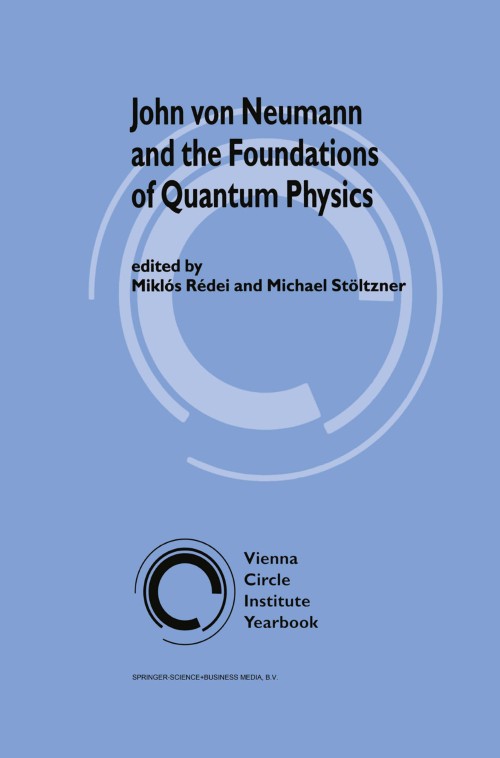
John von Neumann and the Foundations of Quantum Physics [electronic resource] / edited by Miklós Rédei, Michael Stöltzner.
Erişim Adresi
ISBN
9789401720120
Dil Kodu
İngilizce
Yer Numarası
DK/6677
Basım Bildirimi
1st ed. 2001.
Yayın Bilgisi
Dordrecht : Springer Netherlands : Imprint: Springer, 2001.
Fiziksel Niteleme
IX, 373 p. online resource.
Dizi
Vienna Circle Institute Yearbook, Institute Vienna Circle, University of Vienna Vienna Circle Society, Society for the Advancement of Scientific World Conceptions, 2215-1818 ; 8
İçindekiler Notu
A. John Von Neumann and the Foundations of Quantum Physics -- J. v. Neumann’s Influence in Mathematical Physics -- The Axiomatic Method and the Foundations of Science: Historical Roots of Mathematical Physics in Göttingen (1900–1930) -- Opportunistic Axiomatics — von Neumann on the Methodology of Mathematical Physics -- Von Neumann’s Theory of Quantum Measurement -- Von Neumann, Gödel and Quantum Incompleteness -- Entropy, von Neumann and the von Neumann Entropy -- Why von Neumann Rejected Carnap’s Dualism of Information Concepts -- On the Stone — von Neumann Uniqueness Theorem and Its Ramifications -- Von Neumann’s Concept of Quantum Logic and Quantum Probability -- The Impossible Causality: the No Hidden Variables Theorem of John von Neumann -- Quantum Mechanics without Probabilities -- Critical Reflections on Quantum Probability Theory -- Editors’ Notes -- Unpublished Correspondence -- Unsolved Problems in Mathematics (1954) -- Amsterdam Talk about “Problems in Mathematics” (1954) -- Quantum Mechanics of Infinite Systems (1935/6) -- B. General Part -- A New Critique of Theological Interpretations of Physical Cosmology (7th Vienna Circle Lecture) -- Scientific Understanding in the Twentieth Century -- From Russell’s Logical Atomism to Carnap’s Aufbau: Reinterpreting the Classic and Modern Theories on the Subject -- Recent Works on Otto Neurath -- Reviews -- Activities of The IVC -- Activities 2000 -- Preview 2000/2001 -- Research Projects/Workshops -- Publications -- Library and Documentation -- Index of Names.
Özet, vb.
John von Neumann (1903-1957) was undoubtedly one of the scientific geniuses of the 20th century. The main fields to which he contributed include various disciplines of pure and applied mathematics, mathematical and theoretical physics, logic, theoretical computer science, and computer architecture. Von Neumann was also actively involved in politics and science management and he had a major impact on US government decisions during, and especially after, the Second World War. There exist several popular books on his personality and various collections focusing on his achievements in mathematics, computer science, and economy. Strangely enough, to date no detailed appraisal of his seminal contributions to the mathematical foundations of quantum physics has appeared. Von Neumann's theory of measurement and his critique of hidden variables became the touchstone of most debates in the foundations of quantum mechanics. Today, his name also figures most prominently in the mathematically rigorous branches of contemporary quantum mechanics of large systems and quantum field theory. And finally - as one of his last lectures, published in this volume for the first time, shows - he considered the relation of quantum logic and quantum mechanical probability as his most important problem for the second half of the twentieth century. The present volume embraces both historical and systematic analyses of his methodology of mathematical physics, and of the various aspects of his work in the foundations of quantum physics, such as theory of measurement, quantum logic, and quantum mechanical entropy. The volume is rounded off by previously unpublished letters and lectures documenting von Neumann's thinking about quantum theory after his 1932 Mathematical Foundations of Quantum Mechanics. The general part of the Yearbook contains papers emerging from the Institute's annual lecture series and reviews of important publications of philosophy of science and its history.
Konu
Science __ Philosophy.
Elementary particles (Physics).
Quantum field theory.
Quantum physics.
Physics __ Philosophy.
Mathematical physics.
History.
Philosophy of Science.
Elementary Particles, Quantum Field Theory.
Quantum Physics.
Philosophical Foundations of Physics and Astronomy.
Theoretical, Mathematical and Computational Physics.
History.
Elementary particles (Physics).
Quantum field theory.
Quantum physics.
Physics __ Philosophy.
Mathematical physics.
History.
Philosophy of Science.
Elementary Particles, Quantum Field Theory.
Quantum Physics.
Philosophical Foundations of Physics and Astronomy.
Theoretical, Mathematical and Computational Physics.
History.
Diğer Yazarlar
Kurum Adı
Eseri Alıntıla
Referansları kullanmadan önce gözden geçirmeniz ve varsa gerekli düzeltmeleri yapmanız önerilir.
Dijital Kaynak
MARC Görünümü
LEADER 06872nam a22006855i 4500
001 805357
003 TR_AnAIT
005 20260126235953
007 cr nn 008mamaa
008 130305s2001 ne | s |||| 0|eng d
020 |a9789401720120|9978-94-017-2012-0
024 7 |a10.1007/978-94-017-2012-0|2doi
041 |aeng
049 |aTürk Tarih Kurumu Kütüphanesi
050 4|aQ174-175.3
050 4|aB67
072 7|aPDA|2bicssc
072 7|aSCI075000|2bisacsh
072 7|aPDA|2thema
082 04|a501|223
090 |aDK/6677
245 10|aJohn von Neumann and the Foundations of Quantum Physics|h[electronic resource] /|cedited by Miklós Rédei, Michael Stöltzner.
250 |a1st ed. 2001.
264 1|aDordrecht :|bSpringer Netherlands :|bImprint: Springer,|c2001.
300 |aIX, 373 p.|bonline resource.
336 |atext|btxt|2rdacontent
337 |acomputer|bc|2rdamedia
338 |aonline resource|bcr|2rdacarrier
347 |atext file|bPDF|2rda
490 1 |aVienna Circle Institute Yearbook, Institute Vienna Circle, University of Vienna Vienna Circle Society, Society for the Advancement of Scientific World Conceptions,|x2215-1818 ;|v8
505 0 |aA. John Von Neumann and the Foundations of Quantum Physics -- J. v. Neumann’s Influence in Mathematical Physics -- The Axiomatic Method and the Foundations of Science: Historical Roots of Mathematical Physics in Göttingen (1900–1930) -- Opportunistic Axiomatics — von Neumann on the Methodology of Mathematical Physics -- Von Neumann’s Theory of Quantum Measurement -- Von Neumann, Gödel and Quantum Incompleteness -- Entropy, von Neumann and the von Neumann Entropy -- Why von Neumann Rejected Carnap’s Dualism of Information Concepts -- On the Stone — von Neumann Uniqueness Theorem and Its Ramifications -- Von Neumann’s Concept of Quantum Logic and Quantum Probability -- The Impossible Causality: the No Hidden Variables Theorem of John von Neumann -- Quantum Mechanics without Probabilities -- Critical Reflections on Quantum Probability Theory -- Editors’ Notes -- Unpublished Correspondence -- Unsolved Problems in Mathematics (1954) -- Amsterdam Talk about “Problems in Mathematics” (1954) -- Quantum Mechanics of Infinite Systems (1935/6) -- B. General Part -- A New Critique of Theological Interpretations of Physical Cosmology (7th Vienna Circle Lecture) -- Scientific Understanding in the Twentieth Century -- From Russell’s Logical Atomism to Carnap’s Aufbau: Reinterpreting the Classic and Modern Theories on the Subject -- Recent Works on Otto Neurath -- Reviews -- Activities of The IVC -- Activities 2000 -- Preview 2000/2001 -- Research Projects/Workshops -- Publications -- Library and Documentation -- Index of Names.
520 |aJohn von Neumann (1903-1957) was undoubtedly one of the scientific geniuses of the 20th century. The main fields to which he contributed include various disciplines of pure and applied mathematics, mathematical and theoretical physics, logic, theoretical computer science, and computer architecture. Von Neumann was also actively involved in politics and science management and he had a major impact on US government decisions during, and especially after, the Second World War. There exist several popular books on his personality and various collections focusing on his achievements in mathematics, computer science, and economy. Strangely enough, to date no detailed appraisal of his seminal contributions to the mathematical foundations of quantum physics has appeared. Von Neumann's theory of measurement and his critique of hidden variables became the touchstone of most debates in the foundations of quantum mechanics. Today, his name also figures most prominently in the mathematically rigorous branches of contemporary quantum mechanics of large systems and quantum field theory. And finally - as one of his last lectures, published in this volume for the first time, shows - he considered the relation of quantum logic and quantum mechanical probability as his most important problem for the second half of the twentieth century. The present volume embraces both historical and systematic analyses of his methodology of mathematical physics, and of the various aspects of his work in the foundations of quantum physics, such as theory of measurement, quantum logic, and quantum mechanical entropy. The volume is rounded off by previously unpublished letters and lectures documenting von Neumann's thinking about quantum theory after his 1932 Mathematical Foundations of Quantum Mechanics. The general part of the Yearbook contains papers emerging from the Institute's annual lecture series and reviews of important publications of philosophy of science and its history.
532 8 |aAccessibility summary: This PDF is not accessible. It is based on scanned pages and does not support features such as screen reader compatibility or described non-text content (images, graphs etc). However, it likely supports searchable and selectable text based on OCR (Optical Character Recognition). Users with accessibility needs may not be able to use this content effectively. Please contact us at accessibilitysupport@springernature.com if you require assistance or an alternative format.
532 8 |aInaccessible, or known limited accessibility
532 8 |aNo reading system accessibility options actively disabled
532 8 |aPublisher contact for further accessibility information: accessibilitysupport@springernature.com
650 0|aScience|xPhilosophy.
650 0|aElementary particles (Physics).
650 0|aQuantum field theory.
650 0|aQuantum physics.
650 0|aPhysics|xPhilosophy.
650 0|aMathematical physics.
650 0|aHistory.
650 14|aPhilosophy of Science.
650 24|aElementary Particles, Quantum Field Theory.
650 24|aQuantum Physics.
650 24|aPhilosophical Foundations of Physics and Astronomy.
650 24|aTheoretical, Mathematical and Computational Physics.
650 24|aHistory.
700 1 |aRédei, Miklós.|eeditor.|4edt|4http://id.loc.gov/vocabulary/relators/edt
700 1 |aStöltzner, Michael.|eeditor.|4edt|4http://id.loc.gov/vocabulary/relators/edt
710 2 |aSpringerLink (Online service)
773 0 |tSpringer Nature eBook
776 08|iPrinted edition:|z9780792368120
776 08|iPrinted edition:|z9789048156511
776 08|iPrinted edition:|z9789401720137
830 0|aVienna Circle Institute Yearbook, Institute Vienna Circle, University of Vienna Vienna Circle Society, Society for the Advancement of Scientific World Conceptions,|x2215-1818 ;|v8
856 40|uhttps://doi.org/10.1007/978-94-017-2012-0
912 |aZDB-2-SHU
912 |aZDB-2-SXPR
912 |aZDB-2-BAE
950 |aHumanities, Social Sciences and Law (SpringerNature-11648)
950 |aPhilosophy and Religion (R0) (SpringerNature-43725)
001 805357
003 TR_AnAIT
005 20260126235953
007 cr nn 008mamaa
008 130305s2001 ne | s |||| 0|eng d
020 |a9789401720120|9978-94-017-2012-0
024 7 |a10.1007/978-94-017-2012-0|2doi
041 |aeng
049 |aTürk Tarih Kurumu Kütüphanesi
050 4|aQ174-175.3
050 4|aB67
072 7|aPDA|2bicssc
072 7|aSCI075000|2bisacsh
072 7|aPDA|2thema
082 04|a501|223
090 |aDK/6677
245 10|aJohn von Neumann and the Foundations of Quantum Physics|h[electronic resource] /|cedited by Miklós Rédei, Michael Stöltzner.
250 |a1st ed. 2001.
264 1|aDordrecht :|bSpringer Netherlands :|bImprint: Springer,|c2001.
300 |aIX, 373 p.|bonline resource.
336 |atext|btxt|2rdacontent
337 |acomputer|bc|2rdamedia
338 |aonline resource|bcr|2rdacarrier
347 |atext file|bPDF|2rda
490 1 |aVienna Circle Institute Yearbook, Institute Vienna Circle, University of Vienna Vienna Circle Society, Society for the Advancement of Scientific World Conceptions,|x2215-1818 ;|v8
505 0 |aA. John Von Neumann and the Foundations of Quantum Physics -- J. v. Neumann’s Influence in Mathematical Physics -- The Axiomatic Method and the Foundations of Science: Historical Roots of Mathematical Physics in Göttingen (1900–1930) -- Opportunistic Axiomatics — von Neumann on the Methodology of Mathematical Physics -- Von Neumann’s Theory of Quantum Measurement -- Von Neumann, Gödel and Quantum Incompleteness -- Entropy, von Neumann and the von Neumann Entropy -- Why von Neumann Rejected Carnap’s Dualism of Information Concepts -- On the Stone — von Neumann Uniqueness Theorem and Its Ramifications -- Von Neumann’s Concept of Quantum Logic and Quantum Probability -- The Impossible Causality: the No Hidden Variables Theorem of John von Neumann -- Quantum Mechanics without Probabilities -- Critical Reflections on Quantum Probability Theory -- Editors’ Notes -- Unpublished Correspondence -- Unsolved Problems in Mathematics (1954) -- Amsterdam Talk about “Problems in Mathematics” (1954) -- Quantum Mechanics of Infinite Systems (1935/6) -- B. General Part -- A New Critique of Theological Interpretations of Physical Cosmology (7th Vienna Circle Lecture) -- Scientific Understanding in the Twentieth Century -- From Russell’s Logical Atomism to Carnap’s Aufbau: Reinterpreting the Classic and Modern Theories on the Subject -- Recent Works on Otto Neurath -- Reviews -- Activities of The IVC -- Activities 2000 -- Preview 2000/2001 -- Research Projects/Workshops -- Publications -- Library and Documentation -- Index of Names.
520 |aJohn von Neumann (1903-1957) was undoubtedly one of the scientific geniuses of the 20th century. The main fields to which he contributed include various disciplines of pure and applied mathematics, mathematical and theoretical physics, logic, theoretical computer science, and computer architecture. Von Neumann was also actively involved in politics and science management and he had a major impact on US government decisions during, and especially after, the Second World War. There exist several popular books on his personality and various collections focusing on his achievements in mathematics, computer science, and economy. Strangely enough, to date no detailed appraisal of his seminal contributions to the mathematical foundations of quantum physics has appeared. Von Neumann's theory of measurement and his critique of hidden variables became the touchstone of most debates in the foundations of quantum mechanics. Today, his name also figures most prominently in the mathematically rigorous branches of contemporary quantum mechanics of large systems and quantum field theory. And finally - as one of his last lectures, published in this volume for the first time, shows - he considered the relation of quantum logic and quantum mechanical probability as his most important problem for the second half of the twentieth century. The present volume embraces both historical and systematic analyses of his methodology of mathematical physics, and of the various aspects of his work in the foundations of quantum physics, such as theory of measurement, quantum logic, and quantum mechanical entropy. The volume is rounded off by previously unpublished letters and lectures documenting von Neumann's thinking about quantum theory after his 1932 Mathematical Foundations of Quantum Mechanics. The general part of the Yearbook contains papers emerging from the Institute's annual lecture series and reviews of important publications of philosophy of science and its history.
532 8 |aAccessibility summary: This PDF is not accessible. It is based on scanned pages and does not support features such as screen reader compatibility or described non-text content (images, graphs etc). However, it likely supports searchable and selectable text based on OCR (Optical Character Recognition). Users with accessibility needs may not be able to use this content effectively. Please contact us at accessibilitysupport@springernature.com if you require assistance or an alternative format.
532 8 |aInaccessible, or known limited accessibility
532 8 |aNo reading system accessibility options actively disabled
532 8 |aPublisher contact for further accessibility information: accessibilitysupport@springernature.com
650 0|aScience|xPhilosophy.
650 0|aElementary particles (Physics).
650 0|aQuantum field theory.
650 0|aQuantum physics.
650 0|aPhysics|xPhilosophy.
650 0|aMathematical physics.
650 0|aHistory.
650 14|aPhilosophy of Science.
650 24|aElementary Particles, Quantum Field Theory.
650 24|aQuantum Physics.
650 24|aPhilosophical Foundations of Physics and Astronomy.
650 24|aTheoretical, Mathematical and Computational Physics.
650 24|aHistory.
700 1 |aRédei, Miklós.|eeditor.|4edt|4http://id.loc.gov/vocabulary/relators/edt
700 1 |aStöltzner, Michael.|eeditor.|4edt|4http://id.loc.gov/vocabulary/relators/edt
710 2 |aSpringerLink (Online service)
773 0 |tSpringer Nature eBook
776 08|iPrinted edition:|z9780792368120
776 08|iPrinted edition:|z9789048156511
776 08|iPrinted edition:|z9789401720137
830 0|aVienna Circle Institute Yearbook, Institute Vienna Circle, University of Vienna Vienna Circle Society, Society for the Advancement of Scientific World Conceptions,|x2215-1818 ;|v8
856 40|uhttps://doi.org/10.1007/978-94-017-2012-0
912 |aZDB-2-SHU
912 |aZDB-2-SXPR
912 |aZDB-2-BAE
950 |aHumanities, Social Sciences and Law (SpringerNature-11648)
950 |aPhilosophy and Religion (R0) (SpringerNature-43725)
Materyaller
Depodan talep edilen materyal sadece kütüphane içerisinde kullanılmaktadır.
Materyal dışarıya ödünç verilmemektedir.
Materyal dışarıya ödünç verilmemektedir.
