

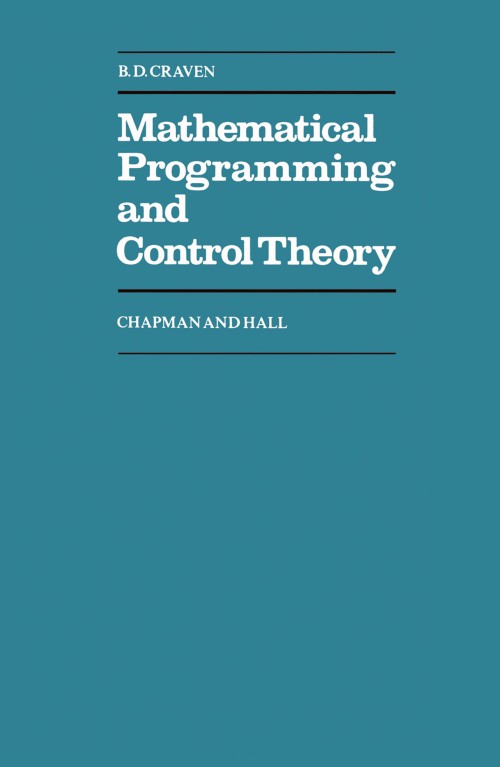
Mathematical Programming and Control Theory [electronic resource] / by B. D. Craven.
Erişim Adresi
ISBN
9789400957961
Dil Kodu
İngilizce
Yer Numarası
DK/6694
Yazar
Basım Bildirimi
1st ed. 1978.
Yayın Bilgisi
Dordrecht : Springer Netherlands : Imprint: Springer, 1978.
Fiziksel Niteleme
XII, 164 p. online resource.
Dizi
Chapman and Hall Mathematics Series
İçindekiler Notu
1 Optimization problems; introduction -- 1.1 Introduction -- 1.2 Transportation network -- 1.3 Production allocation model -- 1.4 Decentralized resource allocation -- 1.5 An inventory model -- 1.6 Control of a rocket -- 1.7 Mathematical formulation -- 1.8 Symbols and conventions -- 1.9 Differentiability -- 1.10 Abstract version of an optimal control problem -- References -- 2 Mathematical techniques -- 2.1 Convex geometry -- 2.2 Convex cones and separation theorems -- 2.3 Critical points -- 2.4 Convex functions -- 2.5 Alternative theorems -- 2.6 Local solvability and linearization -- References -- 3 Linear systems -- 3.1 Linear systems -- 3.2 Lagrangean and duality theory -- 3.3 The simplex method -- 3.4 Some extensions of the simplex method -- References -- 4 Lagrangean theory -- 4.1 Lagrangean theory and duality -- 4.2 Convex nondifferentiable problems -- 4.3 Some applications of convex duality theory -- 4.4 Differentiable problems -- 4.5 Sufficient Lagrangean conditions -- 4.6 Some applications of differentiable Lagrangean theory -- 4.7 Duality for differentiable problems -- 4.8 Converse duality -- References -- 5 Pontryagin theory -- 5.1 Introduction -- 5.2 Abstract Hamiltonian theory -- 5.3 Pointwise theorems -- 5.4 Problems with variable endpoint -- References -- 6 Fractional and complex programming -- 6.1 Fractional programming -- 6.2 Linear fractional programming -- 6.3 Nonlinear fractional programming -- 6.4 Algorithms for fractional programming -- 6.5 Optimization in complex spaces -- 6.6 Symmetric duality -- References -- 7 Some algorithms for nonlinear optimization -- 7.1 Introduction -- 7.2 Unconstrained minimization -- 7.3 Sequential unconstrained minimization -- 7.4 Feasible direction and projection methods -- 7.5 Lagrangean methods -- 7.6 Quadratic programming by Beale’s method -- 7.7 Decomposition.-References -- Appendices -- A.1 Local solvability -- A.2 On separation and Farkas theorems -- A.3 A zero as a differentiable function -- A.4 Lagrangean conditions when the cone has empty interior -- A.5 On measurable functions -- A.6 Lagrangean theory with weaker derivatives -- A.7 On convex functions.
Özet, vb.
In a mathematical programming problem, an optimum (maxi mum or minimum) of a function is sought, subject to con straints on the values of the variables. In the quarter century since G. B. Dantzig introduced the simplex method for linear programming, many real-world problems have been modelled in mathematical programming terms. Such problems often arise in economic planning - such as scheduling industrial production or transportation - but various other problems, such as the optimal control of an interplanetary rocket, are of similar kind. Often the problems involve nonlinear func tions, and so need methods more general than linear pro gramming. This book presents a unified theory of nonlinear mathe matical programming. The same methods and concepts apply equally to 'nonlinear programming' problems with a finite number of variables, and to 'optimal control' problems with e. g. a continuous curve (i. e. infinitely many variables). The underlying ideas of vector space, convex cone, and separating hyperplane are the same, whether the dimension is finite or infinite; and infinite dimension makes very little difference to the proofs. Duality theory - the various nonlinear generaliz ations of the well-known duality theorem of linear program ming - is found relevant also to optimal control, and the , PREFACE Pontryagin theory for optimal control also illuminates finite dimensional problems. The theory is simplified, and its applicability extended, by using the geometric concept of convex cones, in place of coordinate inequalities.
Konu
Social sciences.
Humanities.
Humanities and Social Sciences.
Humanities.
Humanities and Social Sciences.
Kurum Adı
Eseri Alıntıla
Referansları kullanmadan önce gözden geçirmeniz ve varsa gerekli düzeltmeleri yapmanız önerilir.
Dijital Kaynak
MARC Görünümü
LEADER 06138nam a22005535i 4500
001 805374
003 TR_AnAIT
005 20260127000015
007 cr nn 008mamaa
008 121227s1978 ne | s |||| 0|eng d
020 |a9789400957961|9978-94-009-5796-1
024 7 |a10.1007/978-94-009-5796-1|2doi
041 |aeng
049 |aTürk Tarih Kurumu Kütüphanesi
050 4|aH1-99
050 4|aAZ19.2-999
072 7|aGT|2bicssc
072 7|aNON000000|2bisacsh
072 7|aGT|2thema
082 04|a300|223
082 04|a001.3|223
090 |aDK/6694
100 1 |aCraven, B. D.|eauthor.|4aut|4http://id.loc.gov/vocabulary/relators/aut
245 10|aMathematical Programming and Control Theory|h[electronic resource] /|cby B. D. Craven.
250 |a1st ed. 1978.
264 1|aDordrecht :|bSpringer Netherlands :|bImprint: Springer,|c1978.
300 |aXII, 164 p.|bonline resource.
336 |atext|btxt|2rdacontent
337 |acomputer|bc|2rdamedia
338 |aonline resource|bcr|2rdacarrier
347 |atext file|bPDF|2rda
490 1 |aChapman and Hall Mathematics Series
505 0 |a1 Optimization problems; introduction -- 1.1 Introduction -- 1.2 Transportation network -- 1.3 Production allocation model -- 1.4 Decentralized resource allocation -- 1.5 An inventory model -- 1.6 Control of a rocket -- 1.7 Mathematical formulation -- 1.8 Symbols and conventions -- 1.9 Differentiability -- 1.10 Abstract version of an optimal control problem -- References -- 2 Mathematical techniques -- 2.1 Convex geometry -- 2.2 Convex cones and separation theorems -- 2.3 Critical points -- 2.4 Convex functions -- 2.5 Alternative theorems -- 2.6 Local solvability and linearization -- References -- 3 Linear systems -- 3.1 Linear systems -- 3.2 Lagrangean and duality theory -- 3.3 The simplex method -- 3.4 Some extensions of the simplex method -- References -- 4 Lagrangean theory -- 4.1 Lagrangean theory and duality -- 4.2 Convex nondifferentiable problems -- 4.3 Some applications of convex duality theory -- 4.4 Differentiable problems -- 4.5 Sufficient Lagrangean conditions -- 4.6 Some applications of differentiable Lagrangean theory -- 4.7 Duality for differentiable problems -- 4.8 Converse duality -- References -- 5 Pontryagin theory -- 5.1 Introduction -- 5.2 Abstract Hamiltonian theory -- 5.3 Pointwise theorems -- 5.4 Problems with variable endpoint -- References -- 6 Fractional and complex programming -- 6.1 Fractional programming -- 6.2 Linear fractional programming -- 6.3 Nonlinear fractional programming -- 6.4 Algorithms for fractional programming -- 6.5 Optimization in complex spaces -- 6.6 Symmetric duality -- References -- 7 Some algorithms for nonlinear optimization -- 7.1 Introduction -- 7.2 Unconstrained minimization -- 7.3 Sequential unconstrained minimization -- 7.4 Feasible direction and projection methods -- 7.5 Lagrangean methods -- 7.6 Quadratic programming by Beale’s method -- 7.7 Decomposition.-References -- Appendices -- A.1 Local solvability -- A.2 On separation and Farkas theorems -- A.3 A zero as a differentiable function -- A.4 Lagrangean conditions when the cone has empty interior -- A.5 On measurable functions -- A.6 Lagrangean theory with weaker derivatives -- A.7 On convex functions.
520 |aIn a mathematical programming problem, an optimum (maxi mum or minimum) of a function is sought, subject to con straints on the values of the variables. In the quarter century since G. B. Dantzig introduced the simplex method for linear programming, many real-world problems have been modelled in mathematical programming terms. Such problems often arise in economic planning - such as scheduling industrial production or transportation - but various other problems, such as the optimal control of an interplanetary rocket, are of similar kind. Often the problems involve nonlinear func tions, and so need methods more general than linear pro gramming. This book presents a unified theory of nonlinear mathe matical programming. The same methods and concepts apply equally to 'nonlinear programming' problems with a finite number of variables, and to 'optimal control' problems with e. g. a continuous curve (i. e. infinitely many variables). The underlying ideas of vector space, convex cone, and separating hyperplane are the same, whether the dimension is finite or infinite; and infinite dimension makes very little difference to the proofs. Duality theory - the various nonlinear generaliz ations of the well-known duality theorem of linear program ming - is found relevant also to optimal control, and the , PREFACE Pontryagin theory for optimal control also illuminates finite dimensional problems. The theory is simplified, and its applicability extended, by using the geometric concept of convex cones, in place of coordinate inequalities.
532 8 |aAccessibility summary: This PDF is not accessible. It is based on scanned pages and does not support features such as screen reader compatibility or described non-text content (images, graphs etc). However, it likely supports searchable and selectable text based on OCR (Optical Character Recognition). Users with accessibility needs may not be able to use this content effectively. Please contact us at accessibilitysupport@springernature.com if you require assistance or an alternative format.
532 8 |aInaccessible, or known limited accessibility
532 8 |aNo reading system accessibility options actively disabled
532 8 |aPublisher contact for further accessibility information: accessibilitysupport@springernature.com
650 0|aSocial sciences.
650 0|aHumanities.
650 14|aHumanities and Social Sciences.
710 2 |aSpringerLink (Online service)
773 0 |tSpringer Nature eBook
776 08|iPrinted edition:|z9780412155000
776 08|iPrinted edition:|z9789400957978
830 0|aChapman and Hall Mathematics Series
856 40|uhttps://doi.org/10.1007/978-94-009-5796-1
912 |aZDB-2-SHU
912 |aZDB-2-SXH
912 |aZDB-2-BAE
950 |aHumanities, Social Sciences and Law (SpringerNature-11648)
950 |aHistory (R0) (SpringerNature-43722)
001 805374
003 TR_AnAIT
005 20260127000015
007 cr nn 008mamaa
008 121227s1978 ne | s |||| 0|eng d
020 |a9789400957961|9978-94-009-5796-1
024 7 |a10.1007/978-94-009-5796-1|2doi
041 |aeng
049 |aTürk Tarih Kurumu Kütüphanesi
050 4|aH1-99
050 4|aAZ19.2-999
072 7|aGT|2bicssc
072 7|aNON000000|2bisacsh
072 7|aGT|2thema
082 04|a300|223
082 04|a001.3|223
090 |aDK/6694
100 1 |aCraven, B. D.|eauthor.|4aut|4http://id.loc.gov/vocabulary/relators/aut
245 10|aMathematical Programming and Control Theory|h[electronic resource] /|cby B. D. Craven.
250 |a1st ed. 1978.
264 1|aDordrecht :|bSpringer Netherlands :|bImprint: Springer,|c1978.
300 |aXII, 164 p.|bonline resource.
336 |atext|btxt|2rdacontent
337 |acomputer|bc|2rdamedia
338 |aonline resource|bcr|2rdacarrier
347 |atext file|bPDF|2rda
490 1 |aChapman and Hall Mathematics Series
505 0 |a1 Optimization problems; introduction -- 1.1 Introduction -- 1.2 Transportation network -- 1.3 Production allocation model -- 1.4 Decentralized resource allocation -- 1.5 An inventory model -- 1.6 Control of a rocket -- 1.7 Mathematical formulation -- 1.8 Symbols and conventions -- 1.9 Differentiability -- 1.10 Abstract version of an optimal control problem -- References -- 2 Mathematical techniques -- 2.1 Convex geometry -- 2.2 Convex cones and separation theorems -- 2.3 Critical points -- 2.4 Convex functions -- 2.5 Alternative theorems -- 2.6 Local solvability and linearization -- References -- 3 Linear systems -- 3.1 Linear systems -- 3.2 Lagrangean and duality theory -- 3.3 The simplex method -- 3.4 Some extensions of the simplex method -- References -- 4 Lagrangean theory -- 4.1 Lagrangean theory and duality -- 4.2 Convex nondifferentiable problems -- 4.3 Some applications of convex duality theory -- 4.4 Differentiable problems -- 4.5 Sufficient Lagrangean conditions -- 4.6 Some applications of differentiable Lagrangean theory -- 4.7 Duality for differentiable problems -- 4.8 Converse duality -- References -- 5 Pontryagin theory -- 5.1 Introduction -- 5.2 Abstract Hamiltonian theory -- 5.3 Pointwise theorems -- 5.4 Problems with variable endpoint -- References -- 6 Fractional and complex programming -- 6.1 Fractional programming -- 6.2 Linear fractional programming -- 6.3 Nonlinear fractional programming -- 6.4 Algorithms for fractional programming -- 6.5 Optimization in complex spaces -- 6.6 Symmetric duality -- References -- 7 Some algorithms for nonlinear optimization -- 7.1 Introduction -- 7.2 Unconstrained minimization -- 7.3 Sequential unconstrained minimization -- 7.4 Feasible direction and projection methods -- 7.5 Lagrangean methods -- 7.6 Quadratic programming by Beale’s method -- 7.7 Decomposition.-References -- Appendices -- A.1 Local solvability -- A.2 On separation and Farkas theorems -- A.3 A zero as a differentiable function -- A.4 Lagrangean conditions when the cone has empty interior -- A.5 On measurable functions -- A.6 Lagrangean theory with weaker derivatives -- A.7 On convex functions.
520 |aIn a mathematical programming problem, an optimum (maxi mum or minimum) of a function is sought, subject to con straints on the values of the variables. In the quarter century since G. B. Dantzig introduced the simplex method for linear programming, many real-world problems have been modelled in mathematical programming terms. Such problems often arise in economic planning - such as scheduling industrial production or transportation - but various other problems, such as the optimal control of an interplanetary rocket, are of similar kind. Often the problems involve nonlinear func tions, and so need methods more general than linear pro gramming. This book presents a unified theory of nonlinear mathe matical programming. The same methods and concepts apply equally to 'nonlinear programming' problems with a finite number of variables, and to 'optimal control' problems with e. g. a continuous curve (i. e. infinitely many variables). The underlying ideas of vector space, convex cone, and separating hyperplane are the same, whether the dimension is finite or infinite; and infinite dimension makes very little difference to the proofs. Duality theory - the various nonlinear generaliz ations of the well-known duality theorem of linear program ming - is found relevant also to optimal control, and the , PREFACE Pontryagin theory for optimal control also illuminates finite dimensional problems. The theory is simplified, and its applicability extended, by using the geometric concept of convex cones, in place of coordinate inequalities.
532 8 |aAccessibility summary: This PDF is not accessible. It is based on scanned pages and does not support features such as screen reader compatibility or described non-text content (images, graphs etc). However, it likely supports searchable and selectable text based on OCR (Optical Character Recognition). Users with accessibility needs may not be able to use this content effectively. Please contact us at accessibilitysupport@springernature.com if you require assistance or an alternative format.
532 8 |aInaccessible, or known limited accessibility
532 8 |aNo reading system accessibility options actively disabled
532 8 |aPublisher contact for further accessibility information: accessibilitysupport@springernature.com
650 0|aSocial sciences.
650 0|aHumanities.
650 14|aHumanities and Social Sciences.
710 2 |aSpringerLink (Online service)
773 0 |tSpringer Nature eBook
776 08|iPrinted edition:|z9780412155000
776 08|iPrinted edition:|z9789400957978
830 0|aChapman and Hall Mathematics Series
856 40|uhttps://doi.org/10.1007/978-94-009-5796-1
912 |aZDB-2-SHU
912 |aZDB-2-SXH
912 |aZDB-2-BAE
950 |aHumanities, Social Sciences and Law (SpringerNature-11648)
950 |aHistory (R0) (SpringerNature-43722)
Materyaller
Depodan talep edilen materyal sadece kütüphane içerisinde kullanılmaktadır.
Materyal dışarıya ödünç verilmemektedir.
Materyal dışarıya ödünç verilmemektedir.
