LEADER 03899nam a22004935i 4500
001 805409
003 TR_AnAIT
005 20260127000056
007 cr nn 008mamaa
008 131123s2013 sz | s |||| 0|eng d
020 |a9783319025827|9978-3-319-02582-7
024 7 |a10.1007/978-3-319-02582-7|2doi
041 |aeng
049 |aTürk Tarih Kurumu Kütüphanesi
050 4|aHV6001-7220.5
072 7|aJKV|2bicssc
072 7|aSOC004000|2bisacsh
072 7|aJKV|2thema
082 04|a364|223
090 |aDK/6729
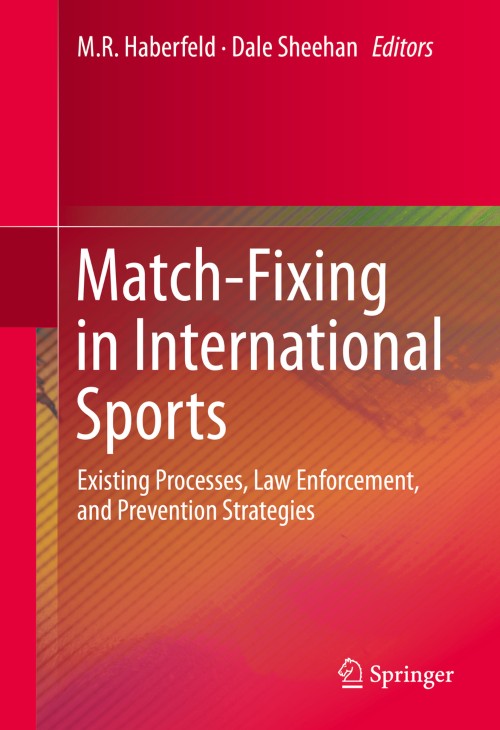
245 10|aMatch-Fixing in International Sports|h[electronic resource] :|bExisting Processes, Law Enforcement, and Prevention Strategies /|cedited by M.R. Haberfeld, Dale Sheehan.
250 |a1st ed. 2013.
264 1|aCham :|bSpringer International Publishing :|bImprint: Springer,|c2013.
300 |aXVIII, 369 p. 17 illus.|bonline resource.
336 |atext|btxt|2rdacontent
337 |acomputer|bc|2rdamedia
338 |aonline resource|bcr|2rdacarrier
347 |atext file|bPDF|2rda
505 0 |aI. Corruption in Sport: Match Fixing Definitional and Operational Issues -- Introduction -- Match Fixing in Western Europe -- Match Fixing in Eastern Europe -- Corruption in Sports: An Argument for the Nodal Approach -- Regional Reflections: A Study of East Africa -- II. Preventing Match Fixing -- Facilitators and Responses to Match-Fixing: A Comparative Approach -- Which Factors Favor Betting Related Cheating in Sports?- Theoretical Model: A Case of Supply and Demand -- Compliance Mechanism as a Tool of Prevention?- III. Future: Where Do We Go From Here? - INTERPOL's Response -- Way Forward: Law Enforcement- An Academic Paradigm.
520 |aMatch-fixing includes everything from bribery of players, to putting undue influences on the owners of the soccer clubs, managers, coaches and others who have the ability to affect the final scores. In addition, match-fixing spills over into the arena of illegal betting (in person and online), which creates a host of additional organized crime opportunities, including human trafficking, prostitution, drugs, extortion and even terrorism. This timely volume brings together international contributions with an aim is to increase awareness of the problems associated with match-fixing and the degree to which key agents in sport, particularly young people, are vulnerable.The contributions are based on INTERPOL’s Global Experts Meeting in Singapore, in November 2012, which brought together key speakers to discuss issues surrounding match-fixing and how to combat corruption in football through channels of education. The purpose of this meeting was to identify ways that academia can play a role in developing and implementing training modules and academic courses, including certification procedures, to prevent match-fixing and develop lines of study at all educational levels. This unique work reflects the gravity of the situation around the world together with possible solutions. It will be of interest to researchers studying organized crime and criminal networks, as well as related areas of sports research and international law.
650 0|aCriminology.
650 0|aInternational law.
650 0|aSports|xLaw and legislation.
650 14|aCriminology.
650 24|aInternational Sports Law.
700 1 |aHaberfeld, M.R.|eeditor.|4edt|4http://id.loc.gov/vocabulary/relators/edt
700 1 |aSheehan, Dale.|eeditor.|4edt|4http://id.loc.gov/vocabulary/relators/edt
710 2 |aSpringerLink (Online service)
773 0 |tSpringer Nature eBook
776 08|iPrinted edition:|z9783319025810
776 08|iPrinted edition:|z9783319025834
776 08|iPrinted edition:|z9783319099262
856 40|uhttps://doi.org/10.1007/978-3-319-02582-7
912 |aZDB-2-SHU
912 |aZDB-2-SXS
950 |aHumanities, Social Sciences and Law (SpringerNature-11648)
950 |aSocial Sciences (R0) (SpringerNature-43726)