LEADER 04045nam a22005535i 4500
001 805420
003 TR_AnAIT
005 20260127000108
007 cr nn 008mamaa
008 130109s1985 ne | s |||| 0|eng d
020 |a9789401577069|9978-94-015-7706-9
024 7 |a10.1007/978-94-015-7706-9|2doi
041 |aeng
049 |aTürk Tarih Kurumu Kütüphanesi
050 4|aK201-487
072 7|aLAB|2bicssc
072 7|aPHI000000|2bisacsh
072 7|aLAB|2thema
082 04|a340.1|223
090 |aDK/6740
100 1 |aSadurski, Wojciech.|eauthor.|4aut|4http://id.loc.gov/vocabulary/relators/aut
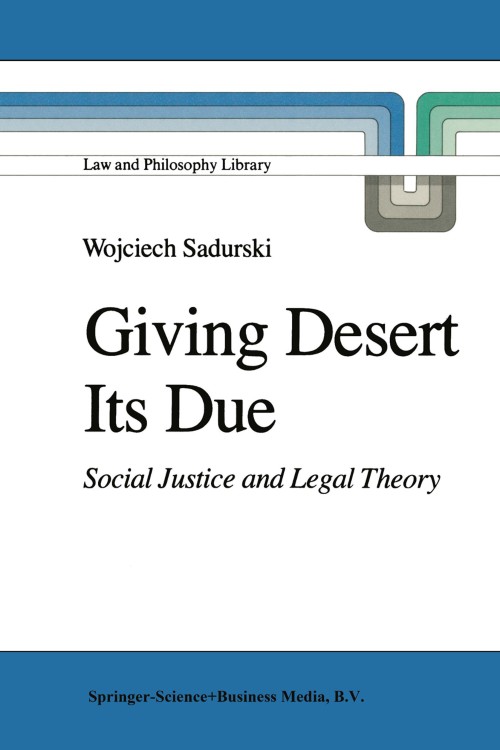
245 10|aGiving Desert Its Due|h[electronic resource] :|bSocial Justice and Legal Theory /|cby Wojciech Sadurski.
250 |a1st ed. 1985.
264 1|aDordrecht :|bSpringer Netherlands :|bImprint: Springer,|c1985.
300 |aXII, 329 p.|bonline resource.
336 |atext|btxt|2rdacontent
337 |acomputer|bc|2rdamedia
338 |aonline resource|bcr|2rdacarrier
347 |atext file|bPDF|2rda
490 1 |aLaw and Philosophy Library,|x2215-0315 ;|v2
505 0 |aOne: Justice — Legal Justice — Social Justice -- 1: The Concept of Justice -- 2: Problems of Justification: Social Contract and Intuition -- 3: Substantive Justice and Equality before the Law -- Two: Justice as Equilibrium -- 4: The Principle of Equilibrium -- 5: Distribution According to Desert -- 6: Needs and Justice -- 7: Preferential Treatment -- 8: Punishment and the Theory of Justice -- Postscript -- 9: Beyond Social Justice -- Notes -- Selected Bibliography.
520 |aDuring the last half of the twentieth century, legal philosophy (or legal theory or jurisprudence) has grown significantly. It is no longer the domain of a few isolated scholars in law and philosophy. Hundreds of scholars from diverse fields attend international meetings on the subject. In some universities, large lecture courses of five hundred students or more study it. The primary aim of the Law and Philosophy Library is to present some of the best original work on legal philosophy from both the Anglo-American and European traditions. Not only does it help make some of the best work avail able to an international audience, but it also encourages increased awareness of, and interaction between, the two major traditions. The primary focus is on full-length scholarly monographs, although some edited volumes of original papers are also included. The Library editors are assisted by an Editorial Advisory Board of internationally renowed scholars. Legal philosophy should not be considered a narrowly circumscribed field.
532 8 |aAccessibility summary: This PDF is not accessible. It is based on scanned pages and does not support features such as screen reader compatibility or described non-text content (images, graphs etc). However, it likely supports searchable and selectable text based on OCR (Optical Character Recognition). Users with accessibility needs may not be able to use this content effectively. Please contact us at accessibilitysupport@springernature.com if you require assistance or an alternative format.
532 8 |aInaccessible, or known limited accessibility
532 8 |aNo reading system accessibility options actively disabled
532 8 |aPublisher contact for further accessibility information: accessibilitysupport@springernature.com
650 0|aLaw|xPhilosophy.
650 0|aLaw|xHistory.
650 14|aPhilosophy of Law.
650 24|aTheories of Law, Philosophy of Law, Legal History.
710 2 |aSpringerLink (Online service)
773 0 |tSpringer Nature eBook
776 08|iPrinted edition:|z9789027719416
776 08|iPrinted edition:|z9789048184125
776 08|iPrinted edition:|z9789401577076
830 0|aLaw and Philosophy Library,|x2215-0315 ;|v2
856 40|uhttps://doi.org/10.1007/978-94-015-7706-9
912 |aZDB-2-SHU
912 |aZDB-2-SXPR
912 |aZDB-2-BAE
950 |aHumanities, Social Sciences and Law (SpringerNature-11648)
950 |aPhilosophy and Religion (R0) (SpringerNature-43725)