

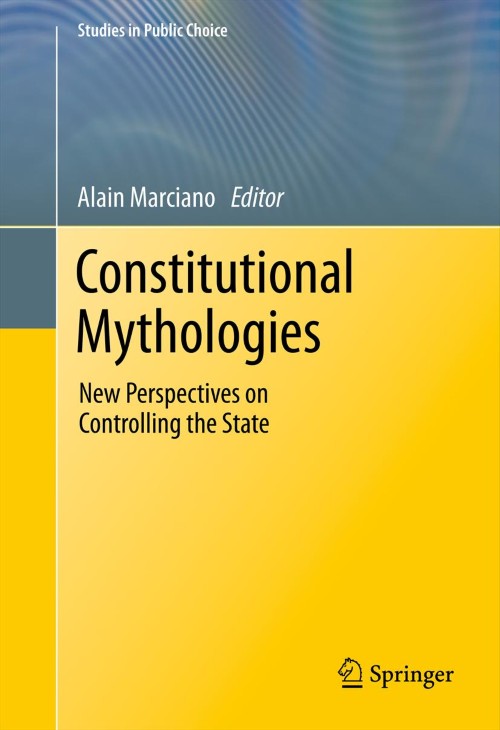
Constitutional Mythologies [electronic resource] : New Perspectives on Controlling the State / edited by Alain Marciano.
Erişim Adresi
ISBN
9781441967848
Dil Kodu
İngilizce
Yer Numarası
DK/6775
Basım Bildirimi
1st ed. 2011.
Yayın Bilgisi
New York, NY : Springer New York : Imprint: Springer, 2011.
Fiziksel Niteleme
VIII, 180 p. online resource.
Dizi
Studies in Public Choice, 2731-5258 ; 23
İçindekiler Notu
Binding Contract or Evolving Focal Point of Coordination: The Meaning of Constitutional Political Economy -- Consent, or Coercion? A Critical Analysis of the Constitutional Contract -- Identity, Constitutions and Constitutional Political Economy -- Power Relations in the Canadian Constitution: The Myths We are Expected to Believe -- Checks and Balances at the OK Corral: Restraining Leviathan -- Popular Sovereignty: A Case Study from the Antebellum Era -- The Constitution of a Direct Democracy -- Constitutional Political Economy -- The Myth of the Constitution as an Economic Document – Do Constitutions Enable Entire Societies to Make Them Better Off?- The European Court of Justice. a Guarantor or a Ianus Geminus?- A Comparison of Central Bank and Judicial Independence -- The Dual Rationale of Judicial Independence in Constitutional Discourse.
Özet, vb.
Our societies obviously rest on common beliefs. These "myths" are tools that help us to develop and build common identities; they form the structure around which societies function. This does not imply that these beliefs are “true,” in the sense that they would be supported by empirical facts. In social matters, myths have undoubtedly important functions to play even if no empirical facts support them. On the other hand, and precisely because they are not discussed, myths may be problematic: they may create illusions, conserve structures that are inefficient and unable to improve the situation of citizens. This is particularly true with constitutions. Constitutions are very important for societies: a constitution is a document — even in societies based on “unwritten” constitutions — which binds citizens together, creating unity among them, and which forms the framework within which our activities take place. As Nobel Prize laureate James Buchanan used to say, "Constitutions contain the rules of the social game we play in our everyday life." However, constitutions are not frequently debated by citizens. This is why we end up with common beliefs about these constitutions: they are above our heads, around us. We take them, their role, function, and nature as given. The purpose of this volume to investigate and challenge common constitutional myths. Featuring contributions from prominent economists, political scientists, and legal scholars, the chapters in this volume address such myths as “constitutions are binding social contracts,” “constitutions are economic documents” and “constitutions are legal documents.” Illustrating their analyses with historical and contemporary examples from the United States, Canada, and Europe, the authors build a multi-layered approach to understanding constitutions and their implications for social and political influence.
Konu
Political science.
Political science __ Philosophy.
Economic policy.
Constitutional law.
Political Science.
Political Philosophy.
Economic Policy.
Constitutional Law.
Political science __ Philosophy.
Economic policy.
Constitutional law.
Political Science.
Political Philosophy.
Economic Policy.
Constitutional Law.
Diğer Yazarlar
Kurum Adı
Eseri Alıntıla
Referansları kullanmadan önce gözden geçirmeniz ve varsa gerekli düzeltmeleri yapmanız önerilir.
Dijital Kaynak
MARC Görünümü
LEADER 04674nam a22005415i 4500
001 805455
003 TR_AnAIT
005 20260127000151
007 cr nn 008mamaa
008 110725s2011 xxu| s |||| 0|eng d
020 |a9781441967848|9978-1-4419-6784-8
024 7 |a10.1007/978-1-4419-6784-8|2doi
041 |aeng
049 |aTürk Tarih Kurumu Kütüphanesi
050 4|aJA1-92
072 7|aJPA|2bicssc
072 7|aPOL000000|2bisacsh
072 7|aJPA|2thema
082 04|a320|223
090 |aDK/6775
245 10|aConstitutional Mythologies|h[electronic resource] :|bNew Perspectives on Controlling the State /|cedited by Alain Marciano.
250 |a1st ed. 2011.
264 1|aNew York, NY :|bSpringer New York :|bImprint: Springer,|c2011.
300 |aVIII, 180 p.|bonline resource.
336 |atext|btxt|2rdacontent
337 |acomputer|bc|2rdamedia
338 |aonline resource|bcr|2rdacarrier
347 |atext file|bPDF|2rda
490 1 |aStudies in Public Choice,|x2731-5258 ;|v23
505 0 |aBinding Contract or Evolving Focal Point of Coordination: The Meaning of Constitutional Political Economy -- Consent, or Coercion? A Critical Analysis of the Constitutional Contract -- Identity, Constitutions and Constitutional Political Economy -- Power Relations in the Canadian Constitution: The Myths We are Expected to Believe -- Checks and Balances at the OK Corral: Restraining Leviathan -- Popular Sovereignty: A Case Study from the Antebellum Era -- The Constitution of a Direct Democracy -- Constitutional Political Economy -- The Myth of the Constitution as an Economic Document – Do Constitutions Enable Entire Societies to Make Them Better Off?- The European Court of Justice. a Guarantor or a Ianus Geminus?- A Comparison of Central Bank and Judicial Independence -- The Dual Rationale of Judicial Independence in Constitutional Discourse.
520 |aOur societies obviously rest on common beliefs. These "myths" are tools that help us to develop and build common identities; they form the structure around which societies function. This does not imply that these beliefs are “true,” in the sense that they would be supported by empirical facts. In social matters, myths have undoubtedly important functions to play even if no empirical facts support them. On the other hand, and precisely because they are not discussed, myths may be problematic: they may create illusions, conserve structures that are inefficient and unable to improve the situation of citizens. This is particularly true with constitutions. Constitutions are very important for societies: a constitution is a document — even in societies based on “unwritten” constitutions — which binds citizens together, creating unity among them, and which forms the framework within which our activities take place. As Nobel Prize laureate James Buchanan used to say, "Constitutions contain the rules of the social game we play in our everyday life." However, constitutions are not frequently debated by citizens. This is why we end up with common beliefs about these constitutions: they are above our heads, around us. We take them, their role, function, and nature as given. The purpose of this volume to investigate and challenge common constitutional myths. Featuring contributions from prominent economists, political scientists, and legal scholars, the chapters in this volume address such myths as “constitutions are binding social contracts,” “constitutions are economic documents” and “constitutions are legal documents.” Illustrating their analyses with historical and contemporary examples from the United States, Canada, and Europe, the authors build a multi-layered approach to understanding constitutions and their implications for social and political influence.
650 0|aPolitical science.
650 0|aPolitical science|xPhilosophy.
650 0|aEconomic policy.
650 0|aConstitutional law.
650 14|aPolitical Science.
650 24|aPolitical Philosophy.
650 24|aEconomic Policy.
650 24|aConstitutional Law.
700 1 |aMarciano, Alain.|eeditor.|4edt|4http://id.loc.gov/vocabulary/relators/edt
710 2 |aSpringerLink (Online service)
773 0 |tSpringer Nature eBook
776 08|iPrinted edition:|z9781441967831
776 08|iPrinted edition:|z9781441967855
776 08|iPrinted edition:|z9781461429562
830 0|aStudies in Public Choice,|x2731-5258 ;|v23
856 40|uhttps://doi.org/10.1007/978-1-4419-6784-8
912 |aZDB-2-SHU
912 |aZDB-2-SXPI
950 |aHumanities, Social Sciences and Law (SpringerNature-11648)
950 |aPolitical Science and International Studies (R0) (SpringerNature-43724)
001 805455
003 TR_AnAIT
005 20260127000151
007 cr nn 008mamaa
008 110725s2011 xxu| s |||| 0|eng d
020 |a9781441967848|9978-1-4419-6784-8
024 7 |a10.1007/978-1-4419-6784-8|2doi
041 |aeng
049 |aTürk Tarih Kurumu Kütüphanesi
050 4|aJA1-92
072 7|aJPA|2bicssc
072 7|aPOL000000|2bisacsh
072 7|aJPA|2thema
082 04|a320|223
090 |aDK/6775
245 10|aConstitutional Mythologies|h[electronic resource] :|bNew Perspectives on Controlling the State /|cedited by Alain Marciano.
250 |a1st ed. 2011.
264 1|aNew York, NY :|bSpringer New York :|bImprint: Springer,|c2011.
300 |aVIII, 180 p.|bonline resource.
336 |atext|btxt|2rdacontent
337 |acomputer|bc|2rdamedia
338 |aonline resource|bcr|2rdacarrier
347 |atext file|bPDF|2rda
490 1 |aStudies in Public Choice,|x2731-5258 ;|v23
505 0 |aBinding Contract or Evolving Focal Point of Coordination: The Meaning of Constitutional Political Economy -- Consent, or Coercion? A Critical Analysis of the Constitutional Contract -- Identity, Constitutions and Constitutional Political Economy -- Power Relations in the Canadian Constitution: The Myths We are Expected to Believe -- Checks and Balances at the OK Corral: Restraining Leviathan -- Popular Sovereignty: A Case Study from the Antebellum Era -- The Constitution of a Direct Democracy -- Constitutional Political Economy -- The Myth of the Constitution as an Economic Document – Do Constitutions Enable Entire Societies to Make Them Better Off?- The European Court of Justice. a Guarantor or a Ianus Geminus?- A Comparison of Central Bank and Judicial Independence -- The Dual Rationale of Judicial Independence in Constitutional Discourse.
520 |aOur societies obviously rest on common beliefs. These "myths" are tools that help us to develop and build common identities; they form the structure around which societies function. This does not imply that these beliefs are “true,” in the sense that they would be supported by empirical facts. In social matters, myths have undoubtedly important functions to play even if no empirical facts support them. On the other hand, and precisely because they are not discussed, myths may be problematic: they may create illusions, conserve structures that are inefficient and unable to improve the situation of citizens. This is particularly true with constitutions. Constitutions are very important for societies: a constitution is a document — even in societies based on “unwritten” constitutions — which binds citizens together, creating unity among them, and which forms the framework within which our activities take place. As Nobel Prize laureate James Buchanan used to say, "Constitutions contain the rules of the social game we play in our everyday life." However, constitutions are not frequently debated by citizens. This is why we end up with common beliefs about these constitutions: they are above our heads, around us. We take them, their role, function, and nature as given. The purpose of this volume to investigate and challenge common constitutional myths. Featuring contributions from prominent economists, political scientists, and legal scholars, the chapters in this volume address such myths as “constitutions are binding social contracts,” “constitutions are economic documents” and “constitutions are legal documents.” Illustrating their analyses with historical and contemporary examples from the United States, Canada, and Europe, the authors build a multi-layered approach to understanding constitutions and their implications for social and political influence.
650 0|aPolitical science.
650 0|aPolitical science|xPhilosophy.
650 0|aEconomic policy.
650 0|aConstitutional law.
650 14|aPolitical Science.
650 24|aPolitical Philosophy.
650 24|aEconomic Policy.
650 24|aConstitutional Law.
700 1 |aMarciano, Alain.|eeditor.|4edt|4http://id.loc.gov/vocabulary/relators/edt
710 2 |aSpringerLink (Online service)
773 0 |tSpringer Nature eBook
776 08|iPrinted edition:|z9781441967831
776 08|iPrinted edition:|z9781441967855
776 08|iPrinted edition:|z9781461429562
830 0|aStudies in Public Choice,|x2731-5258 ;|v23
856 40|uhttps://doi.org/10.1007/978-1-4419-6784-8
912 |aZDB-2-SHU
912 |aZDB-2-SXPI
950 |aHumanities, Social Sciences and Law (SpringerNature-11648)
950 |aPolitical Science and International Studies (R0) (SpringerNature-43724)
Materyaller
Depodan talep edilen materyal sadece kütüphane içerisinde kullanılmaktadır.
Materyal dışarıya ödünç verilmemektedir.
Materyal dışarıya ödünç verilmemektedir.
