

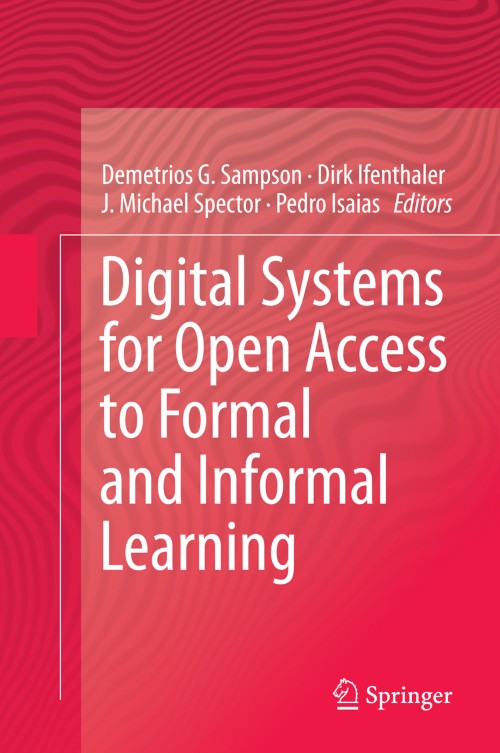
Digital Systems for Open Access to Formal and Informal Learning [electronic resource] / edited by Demetrios G. Sampson, Dirk Ifenthaler, J. Michael Spector, Pedro Isaias.
Erişim Adresi
ISBN
9783319022642
Dil Kodu
İngilizce
Yer Numarası
DK/6796
Basım Bildirimi
1st ed. 2014.
Yayın Bilgisi
Cham : Springer International Publishing : Imprint: Springer, 2014.
Fiziksel Niteleme
XIV, 347 p. 62 illus. online resource.
İçindekiler Notu
Digital Systems for Open Access to Formal and Informal Learning -- I. Open Access to Formal and Informal Learning: Theory and Practice -- The Opem Discover Space Portal: A Socially-Powered and Open Ferderated Infrastructure -- The Evolution of University Open Courses in Transforming Learning: Experiences from Mainland China -- Massive Open Online Courses (MOOCs) and Massive Multiplayer Online Games (MMOGs): Synergies and Lessons to be Learned -- Supporting Open Access to Teaching and Learning of People with Disabilities -- Development of Visualization of Learning Outcomes Using Curriculum Mapping -- Assessing Student Learning Online -- Theorizing Why in Digital Learning -- II. Open Access to Formal and Informal Learning: Methods and Technologies -- Mobile Language Learners as Social Networkers -- A Mobile Location-Based SItuation Learning Frameworkf for Supporting Critical Thinking: A Requirements Analysis Study -- Developing Technological and Pedagogical Affordances to Support Collaborative Inquiry Science Processes -- Learning in or with Games? -- Digital Game-Based Learning in the Context of School Entrepreneurship Education: Proposing a Framework for Evaluating the Effectiveness of Digital Games -- Stimulating Learning via Tutoring and Collaborative Simulator Games -- A Methodology for Oraganizing Virtual and Remote Labs -- Creative Collaboration in a 3D Virtual World -- Active Creation of Digital Games as Learning Tools -- Augmented Reality and Learning in Science Museums -- From Teachers' to Schools' ICT Competence Profiles -- I2Flex: The Meeting Point of Web-Based Education and Innovative Leardership in a K-12 International School Setting.
Özet, vb.
Today, Digital Systems and Services for Technology Supported Learning and Education are recognized as the key drivers to transform the way that individuals, groups and organizations “learn” and the way to “assess learning” in 21st Century. These transformations influence: Objectives - moving from acquiring new “knowledge” to developing new and relevant “competences”; Methods – moving from “classroom” based teaching to “context-aware” personalized learning; and Assessment – moving from “life-long” degrees and certifications to “on-demand” and “in-context” accreditation of qualifications. Within this context, promoting Open Access to Formal and Informal Learning, is currently a key issue in the public discourse and the global dialogue on Education, including Massive Open Online Courses (MOOCs) and Flipped School Classrooms. This volume on Digital Systems for Open Access to Formal and Informal Learning contributes to the international dialogue between researchers, technologists, practitioners and policy makers in Technology Supported Education and Learning. It addresses emerging issues related with both theory and practice, as well as, methods and technologies that can support Open Access to Formal and Informal Learning. In the twenty chapters contributed by international experts who are actively shaping the future of Educational Technology around the world, topics such as: - The evolution of University Open Courses in Transforming Learning - Supporting Open Access to Teaching and Learning of People with Disabilities - Assessing Student Learning in Online Courses - Digital Game-based Learning for School Education - Open Access to Virtual and Remote Labs for STEM Education - Teachers’ and Schools’ ICT Competence Profiling - Web-Based Education and Innovative Leadership in a K-12 International School Setting are presented. An in-depth blueprint of the promise, potential, and imminent future of the field, Digital Systems for Open Access to Formal and Informal Learning is necessary reading for researchers and practitioners, as well as, undergraduate and postgraduate students, in educational technology.
Konu
Educational technology.
Education __ Data processing.
Digital Education and Educational Technology.
Computers and Education.
Education __ Data processing.
Digital Education and Educational Technology.
Computers and Education.
Diğer Yazarlar
Kurum Adı
Eseri Alıntıla
Referansları kullanmadan önce gözden geçirmeniz ve varsa gerekli düzeltmeleri yapmanız önerilir.
Dijital Kaynak
MARC Görünümü
LEADER 06061nam a22005055i 4500
001 805476
003 TR_AnAIT
005 20260127000220
007 cr nn 008mamaa
008 140717s2014 sz | s |||| 0|eng d
020 |a9783319022642|9978-3-319-02264-2
024 7 |a10.1007/978-3-319-02264-2|2doi
041 |aeng
049 |aTürk Tarih Kurumu Kütüphanesi
050 4|aLB1028.3
072 7|aJNV|2bicssc
072 7|aEDU000000|2bisacsh
072 7|aJNV|2thema
082 04|a371.33|223
090 |aDK/6796
245 10|aDigital Systems for Open Access to Formal and Informal Learning|h[electronic resource] /|cedited by Demetrios G. Sampson, Dirk Ifenthaler, J. Michael Spector, Pedro Isaias.
250 |a1st ed. 2014.
264 1|aCham :|bSpringer International Publishing :|bImprint: Springer,|c2014.
300 |aXIV, 347 p. 62 illus.|bonline resource.
336 |atext|btxt|2rdacontent
337 |acomputer|bc|2rdamedia
338 |aonline resource|bcr|2rdacarrier
347 |atext file|bPDF|2rda
505 0 |aDigital Systems for Open Access to Formal and Informal Learning -- I. Open Access to Formal and Informal Learning: Theory and Practice -- The Opem Discover Space Portal: A Socially-Powered and Open Ferderated Infrastructure -- The Evolution of University Open Courses in Transforming Learning: Experiences from Mainland China -- Massive Open Online Courses (MOOCs) and Massive Multiplayer Online Games (MMOGs): Synergies and Lessons to be Learned -- Supporting Open Access to Teaching and Learning of People with Disabilities -- Development of Visualization of Learning Outcomes Using Curriculum Mapping -- Assessing Student Learning Online -- Theorizing Why in Digital Learning -- II. Open Access to Formal and Informal Learning: Methods and Technologies -- Mobile Language Learners as Social Networkers -- A Mobile Location-Based SItuation Learning Frameworkf for Supporting Critical Thinking: A Requirements Analysis Study -- Developing Technological and Pedagogical Affordances to Support Collaborative Inquiry Science Processes -- Learning in or with Games? -- Digital Game-Based Learning in the Context of School Entrepreneurship Education: Proposing a Framework for Evaluating the Effectiveness of Digital Games -- Stimulating Learning via Tutoring and Collaborative Simulator Games -- A Methodology for Oraganizing Virtual and Remote Labs -- Creative Collaboration in a 3D Virtual World -- Active Creation of Digital Games as Learning Tools -- Augmented Reality and Learning in Science Museums -- From Teachers' to Schools' ICT Competence Profiles -- I2Flex: The Meeting Point of Web-Based Education and Innovative Leardership in a K-12 International School Setting.
520 |aToday, Digital Systems and Services for Technology Supported Learning and Education are recognized as the key drivers to transform the way that individuals, groups and organizations “learn” and the way to “assess learning” in 21st Century. These transformations influence: Objectives - moving from acquiring new “knowledge” to developing new and relevant “competences”; Methods – moving from “classroom” based teaching to “context-aware” personalized learning; and Assessment – moving from “life-long” degrees and certifications to “on-demand” and “in-context” accreditation of qualifications. Within this context, promoting Open Access to Formal and Informal Learning, is currently a key issue in the public discourse and the global dialogue on Education, including Massive Open Online Courses (MOOCs) and Flipped School Classrooms. This volume on Digital Systems for Open Access to Formal and Informal Learning contributes to the international dialogue between researchers, technologists, practitioners and policy makers in Technology Supported Education and Learning. It addresses emerging issues related with both theory and practice, as well as, methods and technologies that can support Open Access to Formal and Informal Learning. In the twenty chapters contributed by international experts who are actively shaping the future of Educational Technology around the world, topics such as: - The evolution of University Open Courses in Transforming Learning - Supporting Open Access to Teaching and Learning of People with Disabilities - Assessing Student Learning in Online Courses - Digital Game-based Learning for School Education - Open Access to Virtual and Remote Labs for STEM Education - Teachers’ and Schools’ ICT Competence Profiling - Web-Based Education and Innovative Leadership in a K-12 International School Setting are presented. An in-depth blueprint of the promise, potential, and imminent future of the field, Digital Systems for Open Access to Formal and Informal Learning is necessary reading for researchers and practitioners, as well as, undergraduate and postgraduate students, in educational technology.
650 0|aEducational technology.
650 0|aEducation|xData processing.
650 14|aDigital Education and Educational Technology.
650 24|aComputers and Education.
700 1 |aSampson, Demetrios G.|eeditor.|0(orcid)0000-0002-0174-0137|1https://orcid.org/0000-0002-0174-0137|4edt|4http://id.loc.gov/vocabulary/relators/edt
700 1 |aIfenthaler, Dirk.|eeditor.|4edt|4http://id.loc.gov/vocabulary/relators/edt
700 1 |aSpector, J. Michael.|eeditor.|4edt|4http://id.loc.gov/vocabulary/relators/edt
700 1 |aIsaias, Pedro.|eeditor.|4edt|4http://id.loc.gov/vocabulary/relators/edt
710 2 |aSpringerLink (Online service)
773 0 |tSpringer Nature eBook
776 08|iPrinted edition:|z9783319022635
776 08|iPrinted edition:|z9783319022659
776 08|iPrinted edition:|z9783319347653
856 40|uhttps://doi.org/10.1007/978-3-319-02264-2
912 |aZDB-2-SHU
912 |aZDB-2-SXED
950 |aHumanities, Social Sciences and Law (SpringerNature-11648)
950 |aEducation (R0) (SpringerNature-43721)
001 805476
003 TR_AnAIT
005 20260127000220
007 cr nn 008mamaa
008 140717s2014 sz | s |||| 0|eng d
020 |a9783319022642|9978-3-319-02264-2
024 7 |a10.1007/978-3-319-02264-2|2doi
041 |aeng
049 |aTürk Tarih Kurumu Kütüphanesi
050 4|aLB1028.3
072 7|aJNV|2bicssc
072 7|aEDU000000|2bisacsh
072 7|aJNV|2thema
082 04|a371.33|223
090 |aDK/6796
245 10|aDigital Systems for Open Access to Formal and Informal Learning|h[electronic resource] /|cedited by Demetrios G. Sampson, Dirk Ifenthaler, J. Michael Spector, Pedro Isaias.
250 |a1st ed. 2014.
264 1|aCham :|bSpringer International Publishing :|bImprint: Springer,|c2014.
300 |aXIV, 347 p. 62 illus.|bonline resource.
336 |atext|btxt|2rdacontent
337 |acomputer|bc|2rdamedia
338 |aonline resource|bcr|2rdacarrier
347 |atext file|bPDF|2rda
505 0 |aDigital Systems for Open Access to Formal and Informal Learning -- I. Open Access to Formal and Informal Learning: Theory and Practice -- The Opem Discover Space Portal: A Socially-Powered and Open Ferderated Infrastructure -- The Evolution of University Open Courses in Transforming Learning: Experiences from Mainland China -- Massive Open Online Courses (MOOCs) and Massive Multiplayer Online Games (MMOGs): Synergies and Lessons to be Learned -- Supporting Open Access to Teaching and Learning of People with Disabilities -- Development of Visualization of Learning Outcomes Using Curriculum Mapping -- Assessing Student Learning Online -- Theorizing Why in Digital Learning -- II. Open Access to Formal and Informal Learning: Methods and Technologies -- Mobile Language Learners as Social Networkers -- A Mobile Location-Based SItuation Learning Frameworkf for Supporting Critical Thinking: A Requirements Analysis Study -- Developing Technological and Pedagogical Affordances to Support Collaborative Inquiry Science Processes -- Learning in or with Games? -- Digital Game-Based Learning in the Context of School Entrepreneurship Education: Proposing a Framework for Evaluating the Effectiveness of Digital Games -- Stimulating Learning via Tutoring and Collaborative Simulator Games -- A Methodology for Oraganizing Virtual and Remote Labs -- Creative Collaboration in a 3D Virtual World -- Active Creation of Digital Games as Learning Tools -- Augmented Reality and Learning in Science Museums -- From Teachers' to Schools' ICT Competence Profiles -- I2Flex: The Meeting Point of Web-Based Education and Innovative Leardership in a K-12 International School Setting.
520 |aToday, Digital Systems and Services for Technology Supported Learning and Education are recognized as the key drivers to transform the way that individuals, groups and organizations “learn” and the way to “assess learning” in 21st Century. These transformations influence: Objectives - moving from acquiring new “knowledge” to developing new and relevant “competences”; Methods – moving from “classroom” based teaching to “context-aware” personalized learning; and Assessment – moving from “life-long” degrees and certifications to “on-demand” and “in-context” accreditation of qualifications. Within this context, promoting Open Access to Formal and Informal Learning, is currently a key issue in the public discourse and the global dialogue on Education, including Massive Open Online Courses (MOOCs) and Flipped School Classrooms. This volume on Digital Systems for Open Access to Formal and Informal Learning contributes to the international dialogue between researchers, technologists, practitioners and policy makers in Technology Supported Education and Learning. It addresses emerging issues related with both theory and practice, as well as, methods and technologies that can support Open Access to Formal and Informal Learning. In the twenty chapters contributed by international experts who are actively shaping the future of Educational Technology around the world, topics such as: - The evolution of University Open Courses in Transforming Learning - Supporting Open Access to Teaching and Learning of People with Disabilities - Assessing Student Learning in Online Courses - Digital Game-based Learning for School Education - Open Access to Virtual and Remote Labs for STEM Education - Teachers’ and Schools’ ICT Competence Profiling - Web-Based Education and Innovative Leadership in a K-12 International School Setting are presented. An in-depth blueprint of the promise, potential, and imminent future of the field, Digital Systems for Open Access to Formal and Informal Learning is necessary reading for researchers and practitioners, as well as, undergraduate and postgraduate students, in educational technology.
650 0|aEducational technology.
650 0|aEducation|xData processing.
650 14|aDigital Education and Educational Technology.
650 24|aComputers and Education.
700 1 |aSampson, Demetrios G.|eeditor.|0(orcid)0000-0002-0174-0137|1https://orcid.org/0000-0002-0174-0137|4edt|4http://id.loc.gov/vocabulary/relators/edt
700 1 |aIfenthaler, Dirk.|eeditor.|4edt|4http://id.loc.gov/vocabulary/relators/edt
700 1 |aSpector, J. Michael.|eeditor.|4edt|4http://id.loc.gov/vocabulary/relators/edt
700 1 |aIsaias, Pedro.|eeditor.|4edt|4http://id.loc.gov/vocabulary/relators/edt
710 2 |aSpringerLink (Online service)
773 0 |tSpringer Nature eBook
776 08|iPrinted edition:|z9783319022635
776 08|iPrinted edition:|z9783319022659
776 08|iPrinted edition:|z9783319347653
856 40|uhttps://doi.org/10.1007/978-3-319-02264-2
912 |aZDB-2-SHU
912 |aZDB-2-SXED
950 |aHumanities, Social Sciences and Law (SpringerNature-11648)
950 |aEducation (R0) (SpringerNature-43721)
Materyaller
Depodan talep edilen materyal sadece kütüphane içerisinde kullanılmaktadır.
Materyal dışarıya ödünç verilmemektedir.
Materyal dışarıya ödünç verilmemektedir.
