LEADER 04109nam a22005055i 4500
001 805482
003 TR_AnAIT
005 20260127000228
007 cr nn 008mamaa
008 121227s1960 ne | s |||| 0|eng d
020 |a9789401036795|9978-94-010-3679-5
024 7 |a10.1007/978-94-010-3679-5|2doi
041 |aeng
049 |aTürk Tarih Kurumu Kütüphanesi
050 4|aBC1-199
072 7|aHPL|2bicssc
072 7|aPHI011000|2bisacsh
072 7|aQDTL|2thema
082 04|a160|223
090 |aDK/6802
100 1 |aBarth, H.|eauthor.|4aut|4http://id.loc.gov/vocabulary/relators/aut
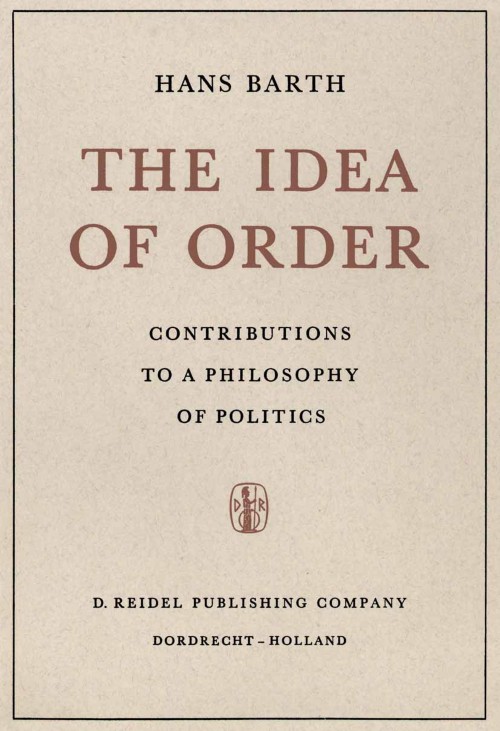
245 14|aThe Idea of Order|h[electronic resource] :|bContributions to a Philosophy of Politics /|cby H. Barth.
250 |a1st ed. 1960.
264 1|aDordrecht :|bSpringer Netherlands :|bImprint: Springer,|c1960.
300 |a224 p.|bonline resource.
336 |atext|btxt|2rdacontent
337 |acomputer|bc|2rdamedia
338 |aonline resource|bcr|2rdacarrier
347 |atext file|bPDF|2rda
505 0 |aI Philosophy and Politics -- II Edmund Burke and German Political Philosophy in the Age of Romanticism -- III Antoine de Rivarol and the French Revolution -- IV De Lamennais’ Political and Social Philosophy -- V Auguste Comte and Joseph de Maistre: The System of Positivism as Theocracy -- VI The Idea of Sanction: Jeremy Bentham and Pierre-Joseph Proudhon -- VII Historical and Natural Right and the Idea of Order as a Problem of Political Philosophy -- Postscript -- Notes.
520 |aIn these essays toward a political philosophy we shall be con cerned with fundamentals. And because it is a question of fundamentals, they will, we imagine, be of interest to many readers. We should like to contribute to a clarification, histor ically and systematically, of some concepts with which every philosophy of society and the state has to deal. We shall admit historical considerations for the sake of insights into the sys tematic ones, and we trust that our inquiry into the systematic will help us to understand the historical. For we are moving in that circle exemplarily described by Johann Gustav Droysen in his Vorlesungen fiber Enzyklopadie und Methodologie der Ge schichte (§ 37) when he writes: 'Undoubtedly we only under stand completely that which is, when we recognize and make clear to ourselves how it came to be. But how it came to be, we recognize only if we investigate and understand, as exactly as possible, how it is. Our grasping that which came to be and comprehending its becoming is only one form and expression of our understanding of the present and existing. And this becoming and having come to be can be derived only by temporally conceiving and analysing the existing in order to understand it. ' We must, therefore, center our attention on what may be called the structure and logic of social order.
532 8 |aAccessibility summary: This PDF is not accessible. It is based on scanned pages and does not support features such as screen reader compatibility or described non-text content (images, graphs etc). However, it likely supports searchable and selectable text based on OCR (Optical Character Recognition). Users with accessibility needs may not be able to use this content effectively. Please contact us at accessibilitysupport@springernature.com if you require assistance or an alternative format.
532 8 |aInaccessible, or known limited accessibility
532 8 |aNo reading system accessibility options actively disabled
532 8 |aPublisher contact for further accessibility information: accessibilitysupport@springernature.com
650 0|aLogic.
650 14|aLogic.
710 2 |aSpringerLink (Online service)
773 0 |tSpringer Nature eBook
776 08|iPrinted edition:|z9789027700018
776 08|iPrinted edition:|z9789401036801
776 08|iPrinted edition:|z9789401036818
856 40|uhttps://doi.org/10.1007/978-94-010-3679-5
912 |aZDB-2-SHU
912 |aZDB-2-SXPR
912 |aZDB-2-BAE
950 |aHumanities, Social Sciences and Law (SpringerNature-11648)
950 |aPhilosophy and Religion (R0) (SpringerNature-43725)