LEADER 04268nam a22004695i 4500
001 805485
003 TR_AnAIT
005 20260127000231
007 cr nn 008mamaa
008 120324s2011 ne | s |||| 0|eng d
020 |a9789460917400|9978-94-6091-740-0
024 7 |a10.1007/978-94-6091-740-0|2doi
041 |aeng
049 |aTürk Tarih Kurumu Kütüphanesi
050 4|aL1-991
072 7|aJN|2bicssc
072 7|aEDU000000|2bisacsh
072 7|aJN|2thema
082 04|a370|223
090 |aDK/6805
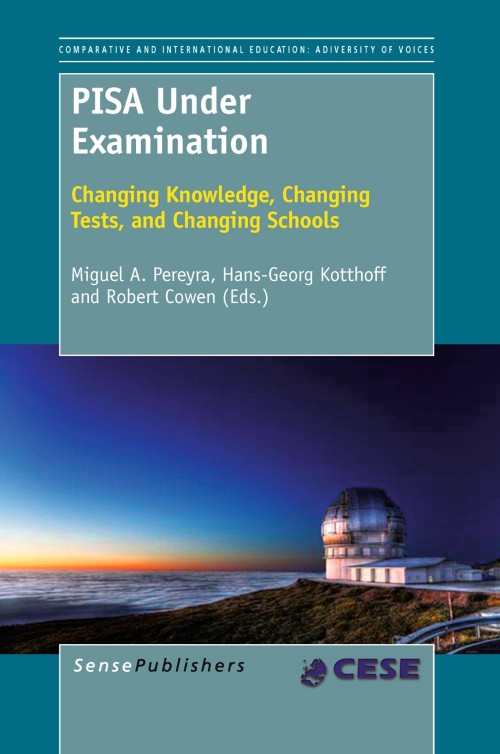
245 10|aPISA Under Examination|h[electronic resource] /|cedited by Miguel A. Pereyra, Hans-Georg Kotthoff, Robert Cowen.
250 |a1st ed. 2011.
264 1|aRotterdam :|bSensePublishers :|bImprint: SensePublishers,|c2011.
300 |aXII, 334 p.|bonline resource.
336 |atext|btxt|2rdacontent
337 |acomputer|bc|2rdamedia
338 |aonline resource|bcr|2rdacarrier
347 |atext file|bPDF|2rda
490 1 |aComparative and International Education: A Diversity of Voices, A Diversity of Voices,|x2214-9899 ;|v11
520 |aFrom the 23rd to 26th of November 2009 in La Palma island, in the Canaries, the Comparative Education Society in Europe (CESE) organized an international symposium entitled PISA under Examination: Changing Knowledge, Changing Tests, and Changing Schools. During four days seventeen leading scholars of Europe and America presented their contributions to debate the different problematiques of the remarkable phenomenon represented by the OECD Programme for International Student Assessment or PISA. PISA is not merely an educational event. It is also a media circus which involves the public rehearsal for reasons for failure or success; and even, in some cases, public and political and academic explanations about why 'failure' was not really that, and why 'success' was not really that either. At the centre of all these indications, we find the growing influence of international agencies on education and schooling which is decisively contributing to a marketisation of the field of education, in the context of an increasingly multilevel and fragmented arena for educational governance based on the formulation, the regulation and the transnational coordination and convergence of policies, buttressed at the same time by the diffusion of persuasive discursive practice. Organized in four sections entitled The Comparative Challenges of the OCDE PISA Programme, PISA and School Knowledge, The Assessment of PISA, School Effectiveness and the Socio-cultural Dimension, PISA and the Immigrant Student Question, and Extreme Visions of PISA: Germany and Finland, the contributions of this book offers a comprehensive approach of all these challenging and significant issues written from different and distinct research and academic traditions.
532 8 |aAccessibility summary: This PDF eBook is produced by a third-party. We have requested that the file be made accessible and compliant with the European Accessibility Act (EAA). However, we have not been able to fully verify its compliance with recognized accessibility standards (such as PDF/UA or WCAG). For detailed accessibility information, please refer to the original publisher’s website. If you require an accessible version of this content, please contact accessibilitysupport@springernature.com. We are committed to improving accessibility and will work with the publisher to meet your needs wherever possible.
532 8 |aPublisher contact for further accessibility information: accessibilitysupport@springernature.com
650 0|aEducation.
650 14|aEducation.
700 1 |aPereyra, Miguel A.|eeditor.|4edt|4http://id.loc.gov/vocabulary/relators/edt
700 1 |aKotthoff, Hans-Georg.|eeditor.|4edt|4http://id.loc.gov/vocabulary/relators/edt
700 1 |aCowen, Robert.|eeditor.|4edt|4http://id.loc.gov/vocabulary/relators/edt
710 2 |aSpringerLink (Online service)
773 0 |tSpringer Nature eBook
830 0|aComparative and International Education: A Diversity of Voices, A Diversity of Voices,|x2214-9899 ;|v11
856 40|uhttps://doi.org/10.1007/978-94-6091-740-0
912 |aZDB-2-SHU
912 |aZDB-2-SXED
950 |aHumanities, Social Sciences and Law (SpringerNature-11648)
950 |aEducation (R0) (SpringerNature-43721)