

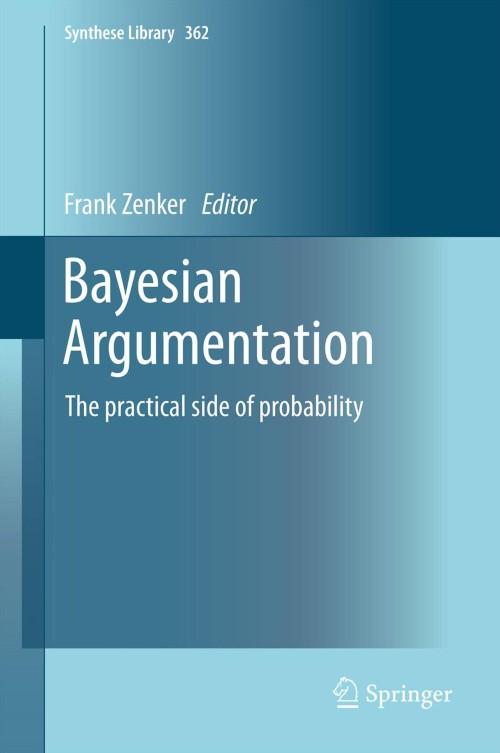
Bayesian Argumentation [electronic resource] : The practical side of probability / edited by Frank Zenker.
Erişim Adresi
ISBN
9789400753570
Dil Kodu
İngilizce
Yer Numarası
DK/6859
Basım Bildirimi
1st ed. 2013.
Yayın Bilgisi
Dordrecht : Springer Netherlands : Imprint: Springer, 2013.
Fiziksel Niteleme
VIII, 216 p. online resource.
Dizi
Synthese Library, Studies in Epistemology, Logic, Methodology, and Philosophy of Science, 2542-8292 ; 362
İçindekiler Notu
Introduction: Frank Zenker. - Part 1 -- The Bayesian Approach to Argumentation -- Chapter 1. Testimony and Argument: A Bayesian Perspective: Ulrike Hahn, Mike Oaksford and Adam J.L. Harris -- Chapter 2. Why are we convinced by the Ad Hominem Argument?: Source Reliability or Pragma-Dialectics: Mike Oaksford and Ulrike Hahn.- Part 2. The Legal Domain.-Chapter 3. A survey of uncertainties and their consequences in Probabilistic Legal Argumentation: Matthias Grabmair and Kevin D. Ashley -- Chapter 4. What went wrong in the case of Sally Clark? A case-study of the use of Statistical Evidence in Court: Amid Pundik -- Part 3. Modeling Rational Agents -- Chapter 5. A Bayesian Simulation Model of Group Deliberation: Erik J. Olsson -- Chapter 6. Degrees of Justification, Bayes' Rule, and Rationality: Gregor Betz -- Chapter 7. Argumentation with (Bounded) Rational Agents: Robert van Rooij and Kris de Jaeghery -- Part 4. Theoretical Issues -- Chapter 8. Reductio, Coherence, and the Myth of Epistemic Circularity: Tomoji Shogenji -- Chapter 9. On Argument Strength: Niki Pfeifer -- Chapter 10 -- Upping the Stakes and the Preface Paradox: Jonny Blamey -- References.
Özet, vb.
Relevant to, and drawing from, a range of disciplines, the chapters in this collection show the diversity, and applicability, of research in Bayesian argumentation. Together, they form a challenge to philosophers versed in both the use and criticism of Bayesian models who have largely overlooked their potential in argumentation. Selected from contributions to a multidisciplinary workshop on the topic held in Lund, Sweden, in autumn 2010, the authors count legal scholars and cognitive scientists among their number, in addition to philosophers. They analyze material that includes real-life court cases, experimental research results, and the insights gained from computer models. The volume provides a formal measure of subjective argument strength and argument force, robust enough to allow advocates of opposing sides of an argument to agree on the relative strengths of their supporting reasoning. With papers from leading figures such as Mike Oaksford and Ulrike Hahn, the book comprises recent research conducted at the frontiers of Bayesian argumentation and provides a multitude of examples in which these formal tools can be applied to informal argument. It signals new and impending developments in philosophy, which has seen Bayesian models deployed in formal epistemology and philosophy of science, but has yet to explore the full potential of Bayesian models as a framework in argumentation. In doing so, this revealing anthology looks destined to become a standard teaching text in years to come.
Konu
Knowledge, Theory of.
Psychology, Industrial.
Sociology __ Methodology.
Computer simulation.
Applied linguistics.
Epistemology.
Work and Organizational Psychology.
Sociological Methods.
Computer Modelling.
Applied Linguistics.
Psychology, Industrial.
Sociology __ Methodology.
Computer simulation.
Applied linguistics.
Epistemology.
Work and Organizational Psychology.
Sociological Methods.
Computer Modelling.
Applied Linguistics.
Diğer Yazarlar
Kurum Adı
Eseri Alıntıla
Referansları kullanmadan önce gözden geçirmeniz ve varsa gerekli düzeltmeleri yapmanız önerilir.
Dijital Kaynak
MARC Görünümü
LEADER 04812nam a22005655i 4500
001 805539
003 TR_AnAIT
005 20260127000333
007 cr nn 008mamaa
008 121208s2013 ne | s |||| 0|eng d
020 |a9789400753570|9978-94-007-5357-0
024 7 |a10.1007/978-94-007-5357-0|2doi
041 |aeng
049 |aTürk Tarih Kurumu Kütüphanesi
050 4|aBD143-237
072 7|aHPK|2bicssc
072 7|aPHI004000|2bisacsh
072 7|aQDTK|2thema
082 04|a120|223
090 |aDK/6859
245 10|aBayesian Argumentation|h[electronic resource] :|bThe practical side of probability /|cedited by Frank Zenker.
250 |a1st ed. 2013.
264 1|aDordrecht :|bSpringer Netherlands :|bImprint: Springer,|c2013.
300 |aVIII, 216 p.|bonline resource.
336 |atext|btxt|2rdacontent
337 |acomputer|bc|2rdamedia
338 |aonline resource|bcr|2rdacarrier
347 |atext file|bPDF|2rda
490 1 |aSynthese Library, Studies in Epistemology, Logic, Methodology, and Philosophy of Science,|x2542-8292 ;|v362
505 0 |aIntroduction: Frank Zenker. - Part 1 -- The Bayesian Approach to Argumentation -- Chapter 1. Testimony and Argument: A Bayesian Perspective: Ulrike Hahn, Mike Oaksford and Adam J.L. Harris -- Chapter 2. Why are we convinced by the Ad Hominem Argument?: Source Reliability or Pragma-Dialectics: Mike Oaksford and Ulrike Hahn.- Part 2. The Legal Domain.-Chapter 3. A survey of uncertainties and their consequences in Probabilistic Legal Argumentation: Matthias Grabmair and Kevin D. Ashley -- Chapter 4. What went wrong in the case of Sally Clark? A case-study of the use of Statistical Evidence in Court: Amid Pundik -- Part 3. Modeling Rational Agents -- Chapter 5. A Bayesian Simulation Model of Group Deliberation: Erik J. Olsson -- Chapter 6. Degrees of Justification, Bayes' Rule, and Rationality: Gregor Betz -- Chapter 7. Argumentation with (Bounded) Rational Agents: Robert van Rooij and Kris de Jaeghery -- Part 4. Theoretical Issues -- Chapter 8. Reductio, Coherence, and the Myth of Epistemic Circularity: Tomoji Shogenji -- Chapter 9. On Argument Strength: Niki Pfeifer -- Chapter 10 -- Upping the Stakes and the Preface Paradox: Jonny Blamey -- References.
520 |aRelevant to, and drawing from, a range of disciplines, the chapters in this collection show the diversity, and applicability, of research in Bayesian argumentation. Together, they form a challenge to philosophers versed in both the use and criticism of Bayesian models who have largely overlooked their potential in argumentation. Selected from contributions to a multidisciplinary workshop on the topic held in Lund, Sweden, in autumn 2010, the authors count legal scholars and cognitive scientists among their number, in addition to philosophers. They analyze material that includes real-life court cases, experimental research results, and the insights gained from computer models. The volume provides a formal measure of subjective argument strength and argument force, robust enough to allow advocates of opposing sides of an argument to agree on the relative strengths of their supporting reasoning. With papers from leading figures such as Mike Oaksford and Ulrike Hahn, the book comprises recent research conducted at the frontiers of Bayesian argumentation and provides a multitude of examples in which these formal tools can be applied to informal argument. It signals new and impending developments in philosophy, which has seen Bayesian models deployed in formal epistemology and philosophy of science, but has yet to explore the full potential of Bayesian models as a framework in argumentation. In doing so, this revealing anthology looks destined to become a standard teaching text in years to come.
650 0|aKnowledge, Theory of.
650 0|aPsychology, Industrial.
650 0|aSociology|xMethodology.
650 0|aComputer simulation.
650 0|aApplied linguistics.
650 14|aEpistemology.
650 24|aWork and Organizational Psychology.
650 24|aSociological Methods.
650 24|aComputer Modelling.
650 24|aApplied Linguistics.
700 1 |aZenker, Frank.|eeditor.|4edt|4http://id.loc.gov/vocabulary/relators/edt
710 2 |aSpringerLink (Online service)
773 0 |tSpringer Nature eBook
776 08|iPrinted edition:|z9789400753563
776 08|iPrinted edition:|z9789400753587
776 08|iPrinted edition:|z9789400793293
830 0|aSynthese Library, Studies in Epistemology, Logic, Methodology, and Philosophy of Science,|x2542-8292 ;|v362
856 40|uhttps://doi.org/10.1007/978-94-007-5357-0
912 |aZDB-2-SHU
912 |aZDB-2-SXPR
950 |aHumanities, Social Sciences and Law (SpringerNature-11648)
950 |aPhilosophy and Religion (R0) (SpringerNature-43725)
001 805539
003 TR_AnAIT
005 20260127000333
007 cr nn 008mamaa
008 121208s2013 ne | s |||| 0|eng d
020 |a9789400753570|9978-94-007-5357-0
024 7 |a10.1007/978-94-007-5357-0|2doi
041 |aeng
049 |aTürk Tarih Kurumu Kütüphanesi
050 4|aBD143-237
072 7|aHPK|2bicssc
072 7|aPHI004000|2bisacsh
072 7|aQDTK|2thema
082 04|a120|223
090 |aDK/6859
245 10|aBayesian Argumentation|h[electronic resource] :|bThe practical side of probability /|cedited by Frank Zenker.
250 |a1st ed. 2013.
264 1|aDordrecht :|bSpringer Netherlands :|bImprint: Springer,|c2013.
300 |aVIII, 216 p.|bonline resource.
336 |atext|btxt|2rdacontent
337 |acomputer|bc|2rdamedia
338 |aonline resource|bcr|2rdacarrier
347 |atext file|bPDF|2rda
490 1 |aSynthese Library, Studies in Epistemology, Logic, Methodology, and Philosophy of Science,|x2542-8292 ;|v362
505 0 |aIntroduction: Frank Zenker. - Part 1 -- The Bayesian Approach to Argumentation -- Chapter 1. Testimony and Argument: A Bayesian Perspective: Ulrike Hahn, Mike Oaksford and Adam J.L. Harris -- Chapter 2. Why are we convinced by the Ad Hominem Argument?: Source Reliability or Pragma-Dialectics: Mike Oaksford and Ulrike Hahn.- Part 2. The Legal Domain.-Chapter 3. A survey of uncertainties and their consequences in Probabilistic Legal Argumentation: Matthias Grabmair and Kevin D. Ashley -- Chapter 4. What went wrong in the case of Sally Clark? A case-study of the use of Statistical Evidence in Court: Amid Pundik -- Part 3. Modeling Rational Agents -- Chapter 5. A Bayesian Simulation Model of Group Deliberation: Erik J. Olsson -- Chapter 6. Degrees of Justification, Bayes' Rule, and Rationality: Gregor Betz -- Chapter 7. Argumentation with (Bounded) Rational Agents: Robert van Rooij and Kris de Jaeghery -- Part 4. Theoretical Issues -- Chapter 8. Reductio, Coherence, and the Myth of Epistemic Circularity: Tomoji Shogenji -- Chapter 9. On Argument Strength: Niki Pfeifer -- Chapter 10 -- Upping the Stakes and the Preface Paradox: Jonny Blamey -- References.
520 |aRelevant to, and drawing from, a range of disciplines, the chapters in this collection show the diversity, and applicability, of research in Bayesian argumentation. Together, they form a challenge to philosophers versed in both the use and criticism of Bayesian models who have largely overlooked their potential in argumentation. Selected from contributions to a multidisciplinary workshop on the topic held in Lund, Sweden, in autumn 2010, the authors count legal scholars and cognitive scientists among their number, in addition to philosophers. They analyze material that includes real-life court cases, experimental research results, and the insights gained from computer models. The volume provides a formal measure of subjective argument strength and argument force, robust enough to allow advocates of opposing sides of an argument to agree on the relative strengths of their supporting reasoning. With papers from leading figures such as Mike Oaksford and Ulrike Hahn, the book comprises recent research conducted at the frontiers of Bayesian argumentation and provides a multitude of examples in which these formal tools can be applied to informal argument. It signals new and impending developments in philosophy, which has seen Bayesian models deployed in formal epistemology and philosophy of science, but has yet to explore the full potential of Bayesian models as a framework in argumentation. In doing so, this revealing anthology looks destined to become a standard teaching text in years to come.
650 0|aKnowledge, Theory of.
650 0|aPsychology, Industrial.
650 0|aSociology|xMethodology.
650 0|aComputer simulation.
650 0|aApplied linguistics.
650 14|aEpistemology.
650 24|aWork and Organizational Psychology.
650 24|aSociological Methods.
650 24|aComputer Modelling.
650 24|aApplied Linguistics.
700 1 |aZenker, Frank.|eeditor.|4edt|4http://id.loc.gov/vocabulary/relators/edt
710 2 |aSpringerLink (Online service)
773 0 |tSpringer Nature eBook
776 08|iPrinted edition:|z9789400753563
776 08|iPrinted edition:|z9789400753587
776 08|iPrinted edition:|z9789400793293
830 0|aSynthese Library, Studies in Epistemology, Logic, Methodology, and Philosophy of Science,|x2542-8292 ;|v362
856 40|uhttps://doi.org/10.1007/978-94-007-5357-0
912 |aZDB-2-SHU
912 |aZDB-2-SXPR
950 |aHumanities, Social Sciences and Law (SpringerNature-11648)
950 |aPhilosophy and Religion (R0) (SpringerNature-43725)
Materyaller
Depodan talep edilen materyal sadece kütüphane içerisinde kullanılmaktadır.
Materyal dışarıya ödünç verilmemektedir.
Materyal dışarıya ödünç verilmemektedir.
