LEADER 04215nam a22005295i 4500
001 805554
003 TR_AnAIT
005 20260127000350
007 cr nn 008mamaa
008 130828s2014 xxu| s |||| 0|eng d
020 |a9781461473664|9978-1-4614-7366-4
024 7 |a10.1007/978-1-4614-7366-4|2doi
041 |aeng
049 |aTürk Tarih Kurumu Kütüphanesi
050 4|aLB2806.15
072 7|aJNKC|2bicssc
072 7|aEDU007000|2bisacsh
072 7|aJNDG|2thema
082 04|a375|223
090 |aDK/6874
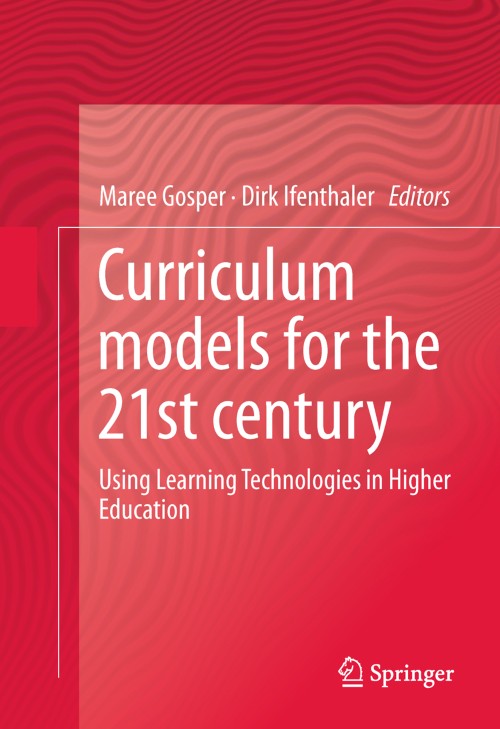
245 10|aCurriculum Models for the 21st Century|h[electronic resource] :|bUsing Learning Technologies in Higher Education /|cedited by Maree Gosper, Dirk Ifenthaler.
250 |a1st ed. 2014.
264 1|aNew York, NY :|bSpringer New York :|bImprint: Springer,|c2014.
300 |aXXVI, 444 p.|bonline resource.
336 |atext|btxt|2rdacontent
337 |acomputer|bc|2rdamedia
338 |aonline resource|bcr|2rdacarrier
347 |atext file|bPDF|2rda
505 0 |aTheoretical Considerations of Curriculum Mapping for the 21st Century -- Case Studies: moving beyond traditional practice, theoretical underpinnings fro change, issues and implications arising from experience, future development and directions -- Technological and pedagogical innovations influencing curriculum renewal: emerging concepts and examples of best practice -- Sustainable educational practice in technology-rich environments -- Transforming new ideas and practices into curriculum models -- Finding and developing resources for curriculum transformation -- Integrating innovation into mainstream practices -- Analysis of important challenges to accomplishing sustainable curriculum change. .
520 |aChanging student profiles and the increasing availability of mainstream and specialized learning technologies are stretching the traditional face-to-face models of teaching and learning in higher education. Institutions, too, are facing far-reaching systemic changes which are placing strains on existing resources and physical infrastructure and calling into question traditional ways of teaching through lectures and tutorials. And, with an ever-increasing scrutiny on teaching and teachers’ accountability for positive educational outcomes, the call for closer attention to learning, teaching and, most especially, to the design and delivery of the curriculum is given increasing relevance and importance. Research provides strong evidence of the potential for technologies to facilitate not only cognition and learning but also to become integral components in the redesign of current curriculum models. Some Universities and individual academics have moved along this pathway, developing new and innovative curriculum, blending pedagogies and technologies to suit their circumstances. Yet, there are others, unsure of the possibilities, the opportunities and constraints in these changing times. Curriculum Models for the 21st Century gives insights into how teaching and learning can be done differently. The focus is on a whole of curriculum approach, looking at theoretical models and examples of practice which capitalize on the potential of technologies to deliver variations and alternatives to the more traditional lecture-based model of University teaching.
650 0|aEducation|xCurricula.
650 0|aEducational psychology.
650 0|aEducational technology.
650 0|aLearning, Psychology of.
650 14|aCurriculum Studies.
650 24|aEducational Psychology.
650 24|aDigital Education and Educational Technology.
650 24|aInstructional Psychology.
700 1 |aGosper, Maree.|eeditor.|4edt|4http://id.loc.gov/vocabulary/relators/edt
700 1 |aIfenthaler, Dirk.|eeditor.|4edt|4http://id.loc.gov/vocabulary/relators/edt
710 2 |aSpringerLink (Online service)
773 0 |tSpringer Nature eBook
776 08|iPrinted edition:|z9781461473657
776 08|iPrinted edition:|z9781461473671
776 08|iPrinted edition:|z9781489995018
856 40|uhttps://doi.org/10.1007/978-1-4614-7366-4
912 |aZDB-2-SHU
912 |aZDB-2-SXED
950 |aHumanities, Social Sciences and Law (SpringerNature-11648)
950 |aEducation (R0) (SpringerNature-43721)