

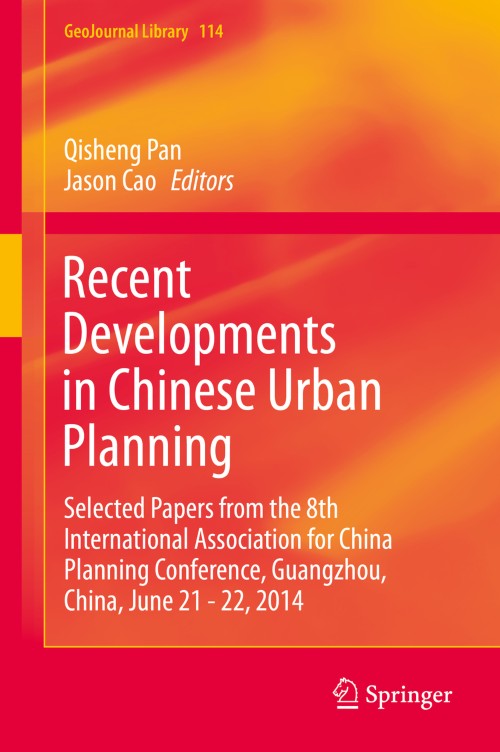
Recent Developments in Chinese Urban Planning [electronic resource] : Selected Papers from the 8th International Association for China Planning Conference, Guangzhou, China, June 21 - 22, 2014 / edited by Qisheng Pan, Jason Cao.
Erişim Adresi
ISBN
9783319184708
Dil Kodu
İngilizce
Yer Numarası
DK/6878
Basım Bildirimi
1st ed. 2015.
Yayın Bilgisi
Cham : Springer International Publishing : Imprint: Springer, 2015.
Fiziksel Niteleme
XIII, 367 p. 208 illus. online resource.
Dizi
GeoJournal Library, 2215-0072 ; 114
İçindekiler Notu
Chapter 1: Research of Beijing Automobile Exhaust Treatment Strategies Based on I/M System Program Zhehao Jin and Qun Huan -- Chapter 2: Analysis about Key Indicators of High Density Blocks in the New Central District from the Perspective of Mitigating Urban Heat Island: A Study at Guangzhou Pin Wang and Qinglin Meng -- Chapter 3: Study on Relationship between Beijing Residential Building Insolation Standards, Improvement of Residential Environment and Urban Ecological Benefits Linfei Han, Jiahua Mu, Haofei Zhang -- Chapter 4: The Methods and Approaches of Green Infrastructure in Promoting China’s Urban Transformation—A Case Study of Dongguan National Wetland Park Shaoping Guan, Xi Zhang, Jingjun Wu -- Chapter 5: The Symbiotic Strategies Study of Low-Carbon Eco-City Based on Multi-symbiosis Theory Xia Zhu, Yangyue Zhou -- Chapter 6: The Paradoxes of Land Resources Allocation’s Game Playing--fromZhoukou grave events Ze Zhang and Ying Gu -- Chapter 7: Conflicts in the Urban Renewal of the Historic Preservation Area- Based on the Investigation of Nanbuting Community in Nanjing Tian Ruan and Meicheng Wang -- Chapter 8: Planning for Emerging Mega City Regions in China - a Preliminary Research within a Socioeconomic Framework Hao Li and Zhu Qian -- Chapter 9: Study and Prospects on the Self-organizing Evolution Stage of County Urbanization in Hubei Lingyun Liu -- Chapter 10: From Three-old Reconstruction to Expansion and Promotion: The Strategic Transformation for County-level City in Rapid Urbanization Area - A Case Study of Guangdong Province in Mainland China Yikeng LUO -- Chapter 11: Spatial structure of regional economic development in Henan Province, China Hao Li and Zhu Qian -- Chapter 12: Understanding Beijing’s Urban Land Use Development 2004-2013 through Online Administrative Data Sources Xiao Rong, Ying Jin, and Ying Long -- Chapter 13: A Configurational Accessibility Study of Road and Metro Network in Shanghai, China Lingzhu Zhang, Alain Chiaradia, Yu Zhuang -- Chapter 14: Research on Interaction between Traffic Improvement around the Old Railway Station and Urban Land Utilization - A Case Study in Hohhot Railway Traffic Regulation Linfei Han, Jianmin Guo, Junyan, Han -- Chapter 15: Study on the Redevelopment Model of Multi-story Residence in the Area of City Center Hu Rui and Zhenyu Che -- Chapter 16: Elementary Analysis of the Impact of Large Scale Sports Events on Space Regeneration of the Hosts - From Cases of 2008 Beijing Olympic Games and 2012 London Olympic Games Ying Gu and Ze Zhang -- Chapter 17: Study on Planning of Healthcare Facilities in High-density Urban Residential Areas - Taking a New Community in Beijing as an Example Jing Li and Tian Chen -- Chapter 18: Jobs-Housing Balance: the Right Ratio for the Right Place Qian Wu, Ming Zhang, and Daniel Yang -- Chapter 19: The Implication of City Form Transformation in Rongcheng Area of Jieyang City Jianwen Huang and Ying Xu -- Chapter 20: Urban Design Practice towards Planning Management in China - Urban Design Guidelines in Wuhan City Liangping Hong, Wenzhu Tao.
Özet, vb.
This book provides a comprehensive overview of the most recent development of Chinese cities. It discusses a broad range of subjects of urban planning, including environmental planning, transportation planning, historical preservation, economic development, geographic information systems (GIS) and other technological applications. China, the most populous country in the world, has experienced unprecedented urbanization in a relatively short period. During the past decades, urbanization in China has centered on land development through industrialization and investment, but it has largely ignored the prosperity and well-being of the people. Livable cities are not just those with magnificent buildings and infrastructure; they are great places where people want to live. China’s recently inaugurated leaders have proposed a new model to actively and prudently enhance the quality of urbanization through compact, intelligent, and low-carbon development. It symbolizes the departure from land-centered urban development to a form of people-oriented urbanization, as China’s Premier, Li Keqiang, has advocated. This new model offers a platform for planning researchers and practitioners to tackle urbanization challenges, such as social equity, environment, energy, ecological and historic preservation, affordable housing, and externalities of mega cities. Furthermore, people-oriented urbanization calls for public participation and stakeholder engagement in the planning process. This book brings together planners, designers, scholars, scientists, and government officials from China and all over the world to exchange ideas on urban regeneration.
Konu
Human geography.
Physical geography.
Human Geography.
Physical Geography.
Physical geography.
Human Geography.
Physical Geography.
Diğer Yazarlar
Kurum Adı
Eseri Alıntıla
Referansları kullanmadan önce gözden geçirmeniz ve varsa gerekli düzeltmeleri yapmanız önerilir.
Dijital Kaynak
MARC Görünümü
LEADER 06676nam a22005055i 4500
001 805558
003 TR_AnAIT
005 20260127000355
007 cr nn 008mamaa
008 150827s2015 sz | s |||| 0|eng d
020 |a9783319184708|9978-3-319-18470-8
024 7 |a10.1007/978-3-319-18470-8|2doi
041 |aeng
049 |aTürk Tarih Kurumu Kütüphanesi
050 4|aGF
072 7|aRGC|2bicssc
072 7|aSOC015000|2bisacsh
072 7|aRGC|2thema
082 04|a304.2|223
090 |aDK/6878
245 10|aRecent Developments in Chinese Urban Planning|h[electronic resource] :|bSelected Papers from the 8th International Association for China Planning Conference, Guangzhou, China, June 21 - 22, 2014 /|cedited by Qisheng Pan, Jason Cao.
250 |a1st ed. 2015.
264 1|aCham :|bSpringer International Publishing :|bImprint: Springer,|c2015.
300 |aXIII, 367 p. 208 illus.|bonline resource.
336 |atext|btxt|2rdacontent
337 |acomputer|bc|2rdamedia
338 |aonline resource|bcr|2rdacarrier
347 |atext file|bPDF|2rda
490 1 |aGeoJournal Library,|x2215-0072 ;|v114
505 0 |aChapter 1: Research of Beijing Automobile Exhaust Treatment Strategies Based on I/M System Program Zhehao Jin and Qun Huan -- Chapter 2: Analysis about Key Indicators of High Density Blocks in the New Central District from the Perspective of Mitigating Urban Heat Island: A Study at Guangzhou Pin Wang and Qinglin Meng -- Chapter 3: Study on Relationship between Beijing Residential Building Insolation Standards, Improvement of Residential Environment and Urban Ecological Benefits Linfei Han, Jiahua Mu, Haofei Zhang -- Chapter 4: The Methods and Approaches of Green Infrastructure in Promoting China’s Urban Transformation—A Case Study of Dongguan National Wetland Park Shaoping Guan, Xi Zhang, Jingjun Wu -- Chapter 5: The Symbiotic Strategies Study of Low-Carbon Eco-City Based on Multi-symbiosis Theory Xia Zhu, Yangyue Zhou -- Chapter 6: The Paradoxes of Land Resources Allocation’s Game Playing--fromZhoukou grave events Ze Zhang and Ying Gu -- Chapter 7: Conflicts in the Urban Renewal of the Historic Preservation Area- Based on the Investigation of Nanbuting Community in Nanjing Tian Ruan and Meicheng Wang -- Chapter 8: Planning for Emerging Mega City Regions in China - a Preliminary Research within a Socioeconomic Framework Hao Li and Zhu Qian -- Chapter 9: Study and Prospects on the Self-organizing Evolution Stage of County Urbanization in Hubei Lingyun Liu -- Chapter 10: From Three-old Reconstruction to Expansion and Promotion: The Strategic Transformation for County-level City in Rapid Urbanization Area - A Case Study of Guangdong Province in Mainland China Yikeng LUO -- Chapter 11: Spatial structure of regional economic development in Henan Province, China Hao Li and Zhu Qian -- Chapter 12: Understanding Beijing’s Urban Land Use Development 2004-2013 through Online Administrative Data Sources Xiao Rong, Ying Jin, and Ying Long -- Chapter 13: A Configurational Accessibility Study of Road and Metro Network in Shanghai, China Lingzhu Zhang, Alain Chiaradia, Yu Zhuang -- Chapter 14: Research on Interaction between Traffic Improvement around the Old Railway Station and Urban Land Utilization - A Case Study in Hohhot Railway Traffic Regulation Linfei Han, Jianmin Guo, Junyan, Han -- Chapter 15: Study on the Redevelopment Model of Multi-story Residence in the Area of City Center Hu Rui and Zhenyu Che -- Chapter 16: Elementary Analysis of the Impact of Large Scale Sports Events on Space Regeneration of the Hosts - From Cases of 2008 Beijing Olympic Games and 2012 London Olympic Games Ying Gu and Ze Zhang -- Chapter 17: Study on Planning of Healthcare Facilities in High-density Urban Residential Areas - Taking a New Community in Beijing as an Example Jing Li and Tian Chen -- Chapter 18: Jobs-Housing Balance: the Right Ratio for the Right Place Qian Wu, Ming Zhang, and Daniel Yang -- Chapter 19: The Implication of City Form Transformation in Rongcheng Area of Jieyang City Jianwen Huang and Ying Xu -- Chapter 20: Urban Design Practice towards Planning Management in China - Urban Design Guidelines in Wuhan City Liangping Hong, Wenzhu Tao.
520 |aThis book provides a comprehensive overview of the most recent development of Chinese cities. It discusses a broad range of subjects of urban planning, including environmental planning, transportation planning, historical preservation, economic development, geographic information systems (GIS) and other technological applications. China, the most populous country in the world, has experienced unprecedented urbanization in a relatively short period. During the past decades, urbanization in China has centered on land development through industrialization and investment, but it has largely ignored the prosperity and well-being of the people. Livable cities are not just those with magnificent buildings and infrastructure; they are great places where people want to live. China’s recently inaugurated leaders have proposed a new model to actively and prudently enhance the quality of urbanization through compact, intelligent, and low-carbon development. It symbolizes the departure from land-centered urban development to a form of people-oriented urbanization, as China’s Premier, Li Keqiang, has advocated. This new model offers a platform for planning researchers and practitioners to tackle urbanization challenges, such as social equity, environment, energy, ecological and historic preservation, affordable housing, and externalities of mega cities. Furthermore, people-oriented urbanization calls for public participation and stakeholder engagement in the planning process. This book brings together planners, designers, scholars, scientists, and government officials from China and all over the world to exchange ideas on urban regeneration.
650 0|aHuman geography.
650 0|aPhysical geography.
650 14|aHuman Geography.
650 24|aPhysical Geography.
700 1 |aPan, Qisheng.|eeditor.|4edt|4http://id.loc.gov/vocabulary/relators/edt
700 1 |aCao, Jason.|eeditor.|4edt|4http://id.loc.gov/vocabulary/relators/edt
710 2 |aSpringerLink (Online service)
773 0 |tSpringer Nature eBook
776 08|iPrinted edition:|z9783319184692
776 08|iPrinted edition:|z9783319184715
776 08|iPrinted edition:|z9783319373201
830 0|aGeoJournal Library,|x2215-0072 ;|v114
856 40|uhttps://doi.org/10.1007/978-3-319-18470-8
912 |aZDB-2-SHU
912 |aZDB-2-SXS
950 |aHumanities, Social Sciences and Law (SpringerNature-11648)
950 |aSocial Sciences (R0) (SpringerNature-43726)
001 805558
003 TR_AnAIT
005 20260127000355
007 cr nn 008mamaa
008 150827s2015 sz | s |||| 0|eng d
020 |a9783319184708|9978-3-319-18470-8
024 7 |a10.1007/978-3-319-18470-8|2doi
041 |aeng
049 |aTürk Tarih Kurumu Kütüphanesi
050 4|aGF
072 7|aRGC|2bicssc
072 7|aSOC015000|2bisacsh
072 7|aRGC|2thema
082 04|a304.2|223
090 |aDK/6878
245 10|aRecent Developments in Chinese Urban Planning|h[electronic resource] :|bSelected Papers from the 8th International Association for China Planning Conference, Guangzhou, China, June 21 - 22, 2014 /|cedited by Qisheng Pan, Jason Cao.
250 |a1st ed. 2015.
264 1|aCham :|bSpringer International Publishing :|bImprint: Springer,|c2015.
300 |aXIII, 367 p. 208 illus.|bonline resource.
336 |atext|btxt|2rdacontent
337 |acomputer|bc|2rdamedia
338 |aonline resource|bcr|2rdacarrier
347 |atext file|bPDF|2rda
490 1 |aGeoJournal Library,|x2215-0072 ;|v114
505 0 |aChapter 1: Research of Beijing Automobile Exhaust Treatment Strategies Based on I/M System Program Zhehao Jin and Qun Huan -- Chapter 2: Analysis about Key Indicators of High Density Blocks in the New Central District from the Perspective of Mitigating Urban Heat Island: A Study at Guangzhou Pin Wang and Qinglin Meng -- Chapter 3: Study on Relationship between Beijing Residential Building Insolation Standards, Improvement of Residential Environment and Urban Ecological Benefits Linfei Han, Jiahua Mu, Haofei Zhang -- Chapter 4: The Methods and Approaches of Green Infrastructure in Promoting China’s Urban Transformation—A Case Study of Dongguan National Wetland Park Shaoping Guan, Xi Zhang, Jingjun Wu -- Chapter 5: The Symbiotic Strategies Study of Low-Carbon Eco-City Based on Multi-symbiosis Theory Xia Zhu, Yangyue Zhou -- Chapter 6: The Paradoxes of Land Resources Allocation’s Game Playing--fromZhoukou grave events Ze Zhang and Ying Gu -- Chapter 7: Conflicts in the Urban Renewal of the Historic Preservation Area- Based on the Investigation of Nanbuting Community in Nanjing Tian Ruan and Meicheng Wang -- Chapter 8: Planning for Emerging Mega City Regions in China - a Preliminary Research within a Socioeconomic Framework Hao Li and Zhu Qian -- Chapter 9: Study and Prospects on the Self-organizing Evolution Stage of County Urbanization in Hubei Lingyun Liu -- Chapter 10: From Three-old Reconstruction to Expansion and Promotion: The Strategic Transformation for County-level City in Rapid Urbanization Area - A Case Study of Guangdong Province in Mainland China Yikeng LUO -- Chapter 11: Spatial structure of regional economic development in Henan Province, China Hao Li and Zhu Qian -- Chapter 12: Understanding Beijing’s Urban Land Use Development 2004-2013 through Online Administrative Data Sources Xiao Rong, Ying Jin, and Ying Long -- Chapter 13: A Configurational Accessibility Study of Road and Metro Network in Shanghai, China Lingzhu Zhang, Alain Chiaradia, Yu Zhuang -- Chapter 14: Research on Interaction between Traffic Improvement around the Old Railway Station and Urban Land Utilization - A Case Study in Hohhot Railway Traffic Regulation Linfei Han, Jianmin Guo, Junyan, Han -- Chapter 15: Study on the Redevelopment Model of Multi-story Residence in the Area of City Center Hu Rui and Zhenyu Che -- Chapter 16: Elementary Analysis of the Impact of Large Scale Sports Events on Space Regeneration of the Hosts - From Cases of 2008 Beijing Olympic Games and 2012 London Olympic Games Ying Gu and Ze Zhang -- Chapter 17: Study on Planning of Healthcare Facilities in High-density Urban Residential Areas - Taking a New Community in Beijing as an Example Jing Li and Tian Chen -- Chapter 18: Jobs-Housing Balance: the Right Ratio for the Right Place Qian Wu, Ming Zhang, and Daniel Yang -- Chapter 19: The Implication of City Form Transformation in Rongcheng Area of Jieyang City Jianwen Huang and Ying Xu -- Chapter 20: Urban Design Practice towards Planning Management in China - Urban Design Guidelines in Wuhan City Liangping Hong, Wenzhu Tao.
520 |aThis book provides a comprehensive overview of the most recent development of Chinese cities. It discusses a broad range of subjects of urban planning, including environmental planning, transportation planning, historical preservation, economic development, geographic information systems (GIS) and other technological applications. China, the most populous country in the world, has experienced unprecedented urbanization in a relatively short period. During the past decades, urbanization in China has centered on land development through industrialization and investment, but it has largely ignored the prosperity and well-being of the people. Livable cities are not just those with magnificent buildings and infrastructure; they are great places where people want to live. China’s recently inaugurated leaders have proposed a new model to actively and prudently enhance the quality of urbanization through compact, intelligent, and low-carbon development. It symbolizes the departure from land-centered urban development to a form of people-oriented urbanization, as China’s Premier, Li Keqiang, has advocated. This new model offers a platform for planning researchers and practitioners to tackle urbanization challenges, such as social equity, environment, energy, ecological and historic preservation, affordable housing, and externalities of mega cities. Furthermore, people-oriented urbanization calls for public participation and stakeholder engagement in the planning process. This book brings together planners, designers, scholars, scientists, and government officials from China and all over the world to exchange ideas on urban regeneration.
650 0|aHuman geography.
650 0|aPhysical geography.
650 14|aHuman Geography.
650 24|aPhysical Geography.
700 1 |aPan, Qisheng.|eeditor.|4edt|4http://id.loc.gov/vocabulary/relators/edt
700 1 |aCao, Jason.|eeditor.|4edt|4http://id.loc.gov/vocabulary/relators/edt
710 2 |aSpringerLink (Online service)
773 0 |tSpringer Nature eBook
776 08|iPrinted edition:|z9783319184692
776 08|iPrinted edition:|z9783319184715
776 08|iPrinted edition:|z9783319373201
830 0|aGeoJournal Library,|x2215-0072 ;|v114
856 40|uhttps://doi.org/10.1007/978-3-319-18470-8
912 |aZDB-2-SHU
912 |aZDB-2-SXS
950 |aHumanities, Social Sciences and Law (SpringerNature-11648)
950 |aSocial Sciences (R0) (SpringerNature-43726)
Materyaller
Depodan talep edilen materyal sadece kütüphane içerisinde kullanılmaktadır.
Materyal dışarıya ödünç verilmemektedir.
Materyal dışarıya ödünç verilmemektedir.
