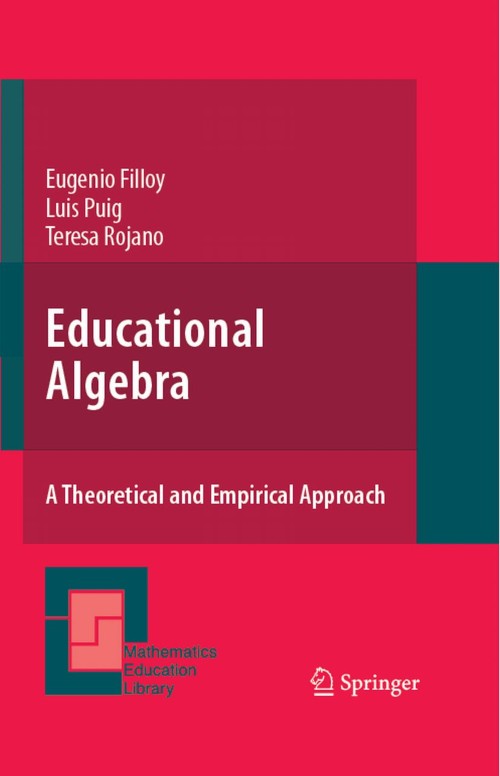
Educational Algebra [electronic resource] : A Theoretical and Empirical Approach / by Eugenio Filloy, Teresa Rojano, Luis Puig.
Erişim Adresi
ISBN
9780387712543
Dil Kodu
İngilizce
Yer Numarası
DK/6896
Yazar
Basım Bildirimi
1st ed. 2008.
Yayın Bilgisi
New York, NY : Springer US : Imprint: Springer, 2008.
Fiziksel Niteleme
XIV, 294 p. online resource.
Dizi
Mathematics Education Library, 2214-983X ; 43
İçindekiler Notu
Curriculum Design and Development for Studens, Teachers and Researchers -- Experimental Design -- Concrete Models and Abstraction Processes -- Teaching Models -- Algebraic Syntax and Solving Word Problems -- Cognitive Tendencies and Abstraction Processes -- Mathematical Sign Systems. Meaning and Sense -- Solving Arithmetic-Algebraic Problems -- Widening Perspectives -- References. A Deep Sea of Luminescent Ideas. .
Özet, vb.
Given its abstract nature and the highly syntactical competence required by the use of symbolic algebra, research on its teaching and learning must rely on approaches that include semiotic concepts and analyses that recall the history of algebraic ideas, among others. Educational Algebra: A Theoretical and Empirical Approach deals with a theoretical perspective on the study of school algebra, in which both components (semiotics and history) occur. This perspective runs opposite to general theoretical models, since it submits components for the design of local frameworks for theoretical analysis. The Methodological design allows for the interpretation of specific phenomena and the inclusion, within such interpretative frameworks, of evidence not included in more general treatments. Such is the case of phenomena observed in subjects who are initiating the study of symbolic algebra, involving the production of personal sign systems at the intermediate level or the level previous to the mathematical sign system which is to be learned. Disciplines such as Linguistics, Logic, Psycholinguistics, Semiotics, general Cognitive Psychology, Mathematics Psychology, Mathematics Epistemology, History of Mathematics, and others have carried out research on the same topics approached by Mathematics Education and have redefined their results within the framework of their respective fields. Specifically, theorists in Linguistics, Information Processing and Didactics of Mathematics have done important work on the notion of code. Today, this notion is a key element to interpreting the idea of representation in the new explanatory models of cognitive problems placed by alternative teaching approaches, including those involving a technological environment. Additionally, Psycholinguistics and Artificial Intelligence in procedural models of human abilities have intended to explain how and why users of mathematical language naturally and commonly make mistakes in syntactical procedures. Educational Algebra: A Theoretical and Empirical Approach adds to previous developments with priority given to a pragmatic perspective on "meaning in use" over "formal meaning". The bulk of these approaches and others of similar nature have lead to a focus on competence rather than on a user’s activity with mathematical language. Such a shift in perspective has fundamental implications on the way mathematical language is studied. Essentially, Grammar—the abstract formal system—and Pragmatics—the principles of the use of language—are complementary domains in this volume. Both are related to different teaching models, whether new or traditional, used in helping students to become competent users of Algebra. Because of this, Educational Algebra: A Theoretical and Empirical Approach will be of interest to researchers and practitioners within the mathematics education field.
Konu
Mathematics __ Study and teaching .
Algebra.
Mathematics Education.
Algebra.
Algebra.
Mathematics Education.
Algebra.
Diğer Yazarlar
Kurum Adı

Eseri Alıntıla
Referansları kullanmadan önce gözden geçirmeniz ve varsa gerekli düzeltmeleri yapmanız önerilir.
Dijital Kaynak
MARC Görünümü
LEADER 05276nam a22005415i 4500
001 805580
003 TR_AnAIT
005 20260127000417
007 cr nn 008mamaa
008 100301s2008 xxu| s |||| 0|eng d
020 |a9780387712543|9978-0-387-71254-3
024 7 |a10.1007/978-0-387-71254-3|2doi
041 |aeng
049 |aTürk Tarih Kurumu Kütüphanesi
050 4|aQA10.92-20
072 7|aJNU|2bicssc
072 7|aPB|2bicssc
072 7|aEDU029010|2bisacsh
072 7|aJNU|2thema
072 7|aPB|2thema
082 04|a510.71|223
090 |aDK/6896
100 1 |aFilloy, Eugenio.|eauthor.|4aut|4http://id.loc.gov/vocabulary/relators/aut
245 10|aEducational Algebra|h[electronic resource] :|bA Theoretical and Empirical Approach /|cby Eugenio Filloy, Teresa Rojano, Luis Puig.
250 |a1st ed. 2008.
264 1|aNew York, NY :|bSpringer US :|bImprint: Springer,|c2008.
300 |aXIV, 294 p.|bonline resource.
336 |atext|btxt|2rdacontent
337 |acomputer|bc|2rdamedia
338 |aonline resource|bcr|2rdacarrier
347 |atext file|bPDF|2rda
490 1 |aMathematics Education Library,|x2214-983X ;|v43
505 0 |aCurriculum Design and Development for Studens, Teachers and Researchers -- Experimental Design -- Concrete Models and Abstraction Processes -- Teaching Models -- Algebraic Syntax and Solving Word Problems -- Cognitive Tendencies and Abstraction Processes -- Mathematical Sign Systems. Meaning and Sense -- Solving Arithmetic-Algebraic Problems -- Widening Perspectives -- References. A Deep Sea of Luminescent Ideas. .
520 |aGiven its abstract nature and the highly syntactical competence required by the use of symbolic algebra, research on its teaching and learning must rely on approaches that include semiotic concepts and analyses that recall the history of algebraic ideas, among others. Educational Algebra: A Theoretical and Empirical Approach deals with a theoretical perspective on the study of school algebra, in which both components (semiotics and history) occur. This perspective runs opposite to general theoretical models, since it submits components for the design of local frameworks for theoretical analysis. The Methodological design allows for the interpretation of specific phenomena and the inclusion, within such interpretative frameworks, of evidence not included in more general treatments. Such is the case of phenomena observed in subjects who are initiating the study of symbolic algebra, involving the production of personal sign systems at the intermediate level or the level previous to the mathematical sign system which is to be learned. Disciplines such as Linguistics, Logic, Psycholinguistics, Semiotics, general Cognitive Psychology, Mathematics Psychology, Mathematics Epistemology, History of Mathematics, and others have carried out research on the same topics approached by Mathematics Education and have redefined their results within the framework of their respective fields. Specifically, theorists in Linguistics, Information Processing and Didactics of Mathematics have done important work on the notion of code. Today, this notion is a key element to interpreting the idea of representation in the new explanatory models of cognitive problems placed by alternative teaching approaches, including those involving a technological environment. Additionally, Psycholinguistics and Artificial Intelligence in procedural models of human abilities have intended to explain how and why users of mathematical language naturally and commonly make mistakes in syntactical procedures. Educational Algebra: A Theoretical and Empirical Approach adds to previous developments with priority given to a pragmatic perspective on "meaning in use" over "formal meaning". The bulk of these approaches and others of similar nature have lead to a focus on competence rather than on a user’s activity with mathematical language. Such a shift in perspective has fundamental implications on the way mathematical language is studied. Essentially, Grammar—the abstract formal system—and Pragmatics—the principles of the use of language—are complementary domains in this volume. Both are related to different teaching models, whether new or traditional, used in helping students to become competent users of Algebra. Because of this, Educational Algebra: A Theoretical and Empirical Approach will be of interest to researchers and practitioners within the mathematics education field.
650 0|aMathematics|xStudy and teaching .
650 0|aAlgebra.
650 14|aMathematics Education.
650 24|aAlgebra.
700 1 |aRojano, Teresa.|eauthor.|4aut|4http://id.loc.gov/vocabulary/relators/aut
700 1 |aPuig, Luis.|eauthor.|4aut|4http://id.loc.gov/vocabulary/relators/aut
710 2 |aSpringerLink (Online service)
773 0 |tSpringer Nature eBook
776 08|iPrinted edition:|z9780387712536
776 08|iPrinted edition:|z9780387518350
776 08|iPrinted edition:|z9781441943897
830 0|aMathematics Education Library,|x2214-983X ;|v43
856 40|uhttps://doi.org/10.1007/978-0-387-71254-3
912 |aZDB-2-SHU
912 |aZDB-2-SXED
950 |aHumanities, Social Sciences and Law (SpringerNature-11648)
950 |aEducation (R0) (SpringerNature-43721)
001 805580
003 TR_AnAIT
005 20260127000417
007 cr nn 008mamaa
008 100301s2008 xxu| s |||| 0|eng d
020 |a9780387712543|9978-0-387-71254-3
024 7 |a10.1007/978-0-387-71254-3|2doi
041 |aeng
049 |aTürk Tarih Kurumu Kütüphanesi
050 4|aQA10.92-20
072 7|aJNU|2bicssc
072 7|aPB|2bicssc
072 7|aEDU029010|2bisacsh
072 7|aJNU|2thema
072 7|aPB|2thema
082 04|a510.71|223
090 |aDK/6896
100 1 |aFilloy, Eugenio.|eauthor.|4aut|4http://id.loc.gov/vocabulary/relators/aut
245 10|aEducational Algebra|h[electronic resource] :|bA Theoretical and Empirical Approach /|cby Eugenio Filloy, Teresa Rojano, Luis Puig.
250 |a1st ed. 2008.
264 1|aNew York, NY :|bSpringer US :|bImprint: Springer,|c2008.
300 |aXIV, 294 p.|bonline resource.
336 |atext|btxt|2rdacontent
337 |acomputer|bc|2rdamedia
338 |aonline resource|bcr|2rdacarrier
347 |atext file|bPDF|2rda
490 1 |aMathematics Education Library,|x2214-983X ;|v43
505 0 |aCurriculum Design and Development for Studens, Teachers and Researchers -- Experimental Design -- Concrete Models and Abstraction Processes -- Teaching Models -- Algebraic Syntax and Solving Word Problems -- Cognitive Tendencies and Abstraction Processes -- Mathematical Sign Systems. Meaning and Sense -- Solving Arithmetic-Algebraic Problems -- Widening Perspectives -- References. A Deep Sea of Luminescent Ideas. .
520 |aGiven its abstract nature and the highly syntactical competence required by the use of symbolic algebra, research on its teaching and learning must rely on approaches that include semiotic concepts and analyses that recall the history of algebraic ideas, among others. Educational Algebra: A Theoretical and Empirical Approach deals with a theoretical perspective on the study of school algebra, in which both components (semiotics and history) occur. This perspective runs opposite to general theoretical models, since it submits components for the design of local frameworks for theoretical analysis. The Methodological design allows for the interpretation of specific phenomena and the inclusion, within such interpretative frameworks, of evidence not included in more general treatments. Such is the case of phenomena observed in subjects who are initiating the study of symbolic algebra, involving the production of personal sign systems at the intermediate level or the level previous to the mathematical sign system which is to be learned. Disciplines such as Linguistics, Logic, Psycholinguistics, Semiotics, general Cognitive Psychology, Mathematics Psychology, Mathematics Epistemology, History of Mathematics, and others have carried out research on the same topics approached by Mathematics Education and have redefined their results within the framework of their respective fields. Specifically, theorists in Linguistics, Information Processing and Didactics of Mathematics have done important work on the notion of code. Today, this notion is a key element to interpreting the idea of representation in the new explanatory models of cognitive problems placed by alternative teaching approaches, including those involving a technological environment. Additionally, Psycholinguistics and Artificial Intelligence in procedural models of human abilities have intended to explain how and why users of mathematical language naturally and commonly make mistakes in syntactical procedures. Educational Algebra: A Theoretical and Empirical Approach adds to previous developments with priority given to a pragmatic perspective on "meaning in use" over "formal meaning". The bulk of these approaches and others of similar nature have lead to a focus on competence rather than on a user’s activity with mathematical language. Such a shift in perspective has fundamental implications on the way mathematical language is studied. Essentially, Grammar—the abstract formal system—and Pragmatics—the principles of the use of language—are complementary domains in this volume. Both are related to different teaching models, whether new or traditional, used in helping students to become competent users of Algebra. Because of this, Educational Algebra: A Theoretical and Empirical Approach will be of interest to researchers and practitioners within the mathematics education field.
650 0|aMathematics|xStudy and teaching .
650 0|aAlgebra.
650 14|aMathematics Education.
650 24|aAlgebra.
700 1 |aRojano, Teresa.|eauthor.|4aut|4http://id.loc.gov/vocabulary/relators/aut
700 1 |aPuig, Luis.|eauthor.|4aut|4http://id.loc.gov/vocabulary/relators/aut
710 2 |aSpringerLink (Online service)
773 0 |tSpringer Nature eBook
776 08|iPrinted edition:|z9780387712536
776 08|iPrinted edition:|z9780387518350
776 08|iPrinted edition:|z9781441943897
830 0|aMathematics Education Library,|x2214-983X ;|v43
856 40|uhttps://doi.org/10.1007/978-0-387-71254-3
912 |aZDB-2-SHU
912 |aZDB-2-SXED
950 |aHumanities, Social Sciences and Law (SpringerNature-11648)
950 |aEducation (R0) (SpringerNature-43721)
Materyaller
Depodan talep edilen materyal sadece kütüphane içerisinde kullanılmaktadır.
Materyal dışarıya ödünç verilmemektedir.
