LEADER 03611nam a22006015i 4500
001 805593
003 TR_AnAIT
005 20260127000435
007 cr nn 008mamaa
008 121213s2013 gw | s |||| 0|eng d
020 |a9783642326332|9978-3-642-32633-2
024 7 |a10.1007/978-3-642-32633-2|2doi
041 |aeng
049 |aTürk Tarih Kurumu Kütüphanesi
050 4|aK7000-7720.22
072 7|aLB|2bicssc
072 7|aLAM|2bicssc
072 7|aLAW051000|2bisacsh
072 7|aLB|2thema
072 7|aLAM|2thema
082 04|a340.9|223
090 |aDK/6909
100 1 |aHartz, Emily.|eauthor.|4aut|4http://id.loc.gov/vocabulary/relators/aut
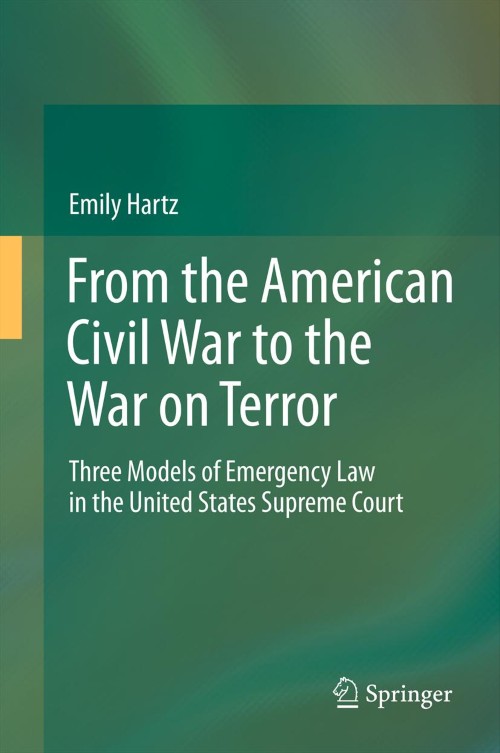
245 10|aFrom the American Civil War to the War on Terror|h[electronic resource] :|bThree Models of Emergency Law in the United States Supreme Court /|cby Emily Hartz.
250 |a1st ed. 2013.
264 1|aBerlin, Heidelberg :|bSpringer Berlin Heidelberg :|bImprint: Springer,|c2013.
300 |aX, 114 p.|bonline resource.
336 |atext|btxt|2rdacontent
337 |acomputer|bc|2rdamedia
338 |aonline resource|bcr|2rdacarrier
347 |atext file|bPDF|2rda
505 0 |aIntroduction -- Part I: Three Models of Emergency Law: The Rights Model -- The Extra Legal Model -- The Procedural Model -- Part II: Emergency Law in the Context of Terrorism: Rasul v. Bush -- Hamdi v. Rumsfeld -- Hamdan v. Rumsfeld -- Boumediene v. Bush -- Concluding Remarks.
520 |aThis book offers a systematic and comprehensive account of the key cases that have come to shape the jurisprudence on emergency law in the United States from the Civil War to the War on Terror. The legal questions raised in these cases concern fundamental constitutional issues such as the status of fundamental rights, the role of the court in times of war, and the question of how to interpret constitutional limitations to executive power. At stake in these difficult legal questions is the issue of how to conceive of the very status of law in liberal democratic states. The questions with which the Supreme Court justices have to grapple in these cases are therefore as philosophical as they are legal. In this book the Court's arguments are systematized according to categories informed by constitutional law as well as classic philosophical discussions of the problem of emergency. On this basis, the book singles out three legal paradigms for interpreting the problem of emergency: the rights model, the extra-legal model and the procedural model. This systematic approach helps the reader develop a philosophical and legal overview of central issues in the jurisprudence on emergency.
650 0|aPrivate international law.
650 0|aConflict of laws.
650 0|aInternational law.
650 0|aComparative law.
650 0|aLaw|xPhilosophy.
650 0|aLaw|xHistory.
650 0|aConstitutional law.
650 0|aPolitical science|xPhilosophy.
650 14|aPrivate International Law, International and Foreign Law, Comparative Law.
650 24|aTheories of Law, Philosophy of Law, Legal History.
650 24|aConstitutional Law.
650 24|aPolitical Philosophy.
650 24|aPhilosophy of Law.
710 2 |aSpringerLink (Online service)
773 0 |tSpringer Nature eBook
776 08|iPrinted edition:|z9783642326325
776 08|iPrinted edition:|z9783642326349
776 08|iPrinted edition:|z9783642427008
856 40|uhttps://doi.org/10.1007/978-3-642-32633-2
912 |aZDB-2-SHU
912 |aZDB-2-SXLC
950 |aHumanities, Social Sciences and Law (SpringerNature-11648)
950 |aLaw and Criminology (R0) (SpringerNature-43727)