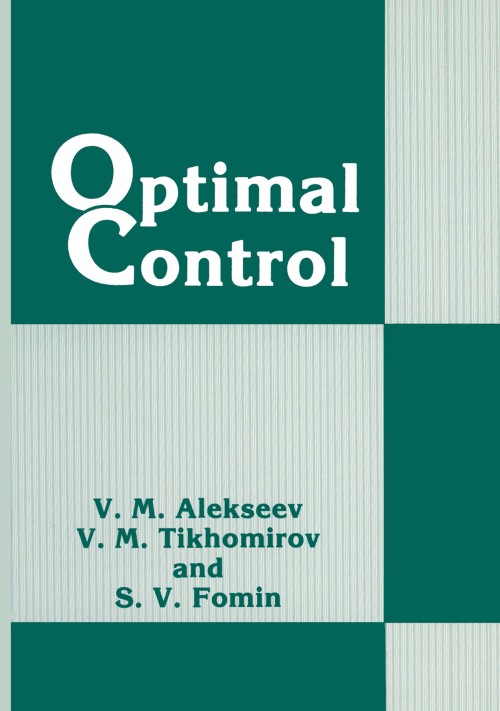
LEADER 04030nam a22005535i 4500
001 805616
003 TR_AnAIT
005 20260127000501
007 cr nn 008mamaa
008 131205s1987 xxu| s |||| 0|eng d
020 |a9781461575511|9978-1-4615-7551-1
024 7 |a10.1007/978-1-4615-7551-1|2doi
041 |aeng
049 |aTürk Tarih Kurumu Kütüphanesi
050 4|aH1-99
050 4|aAZ19.2-999
072 7|aGT|2bicssc
072 7|aNON000000|2bisacsh
072 7|aGT|2thema
082 04|a300|223
082 04|a001.3|223
090 |aDK/6932
100 1 |aAlekseev, V. M.|eauthor.|4aut|4http://id.loc.gov/vocabulary/relators/aut
245 10|aOptimal Control|h[electronic resource] /|cby V. M. Alekseev.
250 |a1st ed. 1987.
264 1|aNew York, NY :|bSpringer US :|bImprint: Springer,|c1987.
300 |aXIII, 309 p.|bonline resource.
336 |atext|btxt|2rdacontent
337 |acomputer|bc|2rdamedia
338 |aonline resource|bcr|2rdacarrier
347 |atext file|bPDF|2rda
490 1 |aContemporary Soviet mathematics
520 |aThere is an ever-growing interest in control problems today, con nected with the urgent problems of the effective use of natural resources, manpower, materials, and technology. When referring to the most important achievements of science and technology in the 20th Century, one usually mentions the splitting of the atom, the exploration of space, and computer engineering. Achievements in control theory seem less spectacular when viewed against this background, but the applications of control theory are playing an important role in the development of modern civilization, and there is every reason to believe that this role will be even more signifi cant in the future. Wherever there is active human participation, the problem arises of finding the best, or optimal, means of control. The demands of economics and technology have given birth to optimization problems which, in turn, have created new branches of mathematics. In the Forties, the investigation of problems of economics gave rise to a new branch of mathematical analysis called linear and convex program ming. At that time, problems of controlling flying vehicles and technolog ical processes of complex structures became important. A mathematical theory was formulated in the mid-Fifties known as optimal control theory. Here the maximum principle of L. S. Pontryagin played a pivotal role. Op timal control theory synthesized the concepts and methods of investigation using the classical methods of the calculus of variations and the methods of contemporary mathematics, for which Soviet mathematicians made valuable contributions.
532 8 |aAccessibility summary: This PDF is not accessible. It is based on scanned pages and does not support features such as screen reader compatibility or described non-text content (images, graphs etc). However, it likely supports searchable and selectable text based on OCR (Optical Character Recognition). Users with accessibility needs may not be able to use this content effectively. Please contact us at accessibilitysupport@springernature.com if you require assistance or an alternative format.
532 8 |aInaccessible, or known limited accessibility
532 8 |aNo reading system accessibility options actively disabled
532 8 |aPublisher contact for further accessibility information: accessibilitysupport@springernature.com
650 0|aSocial sciences.
650 0|aHumanities.
650 14|aHumanities and Social Sciences.
710 2 |aSpringerLink (Online service)
773 0 |tSpringer Nature eBook
776 08|iPrinted edition:|z9780306109966
776 08|iPrinted edition:|z9781461575528
776 08|iPrinted edition:|z9781461575535
830 0|aContemporary Soviet mathematics
856 40|uhttps://doi.org/10.1007/978-1-4615-7551-1
912 |aZDB-2-SHU
912 |aZDB-2-SXH
912 |aZDB-2-BAE
950 |aHumanities, Social Sciences and Law (SpringerNature-11648)
950 |aHistory (R0) (SpringerNature-43722)