

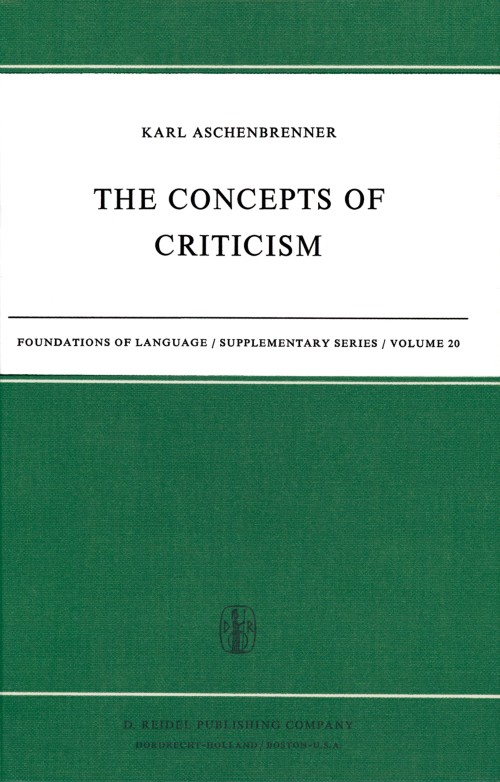
The Concepts of Criticism [electronic resource] / by L. Aschenbrenner.
Erişim Adresi
ISBN
9789401022545
Dil Kodu
İngilizce
Yer Numarası
DK/6974
Yazar
Basım Bildirimi
1st ed. 1974.
Yayın Bilgisi
Dordrecht : Springer Netherlands : Imprint: Springer, 1974.
Fiziksel Niteleme
XII, 551 p. online resource.
Dizi
Foundations of Language Supplementary Series, 2214-0239 ; 20
İçindekiler Notu
1. Criticism and the Concepts of Appraisal -- 2. Critical Non-Appraisive Discourse -- 3. Sources of the Appraisive Vocabulary -- 4. Characterization and Commendation -- 5. Linguistic and Appraisive Communities -- 6. The Nature of Characterization -- 7. Characterization and Characterisms -- 8. Critics and Criticism -- Preliminary: Critical Exclusions -- 0.0 Paracritical and Noncritical Discourse -- I/The Characterization of the Artist -- — Part I -- 1.0 Creative Powers -- 2.0 Creative Response -- Conclusion — Part I -- II/The Characterization of Art -- — Part II -- 3.0 Order -- 4.0 Elemental Quality -- 5.0 Presentation -- 6.0 Essential Characterization -- 7.0 Style and Totality -- 8.0 Contextual Characterization and Generalization -- III/Commendation -- — Part III -- 9.0 General and Ultimate Appraisal -- Critical Source Book -- Preliminary/Critical Exclusions -- I/The Characterization of the Artist -- II/The Characterization of Art -- III/Commendation.
Özet, vb.
Tbis inquiry may be thought of as a sequel to The Concepts of Value and as an extension of the brief core-vocabulary of aesthetic concepts found in one of the appendices to it. In terms of sheer numbers, most of the value concepts of our language are to be found in the area of human relations and of the aesthetic. There are also other value vocabularies, shorter but equally important, for example, the cognitive and logical. These and other objects of pbilosopbical study (for example, the question of "other minds") deserve the kind of empirical survey that has been made of moral and aesthetic notions, if only to test a priori approaches to them. In the present studyan even more determined empirical approach than that adopted for the first has been found necessary. Once the moral or human value vocabulary has been identified, sentential contexts for the use of the terms readily come to mind. In a study of the language of criticism, however, the vocabulary has first to be sought in the utterances of critics themselves and quoted in sufficient context to make their critical intentions clear. The outcome is that the present study is of great length, about half of it being quotations from critics. The rule adopted for arriving at tbis length go on collecting quotations as long as new types of appraisal came was to to light.
Konu
Arts.
Arts.
Arts.
Kurum Adı
Eseri Alıntıla
Referansları kullanmadan önce gözden geçirmeniz ve varsa gerekli düzeltmeleri yapmanız önerilir.
Dijital Kaynak
MARC Görünümü
LEADER 04743nam a22005295i 4500
001 805659
003 TR_AnAIT
005 20260127000549
007 cr nn 008mamaa
008 121227s1974 ne | s |||| 0|eng d
020 |a9789401022545|9978-94-010-2254-5
024 7 |a10.1007/978-94-010-2254-5|2doi
041 |aeng
049 |aTürk Tarih Kurumu Kütüphanesi
050 4|aNX1-820
072 7|aAB|2bicssc
072 7|aART000000|2bisacsh
072 7|aAB|2thema
082 04|a700|223
090 |aDK/6974
100 1 |aAschenbrenner, L.|eauthor.|4aut|4http://id.loc.gov/vocabulary/relators/aut
245 14|aThe Concepts of Criticism|h[electronic resource] /|cby L. Aschenbrenner.
250 |a1st ed. 1974.
264 1|aDordrecht :|bSpringer Netherlands :|bImprint: Springer,|c1974.
300 |aXII, 551 p.|bonline resource.
336 |atext|btxt|2rdacontent
337 |acomputer|bc|2rdamedia
338 |aonline resource|bcr|2rdacarrier
347 |atext file|bPDF|2rda
490 1 |aFoundations of Language Supplementary Series,|x2214-0239 ;|v20
505 0 |a1. Criticism and the Concepts of Appraisal -- 2. Critical Non-Appraisive Discourse -- 3. Sources of the Appraisive Vocabulary -- 4. Characterization and Commendation -- 5. Linguistic and Appraisive Communities -- 6. The Nature of Characterization -- 7. Characterization and Characterisms -- 8. Critics and Criticism -- Preliminary: Critical Exclusions -- 0.0 Paracritical and Noncritical Discourse -- I/The Characterization of the Artist -- — Part I -- 1.0 Creative Powers -- 2.0 Creative Response -- Conclusion — Part I -- II/The Characterization of Art -- — Part II -- 3.0 Order -- 4.0 Elemental Quality -- 5.0 Presentation -- 6.0 Essential Characterization -- 7.0 Style and Totality -- 8.0 Contextual Characterization and Generalization -- III/Commendation -- — Part III -- 9.0 General and Ultimate Appraisal -- Critical Source Book -- Preliminary/Critical Exclusions -- I/The Characterization of the Artist -- II/The Characterization of Art -- III/Commendation.
520 |aTbis inquiry may be thought of as a sequel to The Concepts of Value and as an extension of the brief core-vocabulary of aesthetic concepts found in one of the appendices to it. In terms of sheer numbers, most of the value concepts of our language are to be found in the area of human relations and of the aesthetic. There are also other value vocabularies, shorter but equally important, for example, the cognitive and logical. These and other objects of pbilosopbical study (for example, the question of "other minds") deserve the kind of empirical survey that has been made of moral and aesthetic notions, if only to test a priori approaches to them. In the present studyan even more determined empirical approach than that adopted for the first has been found necessary. Once the moral or human value vocabulary has been identified, sentential contexts for the use of the terms readily come to mind. In a study of the language of criticism, however, the vocabulary has first to be sought in the utterances of critics themselves and quoted in sufficient context to make their critical intentions clear. The outcome is that the present study is of great length, about half of it being quotations from critics. The rule adopted for arriving at tbis length go on collecting quotations as long as new types of appraisal came was to to light.
532 8 |aAccessibility summary: This PDF is not accessible. It is based on scanned pages and does not support features such as screen reader compatibility or described non-text content (images, graphs etc). However, it likely supports searchable and selectable text based on OCR (Optical Character Recognition). Users with accessibility needs may not be able to use this content effectively. Please contact us at accessibilitysupport@springernature.com if you require assistance or an alternative format.
532 8 |aInaccessible, or known limited accessibility
532 8 |aNo reading system accessibility options actively disabled
532 8 |aPublisher contact for further accessibility information: accessibilitysupport@springernature.com
650 0|aArts.
650 14|aArts.
710 2 |aSpringerLink (Online service)
773 0 |tSpringer Nature eBook
776 08|iPrinted edition:|z9789027704825
776 08|iPrinted edition:|z9789401022552
776 08|iPrinted edition:|z9789401022569
830 0|aFoundations of Language Supplementary Series,|x2214-0239 ;|v20
856 40|uhttps://doi.org/10.1007/978-94-010-2254-5
912 |aZDB-2-SHU
912 |aZDB-2-SXL
912 |aZDB-2-BAE
950 |aHumanities, Social Sciences and Law (SpringerNature-11648)
950 |aLiterature, Cultural and Media Studies (R0) (SpringerNature-43723)
001 805659
003 TR_AnAIT
005 20260127000549
007 cr nn 008mamaa
008 121227s1974 ne | s |||| 0|eng d
020 |a9789401022545|9978-94-010-2254-5
024 7 |a10.1007/978-94-010-2254-5|2doi
041 |aeng
049 |aTürk Tarih Kurumu Kütüphanesi
050 4|aNX1-820
072 7|aAB|2bicssc
072 7|aART000000|2bisacsh
072 7|aAB|2thema
082 04|a700|223
090 |aDK/6974
100 1 |aAschenbrenner, L.|eauthor.|4aut|4http://id.loc.gov/vocabulary/relators/aut
245 14|aThe Concepts of Criticism|h[electronic resource] /|cby L. Aschenbrenner.
250 |a1st ed. 1974.
264 1|aDordrecht :|bSpringer Netherlands :|bImprint: Springer,|c1974.
300 |aXII, 551 p.|bonline resource.
336 |atext|btxt|2rdacontent
337 |acomputer|bc|2rdamedia
338 |aonline resource|bcr|2rdacarrier
347 |atext file|bPDF|2rda
490 1 |aFoundations of Language Supplementary Series,|x2214-0239 ;|v20
505 0 |a1. Criticism and the Concepts of Appraisal -- 2. Critical Non-Appraisive Discourse -- 3. Sources of the Appraisive Vocabulary -- 4. Characterization and Commendation -- 5. Linguistic and Appraisive Communities -- 6. The Nature of Characterization -- 7. Characterization and Characterisms -- 8. Critics and Criticism -- Preliminary: Critical Exclusions -- 0.0 Paracritical and Noncritical Discourse -- I/The Characterization of the Artist -- — Part I -- 1.0 Creative Powers -- 2.0 Creative Response -- Conclusion — Part I -- II/The Characterization of Art -- — Part II -- 3.0 Order -- 4.0 Elemental Quality -- 5.0 Presentation -- 6.0 Essential Characterization -- 7.0 Style and Totality -- 8.0 Contextual Characterization and Generalization -- III/Commendation -- — Part III -- 9.0 General and Ultimate Appraisal -- Critical Source Book -- Preliminary/Critical Exclusions -- I/The Characterization of the Artist -- II/The Characterization of Art -- III/Commendation.
520 |aTbis inquiry may be thought of as a sequel to The Concepts of Value and as an extension of the brief core-vocabulary of aesthetic concepts found in one of the appendices to it. In terms of sheer numbers, most of the value concepts of our language are to be found in the area of human relations and of the aesthetic. There are also other value vocabularies, shorter but equally important, for example, the cognitive and logical. These and other objects of pbilosopbical study (for example, the question of "other minds") deserve the kind of empirical survey that has been made of moral and aesthetic notions, if only to test a priori approaches to them. In the present studyan even more determined empirical approach than that adopted for the first has been found necessary. Once the moral or human value vocabulary has been identified, sentential contexts for the use of the terms readily come to mind. In a study of the language of criticism, however, the vocabulary has first to be sought in the utterances of critics themselves and quoted in sufficient context to make their critical intentions clear. The outcome is that the present study is of great length, about half of it being quotations from critics. The rule adopted for arriving at tbis length go on collecting quotations as long as new types of appraisal came was to to light.
532 8 |aAccessibility summary: This PDF is not accessible. It is based on scanned pages and does not support features such as screen reader compatibility or described non-text content (images, graphs etc). However, it likely supports searchable and selectable text based on OCR (Optical Character Recognition). Users with accessibility needs may not be able to use this content effectively. Please contact us at accessibilitysupport@springernature.com if you require assistance or an alternative format.
532 8 |aInaccessible, or known limited accessibility
532 8 |aNo reading system accessibility options actively disabled
532 8 |aPublisher contact for further accessibility information: accessibilitysupport@springernature.com
650 0|aArts.
650 14|aArts.
710 2 |aSpringerLink (Online service)
773 0 |tSpringer Nature eBook
776 08|iPrinted edition:|z9789027704825
776 08|iPrinted edition:|z9789401022552
776 08|iPrinted edition:|z9789401022569
830 0|aFoundations of Language Supplementary Series,|x2214-0239 ;|v20
856 40|uhttps://doi.org/10.1007/978-94-010-2254-5
912 |aZDB-2-SHU
912 |aZDB-2-SXL
912 |aZDB-2-BAE
950 |aHumanities, Social Sciences and Law (SpringerNature-11648)
950 |aLiterature, Cultural and Media Studies (R0) (SpringerNature-43723)
Materyaller
Depodan talep edilen materyal sadece kütüphane içerisinde kullanılmaktadır.
Materyal dışarıya ödünç verilmemektedir.
Materyal dışarıya ödünç verilmemektedir.
